
Men in suits have always governed what we think and who fights whom. Isn’t it time we break the cycle and drop out of the race? Someone has to do it first.
Global politics is the theatre of national security and patriotism, but in reality, it veils a carefully crafted business model, one that will eventually price peace out of the market. Corporations and governments that hold defence equipment will only profit from perpetual global instability, as every escalation, whether it be in Israel, Ukraine, or the South China Sea, will lead to a spike in stock prices for weapons manufacturers. Weapons, in any form—bombs and other physical weapons, drones, surveillance technology, cyber arsenals—are an economic incentive for both the entities that produce them and those that buy them, which includes private actors in addition to governments and nation-states. This means that conflict not only indicates grievance in solidarity anymore, but also a fast-tracked, scalable enterprise—one that an increasingly capitalist global cosmology is determined to keep alive.
Even if there are no direct economic transactions between countries, that may not mean the economic intention does not exist. It is important to question why the United States is willing to donate billions of dollars to Israel if there is no incentive to do so. While one reason is the strategic political position that Israel provides to the US in the Middle East, another is, most unequivocally, that Israel is the breeding ground for global technology, innovation, and entrepreneurship. This billion-dollar “donation” or “aid” is then just an investment into a potential trillion-dollar industry.
According to a report by ODI Global, the largest importers of military weapons are, of course, countries engaged in conflict or those experiencing ongoing tensions. The biggest exporters, on the other hand, are the US, China, Russia, and other NATO allies, which together make up almost 80% of total arms exports. It is obvious who is gaining and who is losing in this race. Corporations that export defence equipment meet every day in air-conditioned rooms while innocent individuals, institutions, and children are bombed to oblivion. Even if we look at India, initiatives such as Atmanirbar Bharat that focus on defence indigenisation are strengthening India’s economy and reducing dependence on imports, but are doing so quite literally at the expense of lives. The solution to national security is not war; it is trying to cut off the root of war in the first place—hatred, media polarisation, and consent manufacturing; the factors that mobilise citizens into believing war is something that they want. Is this the kind of future we want to be funding?
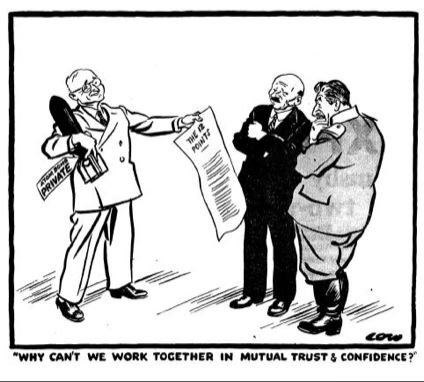
Image source: British cartoon by David Lowe, 1946
Image caption: Truman negotiates with Attlee and Stalin while keeping the ammunition firmly in American hands
Manya Marwah




Comments are closed.