
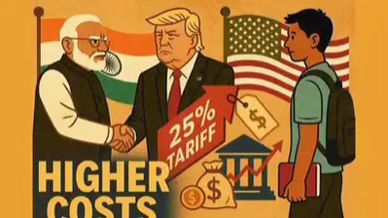
Can we really afford war? I here present a take on tariffs, tumultuous markets, unemployment and unhappy nations.
Tolstoy wrote, “Happy families are all alike; but every unhappy family is unhappy in its own way.” What is a nation if not one giant, unhappy family, each in its own twisted way? We begin right there with the unhappiness—the boils on the world map. With warring nations, job markets have become tighter and the competition fierce. The fate of Delhi University graduates has been sealed—taped with tariffs and marked ‘siren-ready’.
Geopolitics and the Global Economy
According to the WEF’s Global Risks Report, compared with last year, “state-based armed conflict” has climbed from number 8 to number 1 in the rankings for 2025, and sits third for 2027. At the same time, there is a declining investment in humanitarian aid and the size of the UN peacekeeping operations has been reduced from over 100,000 peacekeepers in 2016 to around 68,000 in 2024. The rise in tariff-based protectionism is also expected to lead to a decline in global trade.
“The ensuing risks are becoming more complex and urgent, and accentuating a paradigm shift in the world order characterized by greater instability, polarizing narratives, eroding trust and insecurity.” says Saadia Zahidi, MD of the World Economic Forum. The Geopolitical Risk Index by the World Bank also shows that the instability caused by the invasion of Ukraine and the latest conflict in the Middle East has caused two prominent surges in the charts—within a gap of just two years, as never seen before. China hoarding critical minerals for automotives from the world at such a time, is another bolt in the global economy’s coffin.
The fiscal consequences of the shooting GRI includes complete disruption—with higher inflation, lower economic growth, increased market volatility, trade policy shifts, and the subsequent reduction in global trade and FDIs. And this is to say the least.
Has Delhi University been Spared?
One might here raise the issue of the ultimate cul-de-sac to the long, laborious education journey of our lives—a job. Internships are as competitive as a real life Squid Game sequel. Everyone is fighting for the perfect opportunity to cross another; chemically enhanced rats with superbrains in a race to win the JPMorgan stamp. Francis Fukuyama said, “history ended with the onset of consumerism,” when money became the centre of the economy replacing labour. And now, time is taking a toll on the last man standing in this struggle.
Add to this the geopolitical tensions adversely impacting the Indian job market. A recent survey shows that over 63% of companies are freezing hiring or downsizing in response to the tensions in the Middle East. A shift toward contract-based and freelance roles is also evident as companies adapt to global instability. Thus, the graduating students are meant to be stuck in what The Economic Times defined as a “loop of endless applications and minimal results”.
The Silver Lining
India signed an MoU with the International Labour Organisation, amid global geopolitical tensions, to advance ‘International Reference Classification of Occupations’ and facilitate the youth in availing global employment opportunities—a recent report stated. This usually means that India is committing to align more closely with international labour standards (fair wages, decent work, occupational safety, gender equality)—a landmark development in the global landscape as it signals stability and commitment to fair labour standards. This reveals a sharp contrast with the economies around the world currently unstable due to flaring political tensions.
This helps India attract foreign investment, strengthen exports, and formalise its workforce. For DU graduates, it means better opportunities in globally compliant sectors like IT services, consulting, social sectors, or global supply chains. ILO connections may also open the door for international collaborations, fellowships, or exchange programmes. This entails a silver lining for India’s new position in the current world order—with a rapidly growing economy and worldly connections. A direct impact is caused on the lives of graduating Delhi University students, whose goals and aims circle back to this moment of securing a placement at the glorious end of their college life.
You know the storm is fierce when its warnings rise louder than the cries of a wounded planet. India’s attempt to bind itself to fairer labour standards is like a stitch in the chaos. What war and politics couldn’t reconcile, they have succeeded in tearing apart—trust, trade and the tender hope of the youth.
Shreya Bhushan
Image Caption: From Global Deals to Local Consequences
Image Credits: The Times of India


Comments are closed.