
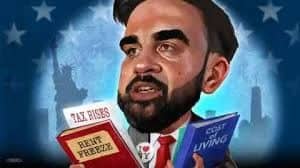
Where capitalism towers and faith flickers, Mamdani performs, turning promises into tricks, doubt into devotion, and New York into a restless audience.
Magic. It is why this society dreams. A little part of us that industrialisation couldn’t take away. A part that remains with us, even after the ripe age when we all become machines. The concept which makes materialism thrive, which makes money an agent. A gateway to the impossible. It replenishes faith and births belief. And when it intersects with reality, we call it a trick.
A magic trick typically has three separate acts. The first one is The Pledge—when the magician presents something ordinary, something without a story, like a hat. The second is The Turn—when that ordinary turns into something extraordinary, something stupefying and confusing but believable; a pigeon out of a hat. The last is The Prestige—the most difficult part. The part which validates the audience’s hope for the existence of magic, something that gives them a reason to turn it into instinct. Revealing that magic is no secret—by the show of empty hands. Becoming a story with an ultimate cliffhanger.
In my world, Zohran Kwame Mamdani is a magician. Now, let’s walk through his acts together.
The Pledge
A very simple man has become the new mayor-elect of the world’s richest country’s richest city. A self-proclaimed socialist on the throne of New York City—arguably the most capitalist city in the world and home to most billionaires. His campaign was strong, as it was straightforward. He is now set to become the city’s first Muslim and South Asian mayor and its youngest in over a century. He began by walking the streets of NYC and asking people about their problems. Later, he designed a campaign targeting these issues and announced that he would be standing for elections—defying all rules of politics, economics and statistics.
His agenda, to me, is simple—find where it hurts and promise a 100% effective painkiller. And he did just that. He focused on an agenda, something that can be absorbed by the common person. Something that objectively promises a better life. And for New Yorkers, it was affordability, an issue that his predecessor, Eric Adams, a fellow democrat, didn’t address. This instilled a belief in people—a desire to trust something bigger than themselves. Ordinary, yet powerful.
The Turn
This is where the extraordinary part comes in. He appealed to the people of NYC with claims of taxing the rich. He stated an increase in the corporate tax from 7.25% to 11.5% and a 2% income tax surcharge on individuals making more than $1 million per year. Just enough to get the wealthy annoyed, but not touching their core wealth—their assets at all.
Contrary to popular belief, real estate is the engine that runs NYC, not finance. The city’s growth is directly measured by its unaffordability. And Zohran is targeting that ruthlessly. This could easily backfire with extreme economic losses because of the reallocation of investors and the wealthy moving their capital elsewhere to escape taxes. This is not sustainable. A socialist city surrounded by a capitalist world suffers capital flight. It just means a reallocation of the cause of inequality.
But Zohran wants regulation, not a total structural reform. His aim is to accomplish the impossible—to give his best try towards equity for all. He limits his beliefs to what is practical. But he faces backlash for the river of his ideology, not the cup of water from it that he’s offering to NYC. What he wants is public infrastructure parallel to the lavish private ownership in the city—more public housing, city-run grocery stores, and free transit—that provides relief and alternative structures without dismantling the entire capitalist system.
The Prestige
Finally, the last act. The part where his crusade becomes inscrutable, mystifying. So much so that people (his audience) become almost mesmerised into placing their entire trust in him. The part where his illusion becomes so strong that it becomes instinct for the people of NYC, that even when evidence suggests otherwise, their faith denies it. Until now, NYC has been shaped by neoliberalism. Zohran isn’t an extremist, but the one word which defines him is. Socialism. People unable to understand the nuances of a socialist economy become victims of bigotry. Their attachment to a leader becomes an attachment to an idea that they can only half comprehend. This is what gives rise to debate, making Zohran’s campaign immortal.
He faces criticism for describing “Globalise the Intifada” as a symbolic call for Palestinian human rights, not for violence or antisemitism. It reflects his very evident thought pattern—supporting whatever is morally right. He focuses on the core strength of an idea but ignores its effects, just like the impact of socialist agendas on NYC’s capitalist economy. But that’s what makes his magic real. His own belief in the illusion, irrespective of the reality.
Conclusion
As it is with all tricks, this story remains unfinished. The ultimate cliffhanger becomes whatever manifests when he claims his office. His image—the illusion he created to win the campaign—is one thing. He owes his win to the loophole between realists and relativists. But now it’s time to act on it. If he actually pursues his claims, he will have to face the New York State jurisdiction and the cumulative force of all the most powerful people in the world against him. And if he doesn’t, he faces massive protests by the common people of NYC who were promised more affordable lives.
But there’s another option. What if he accomplishes both? What if he finds a way that promotes his idea of affordability without facing a backlash from the wealthy? Right now, he faces capital flight, operational risks and long timelines—most of whose cost is imminent before benefits. However, perhaps he gradually implements progressive taxes with tied incentives (like credits for investment in housing or green projects) or private-public partnerships so that the growth seems mutual, not anti-rich. This would mean him calling the first-row audience members up on the stage before the curtains roll.
Nonetheless, in my world, Zohran Kwame Mamdani remains a magician—living his illusion.
Read Also: “One day we logged in, and then we never logged out.” DUB speaks to Ria Chopra
Image Credits: The Financial Times
Shreya Bhushan