
Tag

Waste Management

Browsing

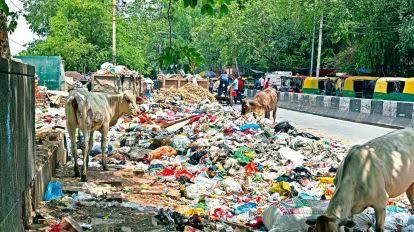
Delhi University noticed a hike in the amount of waste guarding the walls of college campuses, giving way to health and safety concerns.

With the monsoon in full swing, the waste crisis at Delhi University has only worsened, as clogged drains and stagnant rainwater exacerbate the already deteriorating conditions around campus walls. Piles of garbage and construction debris have increasingly lined the perimeter walls of colleges, especially Shaheed Bhagat Singh College in South Campus, raising serious health and safety concerns.

Waste, including rubble, household trash, and discarded furniture, is routinely dumped along the college’s boundary facing the main road. Despite efforts by the Municipal Corporation of Delhi (MCD), including clean-up drives and the recent installation of hidden CCTV cameras by the college, the situation has only worsened in recent months. Residents and local contractors continue to dispose of waste—often under the cover of night.

Rajinder Chauhan, a local snack vendor, in a conversation with Hindustan Times remarked:

MCD came around six weeks ago to clean this up, but it was half-hearted. The area wasn’t restored properly. People are still dumping trash here.

College Principal Arun Kumar Attree formally raised the issue with the MCD in a letter dated 21st November 2024, warning that the unhygienic conditions posed a threat to students, staff, and nearby residents. Student group ABVP also stepped in, with third-year BCom student Mohd Adnan Khan confirming a complaint had been filed, urging immediate intervention.

Neighbouring College of Vocational Studies (CVS) has reported slightly better conditions due to the presence of a garbage collection facility nearby. However, the issue persists across South Campus, particularly worsening during the monsoon season. 

Principal Attree believes the bulk of the dumping originates from surrounding areas such as Chirag Delhi and Sheikh Sarai. Chetan Sharma, Chairman of the Federation of GK-2 Complex RWA, noted that this reflects larger issues of irresponsible public behaviour and unchecked urban waste disposal.

On 10th July 2025, Delhi Chief Minister Rekha Gupta addressed the public, proudly highlighting the city’s improvement in flood management. She cited the absence of waterlogging at the historically flood-prone Minto Bridge as a sign of progress not seen in the past 27 years. However, this has sparked questions about the disparity in attention given to student-affiliated areas, which continue to suffer under neglect.

With the arrival of the new academic session just days away, urgent action is needed. Yet, no official response from the MCD has been recorded so far.

Read Also: Unlawful Detentions, Custodial Torture. Delhi Police Faces Scrutiny Over Crackdown on Student Activists

Featured Image Source: The Indian Express

Ananya Agarwal
[email protected]


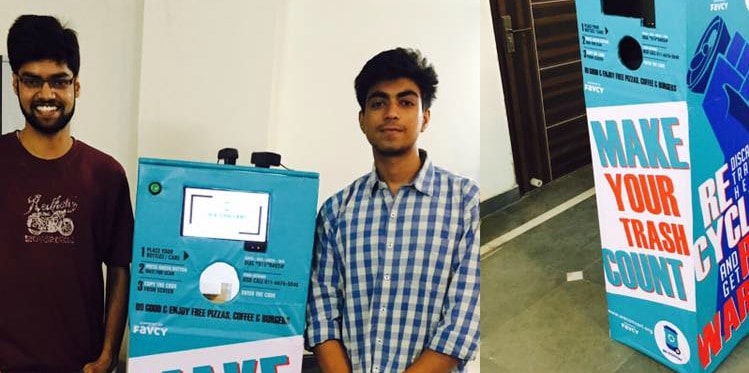
Jose Rizal could not have said it better when he exclaimed, “The youth is the hope of our future.” Today, we see many young individuals, both college and school students, achieving great feats at the social front. Recently, a similar path was taken by Ashutosh and Pranav, Co-founders of WeConvert to make an impact in the field of garbage disposal. These students from Bhaskaracharya College of Applied Sciences (Delhi University) started their journey to revolutionize the waste being managed in the country. DU Beat gets up close and personal:

DUB:Can you tell us a little about We-Convert?

It was just another day for us when we were talking about how to put our engineering skills to something useful and creative. On our way to the platform at the metro station, a vending machine caught our attention. That is when we thought about a machine that could collect waste automatically. After a few minutes, both of us realised the only way to get people to use that machine would be by rewarding people.
Waste management has always been an issue in India. No organization, be it private or government, has come out with any solution that could prove to be successful. Therefore, to solve this problem, we created We-Convert. We introduced the concept of e-collectors that are meant to accept a user’s waste material and in return generate some rewards. These machines will be installed at various locations, initially only in Delhi/NCR.

DUB: What was the inspiration behind setting up a waste management domain?

There has been tremendous increment in the amount of waste material generated- almost 7% annually and we felt that there has been no practical solution to it. Around 500 billion bottles and beverage cans are discarded globally every year. Out of this, India contributes nearly 5.6 million metric tons of such waste generation (according to a report suggested by CPCB). Delhi alone is responsible for generation of 689.5 metric tons of such waste every day.
Most people never dispose their waste correctly. No one takes the pain to find a bin, identify the colour and throw their waste rationally.

In order to provide a solution to these problems, we let ourselves go with this idea of developing smart waste collecting machines that will reward people for disposing their waste correctly.

There has been tremendous increment in the amount of waste material generated- almost 7% annually- and we felt that there has been no practical solution to it.

DUB: What would be your perspective on the current waste disposal issues and how does your start up aim to resolve them?

It is our belief that the current waste disposal system has many flaws.This gave us an opportunity to develop our smart machines. No individual takes the pain to throw their waste correctly. This is the reason why our streets are full of paper waste, bottles, cans etc. The recycling procedure has always been an issue in the Indian context. The Indian recycling units tends to import scrap material worth Rs. 28 crores. Incentivising the entire process is an innovative technique to get ordinary people involved in recycling.

DUB: Could you elaborate more on how one can get involved?

We had our machines installed at various locations earlier and are waiting for the re-launch after development.A user who approaches the machine needs to follow the instructions written on the machine:
• Drop in your waste into the inlet of the machine. Then press the start button located on the upper left corner.
• Wait for the machine to scan. The machine takes 10-12 seconds to detect your waste material.
• If the waste detected is a bottle/can/glass, the machine will reward you else you won’t be rewarded for the rest of the waste categories.
• The machine will shred the bottles/cans and will store them in the inbuilt containers and the rest of the waste will be stored in a different container of the machine.
• The user will be given a 5-digit unique code that needs to be entered via USSD on your mobile keypad (No internet or Mobile App is required).
• Once the USSD number is dialed, the user will receive a message(SMS) with a link to redeem their credit points. The user needs to follow the steps as guided by the link in the SMS.
• The rewards include attractive offers from food chains and online retailers.

DUB: What advice would you give to college students who would like to make a difference like your team?

We started this project in our final year of college. Prior to that, we used to seek out opportunities so as to shape our interest and path for development. A start up is something that provides you with an opportunity to test your skills, understand people’s problems, solve the issues with your idea/concept, and most importantly, provide you with experience that no college can teach you. On behalf of We-Convert team, we suggest all students to get out of their comfort zone and seek experiences beyond what your books and classrooms have to offer.

DU Beat would like to congratulate WeConvert and wish its team all the success in the time to come!

Feature Image Credits: We-Convert

Interview taken by Shaina Ahluwalia for DU Beat.

[email protected]