

Delhi’s third spaces haven’t disappeared, but they’ve been priced out of reach. A DU student traces how commercialisation of shared space reshapes belonging, class, and democracy itself.
Last August witnessed a day of relentless rain. It was cold and gloomy, yet warm and fuzzy. I held on tightly to my umbrella and made my way to college, drenched in water. Turns out, I was not the only one stupid enough to show up. My friends and I made a day out of it, running in the lawns in the pouring rain.
What drew us to running in the lawns was not a moment of intellect. It was the fact that four girls, who we later learnt were fourth year Maths honours students, appeared to be having the time of their lives doing it. What I was experiencing had a name given to it all the way back in 1989.
Ray Oldenburg, in his book ‘The Great Good Place’, described the ‘third place’ — a place that is neither home (first place) nor work (second place). A third place is simply a space to be, without the obligations and demands of modern society. It is a place you go as and when you deem fit. A place you irrevocably love. A place unfettered by the pull to be someone you’re not. A place to stop pretending and just be. A place of unfiltered and unique experiences. A place of human experiences.
Karen Christensen explains how third places are the key to solving loneliness, political polarization and climate resilience; problems manufactured by a capitalistic and consumerist society. Hence, it does not come as a surprise that the same society is gradually eroding the solution to these problems. It does, however, come with a wave of sadness when you begin to see it happening.
Christensen’s version of an ideal third place is this: a third place is neutral ground, meaning you don’t need an invite and nobody looks at you funny for walking in. It’s convenient enough that you could show up on a random day without planning it. It has regulars — people who’ll notice if you stop coming. It’s unstructured, so there’s no schedule to follow and no clock you’re watching. It’s free, or close enough to free that money never becomes the reason you didn’t go. Conversation is the whole point and there’s actual genuine laughter. And somehow, walking out of it, you feel lighter than when you walked in. That’s the real test: whether you leave it feeling better than you arrived.
When I think about third places in Delhi, the first thing that comes to mind is college. And after that, it is a vast, deserted abyss.
The problem is not necessarily that third places have ceased to exist, but they have definitely been transformed. Driven by profit, third places have become highly curated “aesthetic” spots, and their essence has been diluted by us. Cafés and co-working spaces profit from selling the feeling of community back to us at a markup. Real estate developers profit from rebranding a commercial project as a public good. Urban planners, especially in newer, tightly zoned sectors of the city, design out the informal and unplanned in favour of the neat and monetisable.
And we, the ones who now default to the aesthetic café over the beloved chai tapri because it photographs better, are complicit too — chasing curation over the unpredictability that used to be the entire point. What it costs is simple: a third place that once asked nothing of you now asks for a minimum spend before you’re allowed to stay.
That day in the rain in my college wasn’t unique. Walk through any DU campus on an ordinary day and you’ll see it; in scenes so regular they fail to stand out as extraordinary; in a shop on wheels outside the gate where someone’s always owed twenty rupees and nobody’s keeping count; in the canteen chai that costs less than a metro ticket and buys you an hour of sitting there, uninterrupted and unbothered. DU, for a lot of us, is one enormous, sprawling third place before it’s anything else.
But then summer break arrives and takes the entire architecture with it. So I went looking.
Sadly, I rarely found another free third space. Pierre Bourdieu wrote about social capital, which is the idea that one’s ease in different social settings and ability to walk into a room and belong, is, in itself, a kind of inherited wealth. Some people grow up with it and others don’t. Third places, historically, were one of the few places you could build social capital regardl fess of where you come from, because it allows you to exist in the here and now. Ideally, a third place doesn’t make decisions for you, nor does it determine your worth based on factors like gender, class or race.
But swap that canteen for a café with a Rs. 500 minimum order, or that library for a members-only space with a community vibe, and the entry fee creates a barrier, excluding those who do not have the means. Third places, rather than being the means to an end, become an end in themselves. An end that is neither achievable nor presented to a segment of society. This process, the commercialisation of third places is eroding a community which we will grieve sooner or later. Perhaps we already are.
Collaterally, we end up hanging out only with people who can afford to hang out the same way we can. This isn’t new.
Delhi makes this especially visible. A thesis on Dwarka’s Sector 23 makes a version of this same point from an urban design lens: when a sector is planned too tightly, with no room for the unplanned, informal gathering spaces that make a neighbourhood feel lived-in, you get vitality failure. The neighbourhood has streets with nowhere to loiter and parks that are green yet empty, while the city builds infrastructure without creating the conditions for people to actually use it together.
You can see the same failure everywhere in the city. The chai stall becomes a trendy café. The maidan gets fenced off and rebranded as a recreational zone with entry timings. The third places that survive start to feel curated and merely dressed in the aesthetic of community without much of the actual unpredictability that makes a third place work. Christensen makes a similar distinction: a public space and a third place aren’t automatically the same thing. It is entirely possible to have the space but lose the function.
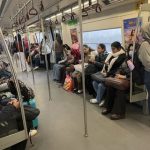
One living example is the metro. If you want to see what’s left of shared space in this city, get on the Blue Line at rush hour. Oldenburg would probably disqualify it outright because there’s rarely ever a conversation between strangers. There’s mostly earphones and silence, and no regulars in the sense of people who’d notice if you stopped showing up. It’s not a place most people linger in by choice. But for the length of one ride, a flat ₹30 buys you the same space as everyone else — everyone standing in identical conditions, none of them curated into that space by an app or a membership.
The question to be asked is what happens to a city, and by extension, a democracy, when the places where you’d bump into someone unlike yourself start demanding something before you’ve even had the chance to explore them.
Third places have always been an agent of political work, in that they force proximity across differences. The randomness of who’s sitting next to you is the entire point because you didn’t choose them, an algorithm didn’t curate them for you, and yet you end up talking anyway.
Karen Christensen’s update to Oldenburg’s work makes the case that this kind of unchosen encounter is now doing real work against polarisation and loneliness — two things we don’t usually think of as connected to a chai stall, but probably should. When those spaces disappear, we just start socialising exclusively with people who already agree with us, already look like us, already spend the way we do. The bubble doesn’t feel like a bubble from the inside.
I don’t have a tidy policy fix for this, and I’m a little suspicious of pieces that pretend they do. But I think the least we can do is stop taking “revitalisation” and “placemaking” at face value every time a developer or a municipal body reaches for those words. What’s actually being revitalised, and for whom?
Rishika Jain
Read Also: Beyond the Binary of Pink and Blue
Image Credit: Rishika Jain for DU Beat