Tag

St. Stepehns College

Browsing

Explore St. Stephen’s College, Delhi University, one of India’s top-ranked colleges for Arts and Sciences.  Explore updated courses, fees, admissions, campus facilities, student life, and placements.

Founded on 1 February 1881, St. Stephen’s College Delhi University is one of India’s oldest and most prestigious DU Colleges. Predating the University of Delhi, St. Stephen’s was initially affiliated with Calcutta University, then Punjab University, before becoming one of the three original constituent colleges of Delhi University in 1922.

The college is guided by its motto “Ad Dei Gloriam” (Latin for “To the Glory of God”) and aims to nurture minds that are both academically curious and socially responsible. Ranked 5th in NIRF 2024 and accredited with an A+ grade by NAAC, St. Stephen’s College consistently ranks among the top DU colleges in India. Surveys by India Today and The Week recognize its blend of tradition, academic excellence, and community-driven education.

St. Stephen College Infrastructure & Campus Facilities

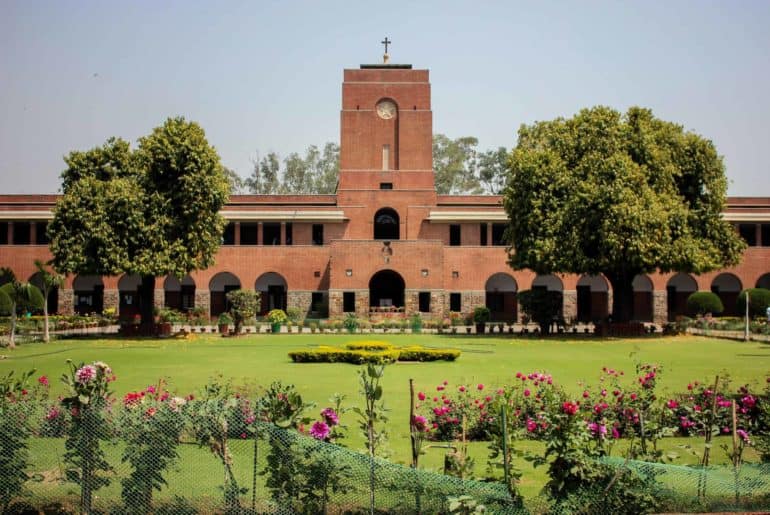
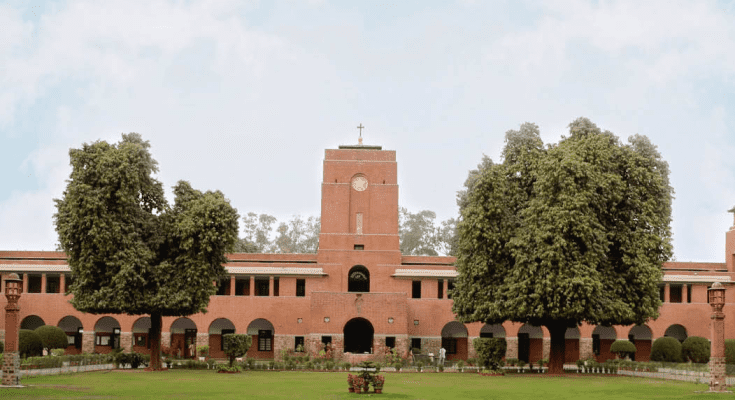
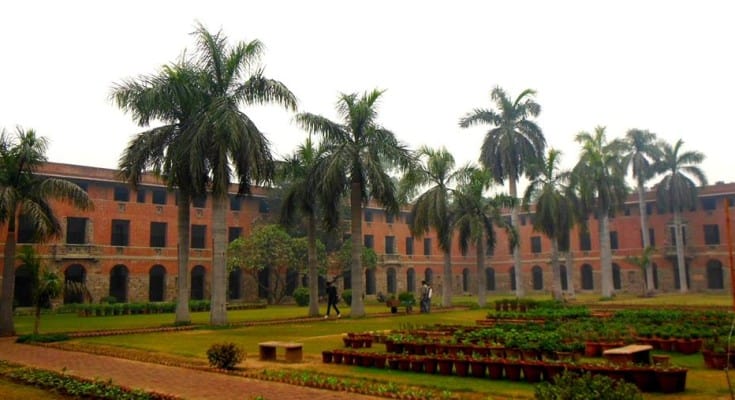
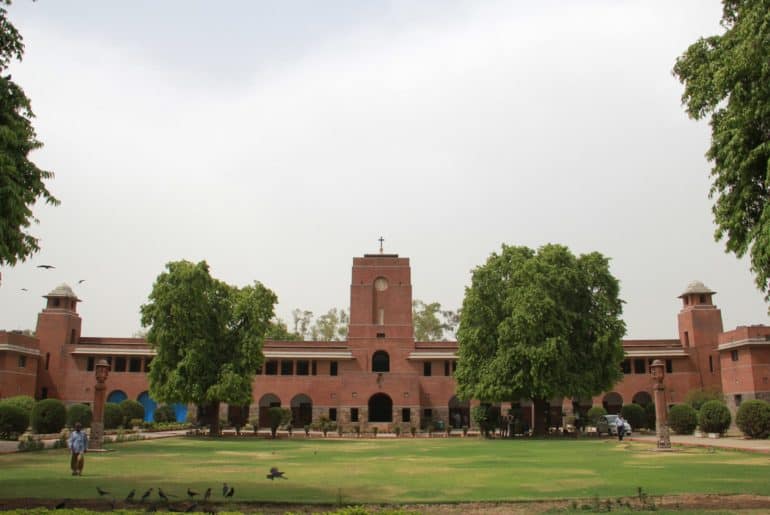
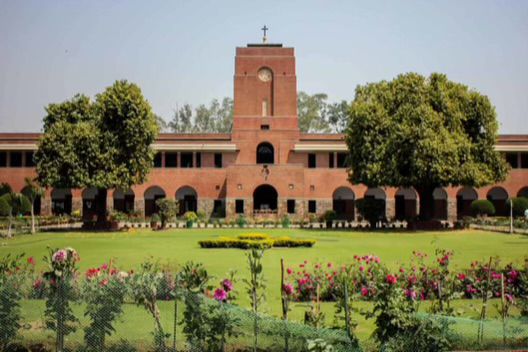
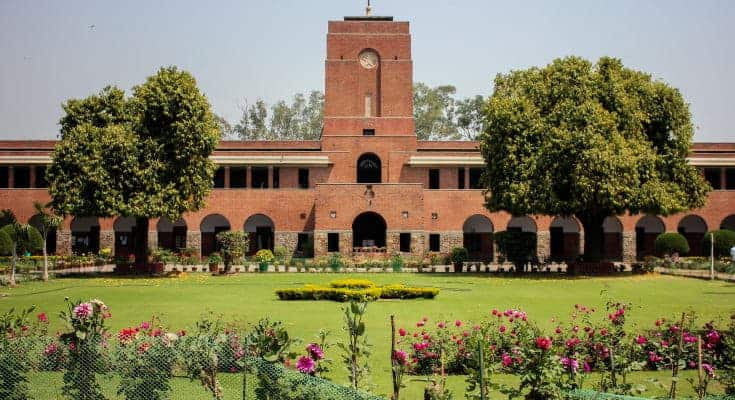
Located in the University Enclave, North Campus, St. Stephen’s College Delhi University features a historic red-brick campus designed by Walter Sykes George. The Indo-Saracenic architecture, arched corridors, and lush courtyards create a serene, intellectually stimulating environment. The college is easily accessible via Vishwavidyalaya Metro Station and other major Delhi routes.

St. Stephen’s College, Delhi University, boasts state-of-the-art academic infrastructure designed to enhance student learning and research. Its spacious, well-lit classrooms and lecture halls are ICT-enabled with projectors and advanced audio systems for interactive learning. Established in 1881, the St. Stephen’s College library houses over 1,00,000 volumes, including rare books and Persian manuscripts, with seamless access to e-resources via DULS, NLIST, and other academic databases. The college’s modern laboratories in Physics, Chemistry, and Biology support advanced undergraduate research, while the Computer and Internet Resource Centre offers high-speed internet and modern PCs for digital learning. They also have well-equipped seminar rooms host guest lectures, workshops, and departmental discussions, fostering vibrant academic engagement at one of Delhi University’s top colleges.

The St. Stephen’s Café and Dining Hall provide affordable, nutritious meals along with informal spaces for student interaction. Common rooms, including the Junior Common Room (JCR) and Ladies Common Room (LCR), serve as vibrant hubs for meetings, recreation, and dialogue. The on-campus bookstore and stationery shop stock textbooks, reference materials, and essential supplies for all courses. To support student health and wellness, the college provides medical and counselling services with an on-campus nurse, visiting doctor, and professional counselling support. Additionally, a State Bank of India ATM is available on campus, ensuring convenient banking access at one of Delhi University’s top colleges.

St. Stephen’s College has a rich tradition in sports with facilities for cricket, football, hockey, tennis, basketball, athletics, badminton, and an indoor gymnasium. The college organizes Mukherjee Memorial Debate and inter-college tournaments to encourage teamwork and fitness.

The 25-acre campus is adorned with well maintained lawns, heritage trees, and gardens. St. Stephen’s promotes sustainability and eco-conscious initiatives, encouraging students to participate in green drives.

Courses Offered at St. Stephen’s College, Delhi University

St. Stephen’s College, Delhi University, offers a wide range of undergraduate (UG) programs across Arts, Science, and Physical Sciences, focusing on academic excellence and holistic development.

Undergraduate Courses (UG)

The college offers B.A. (Hons) courses in Economics, English, History, Philosophy, Political Science, Sanskrit, and Sociology, along with B.A. Programme combinations such as English + History, Economics + Political Science, and Philosophy + Sanskrit. Science students can opt for B.Sc. (Hons) in Physics, Chemistry, and Mathematics, or B.Sc. in Physical Sciences with specializations in Electronics and Chemistry. The UG fee structure is divided into annual DU fees, paid via the Delhi University Admission Portal, and semester-wise college fees. Typical fees range from approximately ₹29,437 for B.A. courses to ₹30,688 for B.Sc. (Hons) Physics/Chemistry, with concessions available for differently-abled (₹1,150–₹1,350), staff wards (₹8,850–₹10,401), and SC/ST, EWS, or Martyr’s children (₹28,895–₹30,508)

Postgraduate Courses (PG)

For postgraduate (PG) programs, St. Stephen’s College emphasizes advanced study and research in Arts and Science. PG offerings include M.A. courses in English, History, Philosophy, Political Science, and Sanskrit, as well as M.Sc. courses in Physics, Chemistry, Mathematics, and Operational Research. PG fees follow the same pattern with annual DU fees and semester-wise college fees, typically around ₹29,111 for general category students. Concessions are similarly provided for differently-abled students (₹1,150–₹1,350), staff wards (₹8,850–₹10,401), and SC/ST, EWS, or Martyr’s children (₹28,895–₹30,508), making St. Stephen’s College one of Delhi University’s most sought-after institutions for both undergraduate and postgraduate education.

Extracurricular Activities & Student Life at St. Stephen’s College

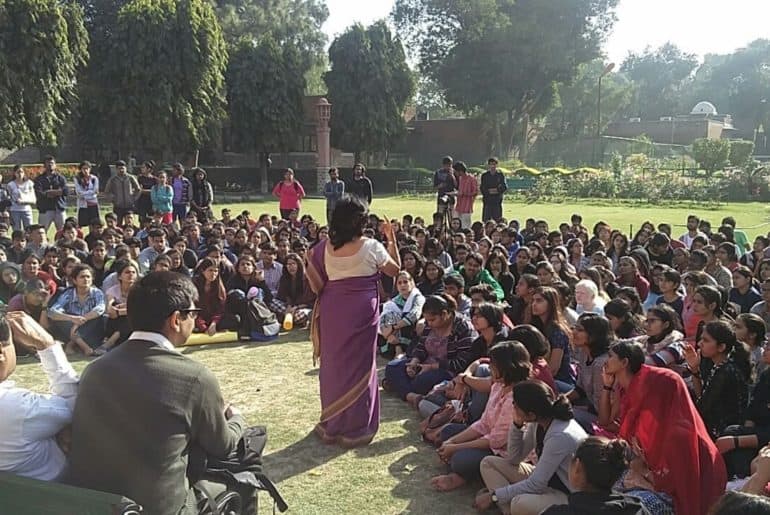
The college promotes unity in diversity, with students from almost every Indian state, Union Territory, and countries like Japan, Europe, USA, and UK. College life includes regional festivals, music and theatre performances, inter-college competitions, sports events, and food festivals, reflecting a vibrant Delhi University experience.

St. Stephen’s College, Delhi University, is rich in traditions and ceremonies that foster community and celebrate its heritage. Weekly morning assemblies, held Monday to Thursday, are mandatory for first-year students and encourage discipline and engagement. Key events include Founder’s Day on 7th December, commemorating Rev. Samuel Scott Allnutt, the college’s first Principal, and Rudra Dinner on 12th February, a service-based dinner honoring Rev. C. F. Andrews’ birth anniversary. The Dismissal Service marks the end-of-year farewell for graduating students, while Foundation Day on 1st February celebrates the college founders. Additionally, the two-day Deenabandhu Andrews Samvaad revisits the values of Deenabandhu Andrews, and Alumni Reunion Day, held on the Sunday following Founder’s Day, strengthens lifelong connections among the St. Stephen’s College alumni community.

St. Stephen’s College, Delhi University, offers a vibrant array of student societies and clubs that cater to academic, cultural, literary, social, and recreational interests. Academic societies include Economics, Mathematics, Physics, Chemistry, History, English Literary Society, Hindi & Sanskrit Sahitya Sabha, and Bengali & Malayalam Literary Societies, while cultural and artistic societies feature Fine Arts, Music, Choreography, Cine Club, Photographic Society, and Team YearBook. Literary and language enthusiasts can join Bazam-E-Adab, Poetry Society, Shakespeare Society, and Punjabi & Japanese Literary Societies, whereas debating and discussion forums include the Debating Society, Informal Discussion Group, Philosophical Society, Civil Services Forum, Planning Forum, and Leadership Cell. Social and service-oriented groups such as the Social Service League, Gandhi Ambedkar Study Circle, Enabling Unit, Gender Study Cell, and Enactus promote community engagement, while special interest and recreational clubs like the Hiking Club, Quiz Club, Electronics Society, Finance & Investment Cell, Campus Placement Cell, and Junior Combination Room enrich campus life at one of Delhi University’s most dynamic colleges.

Admissions at St. Stephen’s College (DU)

Undergraduate Admissions

Admission requires CUET registration via NTA and registration on the DU UG CSAS portal. Minimum eligibility: Class XII pass.

Christian Minority Seats (50% reserved):

  • 25% CNI (Delhi Diocese)
  • 16.5% other Christian denominations
  • 8.5% Christian Scheduled Tribes

Supernumerary seats include PwBD (5%), Martyrs’ children (3%), Sports (5%), PMSSS/MEA nominees, and staff wards. Unreserved seats are CUET merit-based, ensuring a balanced and diverse student body.

Postgraduate Admissions

Admissions for PG courses are via CUET-PG through the Delhi University PG portal. Applicants also complete the College PG Application Form. Minority PG admissions follow High Court seat allocation guidelines.

Recognition & Rankings

St. Stephen’s College, Delhi University (DU), is one of India’s oldest and most prestigious institutions, known for its academic excellence, rich heritage, and vibrant intellectual community.

  • NAAC Accreditation: A++ Grade
  • NIRF 2025 Ranking: #5 in India (Colleges Category)
  • India Today 2025 Ranking: Among India’s top colleges for Arts and Science
  • Affiliation: University of Delhi (DU)
  • UGC Approval: Recognized by the University Grants Commission (UGC)

Notable Alumni of St. Stephen’s College

The alumni of St. Stephen’s College, Delhi University, have made their mark globally across diverse fields such as economics, politics, journalism, and literature. Distinguished Stephen’s graduates include Amartya Sen, Nobel Laureate in Economics; Ajay Banga, President of the World Bank and former CEO of Mastercard; Shashi Tharoor, Member of Parliament and author; and Barkha Dutt, renowned journalist and author. St. Stephen’s College continues to uphold its tradition of fostering generations of leaders, scholars, and changemakers who have contributed significantly to academia, governance, business, and public life.

Internships & Placements at St. Stephen’s College

St. Stephen’s College, Delhi University, features a robust Campus Placement Cell that connects students with top industry opportunities through placements, internships, fellowships, and mentorship programs. 

In the 2024–25 placement season, over 35 recruiters participated, offering more than 200 opportunities across sectors such as Consulting, Finance, IT, and Education. Leading companies including McKinsey, BCG, EY, Deloitte, KPMG, J.P. Morgan, and TCS recruited from the college, with the highest package reaching ₹24.5 LPA and the average package at ₹10.5 LPA. Internship stipends averaged ₹33,500 per month, with the highest going up to ₹1.4 lakh per month. The student body for placements comprised 55% Arts and 45% Science students, with a gender ratio of 55% female to 45% male, making it one of Delhi University’s best institutions for career advancement and industry exposure.

Image Credits: DU Beat Archives

Neeraja Unnikrsihnan
[email protected]

A ceiling collapse disrupted a music concert at St. Stephen’s College, calling for greater accountability to address the failing state of infrastructure and misallocation of funds.

On the evening of 29 September 2023, St. Stephen’s College Music Society organized a Launch concert in the college hall. However, the event took an unexpected turn when the ceiling collapsed, abruptly interrupting the performance and causing injuries to a first-year student.

This incident is part of a concerning pattern, as several ceiling collapses have been reported at various University of Delhi (DU) colleges. In April, Lady Shri Ram College (LSR) experienced a similar occurrence when the roof of a residence hall’s bathroom stall collapsed. Then, in May, at Kamala Nehru College (KNC), a portion of the ceiling collapsed, which narrowly avoided injuring  a student. In June, a ceiling fan crashed down on a student at Hansraj College.

Several concerns have been raised regarding the deteriorating state of infrastructure within DU. At St. Stephen’s College, the fee amounts to ₹23,000, with the substantial portion of ₹14,000 allocated to the college development fund. However, when students have sought transparency concerning the specific categorisation of funds within the college development fund, they have encountered unclear responses.

A student from St. Stephen’s College commented on the matter, noting,

The foyer has been closed off for four months due to safety concerns, and no repairs have been undertaken. They simply cite it as a ‘heritage building,’ using it as an excuse, while the guesthouses are in a constant state of renovation.

Furthermore, the student also pointed out that the first-floor corridor’s construction remains incomplete. 

Serious concerns exist regarding fund misallocation at DU. In 2020, the St. Stephen’s library ceiling collapsed, restricting library access and operating hours for students. Despite these challenges, library fees remained unchanged. Campus Wi-Fi problems persist, forcing students to rely on limited cellular data while paying full IT/IRC fees. Team Veritas discovered a 33.3% increase in the establishment fee from ₹14,000 in 2017-18 to approximately ₹19,000 in 2019-20.

Many students were disheartened over the incident as preparations for the concert took place regularly for over a month. A student who requested to be referred to as Bob said,

We had a total of 12 performances and while the 8th performance was going on, suddenly I saw that the roof had collapsed. This isn’t the first time something like this happened. In the past, we’ve had roofs falling in classrooms and resident blocks. However, this is the first time it has happened on such a large scale with everyone present.

Following the incident, the music society immediately took charge and evacuated everyone from the college hall. However, St. Stephen’s College has not provided a satisfactory response to the situation.

Read also: Roof Collapse at Deen Dayal Upadhyaya College: Infrastructure Mishap Plagues DU Again!

The dead body was found at the Sarai Rohilla railway station while the Professor’s Mother was found hanging at their Pitampura residence. 

The decapitated body of a Delhi University professor was found on a railway track near the Sarai Rohilla railway station this Saturday afternoon. Around half-an-hour later, the man’s 55-year-old mother was found hanging at their flat in northwest Delhi’s Pitampura, the police said.

27-year old Allen Stanley hailed from Kottayam in Kerala and was an ad-hoc Professor at St. Stephen’s College, North Campus, University of Delhi (DU). His mother Lissy, was found with cloth stuffed in her mouth and her limbs tied, hanging from the ceiling fan in their Ashiana Apartment flat, as reported by the Times of India. 

Stanley taught Philosophy at the college, and was also pursuing a PhD from another institute. A four page note in Malayalam along with two knives were also found in the flat. According to the Hindustan Times (HT), investigators said they suspect the teacher, who taught at St. Stephen’s College, may have killed his mother before taking his own life. They added that the duo was facing an abetment to suicide case, filed at a police station in Kerala reportedly by the family of the Professor’s father’s former wife. Police investigation has revealed that the woman’s husband had allegedly killed himself in December last year. Although, the mother-son duo had secured anticipatory bail in the case, they were depressed because of it, the police said.

Kottayam’s superintendent of police (SP) Hari Shankar, however, said that there was no case against the DU teacher and his mother in the district. “We have checked with the police station in Pambadi and found no case against them here,” he said, adding that he has informed the Delhi police about the same.

The bodies of the deceased were sent to separate government hospitals where the autopsies will be conducted by Tuesday. The police have informed the man’s brother, who lives in Kerala, about the deaths. He had reportedly given the police some insight into the reason his family members may have been depressed. 

St. Stephen’s College principal, John Varghese in conversation with HT, said, “The young man was an adhoc teacher at our college. On Saturday, he did not come to college and we got to know that he had committed suicide. The college administration was not aware of any previous FIRs against him. He had not spoken to any of his colleagues about it.”

Image Credits: DU Beat Archives

Bhavya Pandey 

[email protected]


For a city that has all kinds of people under its fold, the Keralite is no different. The experience of being a mallu in Kerala may seem like it is for any other outstation students but is that the case? The reality may seem far from commonly understood notions. Here is a thought on the same

Dilli walo ki Dilli. A beautifully, polluted city, with its noises, midnight weddings, and of course varied people and cultures. A mini India on its own, here lies the famous Delhi University. A University, that many aspire to live ‘the’ college life in. A University that attracts thousands of students from all over India and to the students from Kerala is no exception.

Like everyone else who comes to this interestingly unorganized mess, the Malayali ventures forth, not knowing the language or the culture, mostly because of an uncle or aunt that migrated years ago. Otherwise in hopes of seeing places beyond home beyond the watchful eyes of his/her parents. Struggling to fit in and learn the language otherwise fitting in too well.  Being a Malayali in DU means you are not alone. There is and always will be a Kerala fraternity to look after you. A community that you somehow become part of, not even realizing that you never stepped out of your birthplace “The God’s own country”. One leaves Kerala, only to be back here again.

The Malayalis have and always will remain in DU. They are leaving behind their cultural legacy. A reminiscence that shall follow. The community has not only become an integral part of the university campus but has also contributed immensely to its growth. The Malayali community has been successful in establishing literary circles and societies on the campus.  An apt example would be Maithry an organization started by a few Stephenians in 2015 and has been active till now. It has a democratic election that includes every single Malayali in DU, who are democratically elected. The members of Maithry provide help desks to make it easier for Keralites to have smoother admissions all around the DU Campus. It also organizes Freshers for the students.  Maithry was able to contribute around ten lakh rupees in the chief minister’s relief fund for Kerala Floods. It also organized Onam an ethnic festival of Kerala, which had Mr. Shashi Tharoor as the chief guest. “Maithry was also able to provide scholarships to six students last year that included their annual fees, an initiative that we began in memory of two Malayali students who passed during their college here in DU,” informed Mr. Mehroof, the president of Maithry that that is the Malayalai Student’s fraternity, Delhi University.

In fact, the Malayalis have also been able to establish their cultural identity in individual colleges as well. The Malayali literary society of St Stephens College is a very good example. The society was successful in organizing a fund collection drive for Kerala victims. It also celebrated Kerala Piravi and Onam in the college, where hundreds of students both Mallus and non-Mallus came together with women wearing the traditional set saree and men, wearing the mundu. Du beat was able to speak to Mr. Ashish the present of MLS (Malayalam literary society, St Stephens college)

Being a mallu in DU is equivalent to being in a world of its own with its own differences. There seemed to be a subtle difference amongst the community with respect to the community. A faction referred to as, the Delmals. The individuals, who are born and brought up in Delhi being Malayalis. The chemistry between these two kinds of people may at times be not the most perfect but they do learn to live together though having cultural difference despite having the same identity.

The simple fact cannot be overlooked that each Malayali will have his own subjective differences with respect to the experiences gathered from their college lives. One thing is but certain that no matter what, the Malayali community in DU has always been together in supporting homesick students, helping them find another home here and spread the Malayali “thanima” all around, for many more years to come.


Stephen Mathew
[email protected]


A team from the University Grants Commission is set to visit St. Stephen’s College on 10th and 11th May 2018, after the Governing Body (GB) of the college had in-principle agreed to apply for autonomy.

The most recent development in the fight against commercialisation of public education through privatisation, the University Grants Commission (UGC) is going to be visiting the campus of St. Stephen’s College for an inspection on 10th-11th May 2018. This visit is a consequence of the Governing Body of the college agreeing in-principle to apply for autonomy.

The issue of autonomy has been much talked about in the University of Delhi this year, with several protests being organised and students as well as teachers’ speaking out against this pressing issue.

Nandita Narain, a senior professor from the maths department of St. Stephen’s College, told DU Beat “44 out of 56 permanent teachers of the college have written to the UGC in opposition to this move in which we have outlined our objection against the way this decision was taken, in an emergency meeting of the GB last year, without any kind of consultation from the teachers, karamcharis, and students, who are the primary stakeholders.”

Adding to the objections raised by the teachers, she further said, “There is no clarity surrounding the implications of this move as no clear picture has been laid out regarding the financial structure of the college, the regulation of fees, and the service conditions of the teachers. The fate of the Ad-hoc teachers’ is also shaky.” She pointed out that there is nothing to gain from this move, as the college is not equipped to take on the massive administrative and academic burdens that will come with autonomy. Questioning the functioning of the administration, she also told the DU Beat correspondent that the present management functions in an arbitrary and non-transparent manner.

Delhi University Teachers’ Association (DUTA) and All India Students’ Association (AISA) are conducting protests outside St. Stephen’s College tomorrow at 10 a.m., when the UGC visit is scheduled. AISA has also started a signature campaign to oppose this move. In a phone conversation with DU Beat, Kawalpreet Kaur, Head of AISA’s Delhi University Unit said, “We have been conducting a signature campaign since the examinations started, by putting up a desk at the Vishwavidyalaya Metro Station in the evening. Tomorrow, we will also be protesting along with DUTA when the UGC visit is scheduled, to convey that we are against the arbitrary manner in which the decisions are being taken by the administration, when the students and teachers are totally in opposition to this move. Through the signature campaign, we have aimed to start a long-term agitation against this move towards autonomy, and we will also be actively protesting any fee hikes that will happen in the coming semesters in any colleges of DU.”


Feature Image Credits: St. Stephen’s College

Bhavya Banerjee

[email protected]

The placement season this session at the University of Delhi touched new heights in terms of the number of companies involved and the number of students securing placements. Because of the initiatives of the various placement cells, this year witnessed a rise in the average pay packages offered.
The highest placement offer this year of Rs. 31 lakhs per annum (LPA) was bagged by a student of Shri Ram College of Commerce (SRCC), offered by the consultancy giant Parthenon-EY. This placement marked an exponential improvement for the Placement Cell of SRCC as their highest placement for the last academic session 2016-17 was Rs. 30 LPA. Kirori Mal College and Shaheed Bhagat Singh College both witnessed their highest placement offer at Rs. 19 LPA. The highest offer in St. Stephen’s College was Rs. 19-20 LPA in terms of cost to company (CTC) by the Boston Consulting Group. Hansraj College observed a boost as well since their highest offer increased from last year’s figures of Rs. 16 lakhs per annum to Rs. 17.5 LPA this year.

The average pay packages this year start off at Rs. 3.9 LPA at Daulat Ram College. Kirori Mal College, where over 90 students were placed, and Sri Venkateswara College, where the current number students placed is 146 (subject to increase), both received average salary packages of Rs. 4.1 lakhs. Shaheed Bhagat Singh College observed an increase to an average of Rs. 4 lakhs per annum from the previous year’s Rs. 3.2 lakhs, out of the 170 students placed. Hansraj College yet again managed to increase their average package amount from Rs. 5.02 lakhs to Rs. 6 lakhs. SRCC also observed an average salary package of Rs. 6 LPA this year.

St. Stephen’s College, Hansraj College, and Sri Venkateswara College witnessed 85+ companies visiting their campus for placements this season.

Notable names like KPMG (India), KPMG (Global), Hindustan Times, Inshorts, Decathlon, Bain and Company, Barnes & Noble Loudcloud, Zycus Infotech, Fidelity Information Services (FIS), Accenture, Ernst & Young, Deloitte, and TATA Power, recruited the most number of students. First time recruiters like Hindustan Times, Inshorts, Byjus, and Saavn, among others, were also involved this placement season.

The most popular job profile remains Audit Associate or Analyst for commerce students. However, this year noticed a trend of inclusivity of companies branching out to the humanities and science streams as well. There were a plethora of job opportunities for science and humanities students. Companies like NIIT, IdInsight, FRR Forex, StartupEd, Decathlon, Bain & Company, Dell, Teach for India and Urbanclap, recruited from all courses. The profiles offered for humanities and science students ranged from business development, research, marketing, content writing, human resources, etc.

Communication skills, practical knowledge, achievements in academics and extracurricular activities, analytical skills, quick and out of the box thinking, strong logical and reasoning abilities, and academic proficiency are some qualities that hiring companies look for in a student.

(All information is based on the data received from participating colleges in a DU Beat survey)


Feature Image Credits: AstroBetter

Bhavya Banerjee
[email protected]

The Minister of Human Resource Development (HRD), Prakash Javadekar, announced the 2018 National Institute Ranking Framework (NIRF) rankings at an event in Vigyan Bhawan.

The Ministry Of Human Resource Development’s National Institutional Ranking Framework (NIRF) ranked Indian Institute of Science Bengaluru as the overall best institution in the country. At an event in the Vigyan Bhawan, the Minister of Human Resource Development (HRD), Prakash Javadekar announced the NIRF rankings wherein, Indian Institute of Management (IIM) Ahmedabad was declared the best management institution and Indian Institute of Technology (IIT) Madras bagged the position of best engineering college. In the University Rankings, IISC Bengaluru stood first, followed by Jawahar Lal Nehru University (JNU), and Banaras Hindu University (BHU). The premier healthcare institute All India Institute of Medical Sciences (AIIMS), Delhi, was ranked the number one institute under the medical college category. University of Delhi’s Miranda House, situated in North Campus, was announced as the best college, and National Law School of India University (NLSIU) Bengaluru, stood first in the law school category.  Other eminent colleges of Delhi University, like, Hindu College, Lady Shri Ram College for Women, and Shree Ram college of Commerce were also part of the top 10 colleges in India for the year 2018.

This year, NIRF added medical, dental, architecture and law categories in its rankings, apart from the other four categories of 2016, Universities, Engineering, Management and Pharmacy. A total of 4000 institutions had applied this year, in comparison to the 3000 that were considered last year. The rankings have acquired much significance as the performance of the institutions is linked the “Institutions of Eminence” scheme.

The top 5 colleges given are:

1. Miranda House, University of Delhi

miranda

Image Credits: Miranda House.


2. St. Stephen’s College, University of Delhi

St.-Stephens-735x400

Image Credits: St. Stephen’s College.


3. Bishop Heber College, Tiruchirappalli

TY04COLLEGE hindu

Image Credits: The Hindu.


4. Hindu College, University of Delhi

hindu-college1 hindu college

Image Credits: Hindu College.


5. Presidency College, Chennai

446237-presidencycollege dna india

Image Credits: DNA India.


Feature Image Credits: Miranda House.

Oorja Tapan

[email protected]

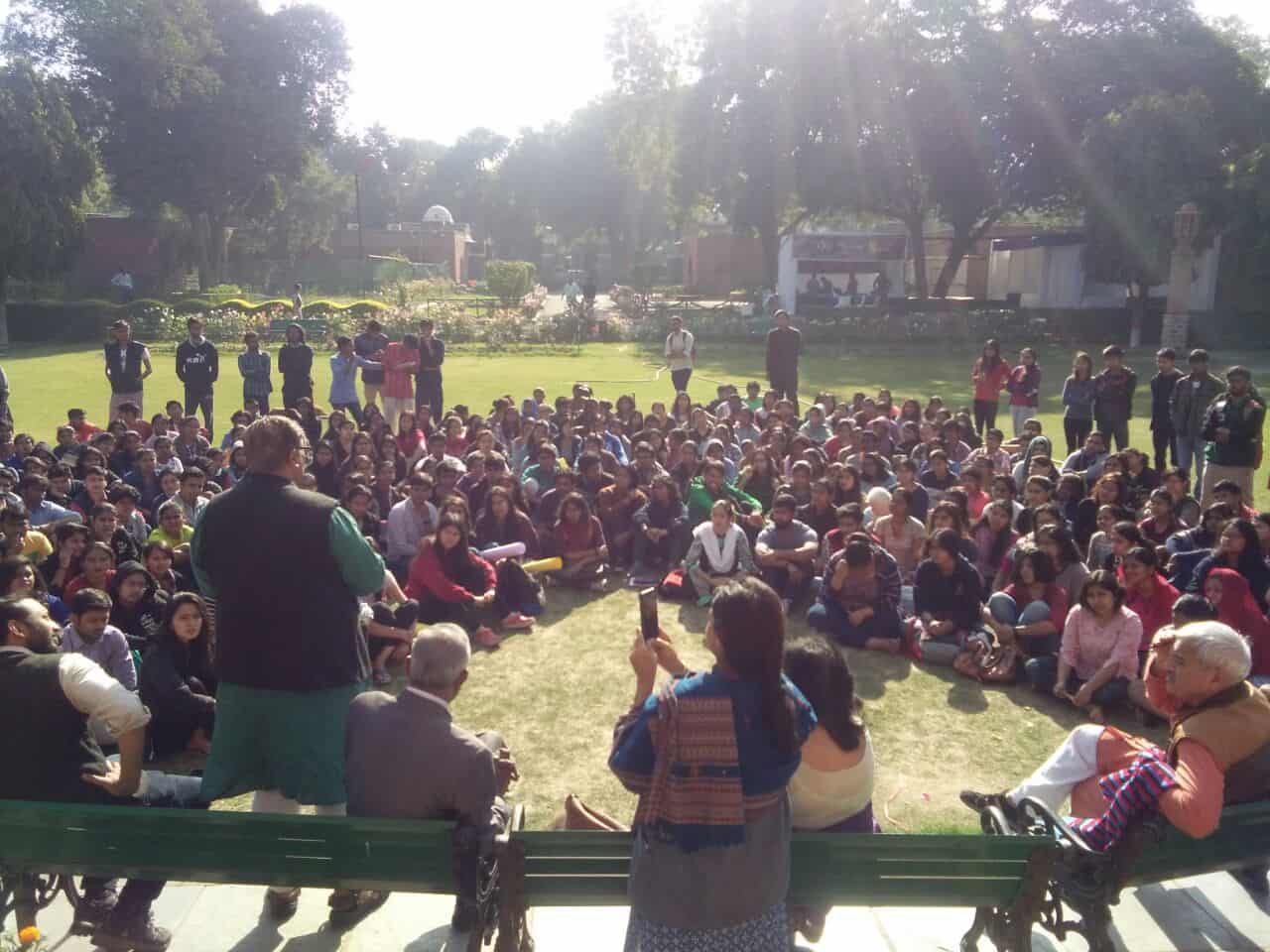
At a hastily convened meeting of the Governing Body of St. Stephens College to discuss the issue of autonomous status for the college today, the decision to go ahead with the proposal was agreed to in principle, despite the opposition of four members of the Governing Body. This meeting of the GB was met with a huge silent protest from students, teachers, and the non-teaching staff of the college. Students who demanded that they, and the teachers, should be consulted by the authorities before they decide to go ahead with applying for autonomy, held placards and posters with slogans like ‘Discuss, not Decide,’ and ‘Come, Communicate, Convince’ written on it. This protest by the students was also supported by a protest outside the college gate by members of the Delhi University Teachers Association.

Placards with discuss not decide written on them


“More than 500 students of St. Stephen’s College gathered in the Senior Combination Room lawns to stand up for their rights, for the entire college community. The students and the faculty stood in protest as a consensus of all stakeholders is necessary before a Governing Body Meeting regarding application for granting of autonomous status to St. Stephen’s College is convened,” says a press release issued on behalf of the students of the college. The students also alleged that one of the GB members, who is a University representative, claimed that he came to know about the meeting from the newspapers and learned that his signature was forged on arriving at the venue. The students demanded that the process of achieving autonomous status be halted until a consensus is reached among all students, teachers and non-teaching staff.

Meanwhile, at the GB meeting, the teacher representatives, including DUTA President Nandita Narain, pointed out that even the UGC Guidelines stipulated prior consultation with students and teachers before applying for autonomy, after which the GB voted in majority to move ahead with autonomy in principle, but follow the procedure laid down for consultation before sending the application to the University. DUTA also staged a protest outside the college and said that this is a move by the government towards privatisation. “We want academic and governance autonomy for the University but not autonomy for the constituent colleges. We will not let anything happen without consensus and will oppose the move,” said AK Bhagi, an Executive Council member.

On the evening of February 26, in another press release on the website of St. Stephen’s College, Prof. John Varghese, the principal of the college said, “Autonomy will deliver higher standards of excellence in academics through new courses that will enhance the employability of the students. It will help the college grow intellectually as well as increase the infrastructure that has seen minimal growth since the 1960s.” The press release confirmed that the GB voted in majority to pass a resolution which will authorise the principal of the college to make all arrangements for getting the college ‘autonomous status.’

Students and Faculty members during the protest

Earlier this year, after UGC came out with new provisions for granting autonomous status to institutions, St. Stephens decided to apply for autonomy. Other colleges including Hindu, SRCC, Ramjas, Sri Venkateswara College and Hansraj have approached the University for granting them greater autonomy.

Although autonomy will allow colleges the freedom to decide their own syllabus, course and examination patterns, this will also make the college responsible for raising its own funds which may result in a sharp increase in the fees that students pay. This is a prime concern, since many students come from different backgrounds, and may not be able to afford the exorbitant fee hike if the college goes autonomous.


Image Credits: Students of St. Stephens College


Srivedant Kar

[email protected]

Professor John Varghese, currently the Head of Department, Media and Communication, at the English and Foreign Languages University, Hyderabad, was appointed as the 13th Principal of St. Stephen’s College on Wednesday. The current Principal, Revd. Dr. Valson Thampu, who has held the office since 2007, retires on February 29.

The decision to appoint Professor Varghese as the Principal was taken by the Supreme Council of the college, along with Revd. Thampu himself. He was chosen from among three candidates who applied for the position. On February 10, Revd. Thampu announced on his Facebook page that, “The candidates eligible for the post were interviewed in detail today and the selection of Prof. Varghese was unanimous. Professor Varghese is an outstanding academic, experienced administrator and visionary leader.” He was formerly a faculty member at the Department of English in St.Stephen’s College. Revd. Thampu also wished Prof. Varghese “all blessings and good wishes in assuming this significant and challenging responsibility.” According to a Times of India news report, Prof. Varghese is an alumnus of Loyola College, Chennai. The same news report also mentions that the eligibility criteria and academic qualifications that a prospective Principal must meet at Stephen’s are rigorous.

Professor Varghese was introduced at the morning assembly held for first year students on February 11. “It will be interesting to see how much of the current system in college will be retained and continued,” said a first year student. On his Facebook page, Revd. Thampu has referred to his retirement as a festival that he looks forward to as a new beginning.

Image credits: ststephens.edu

autonomy

The Union Home Ministry of Human Resource Development (MHRD) is working on a plan to give complete autonomy to some of the country’s prestigious colleges. The move will free the colleges from the administrative control of the Universities they’re currently affiliated to. So here’s how this dramatic step promises to topple the world of the various colleges being spoken of and what the implication of this fancy jargon will be, on us students.

Lady Shri Ram College for Women (LSR), Sri Ram College of Commerce (SRCC) and St Stephen’s College – three of the top ranking colleges of Delhi University are being sought to be brought under the ambit of this drastic step. However in what ensued, was a collective and outright state of condemnation and panic by the faculty and the students alike.

Earlier in the year, the staff association of LSR resolved “to reject any move to delink Lady Shri Ram College from the Delhi University in any manner and in any aspect in part or in whole “. As far as LSR is concerned, clarified Ms. Meenakshi Gopinath, no such application form for autonomy had been filled or no such proposal was lying in the pipeline. This statement came in the wake of similar rumours about granting of autonomous status to these colleges. The statement also went onto say that privatisation of these colleges would compromise on inclusiveness, equity and quality of higher education in India. Calling it as one of the ways for the state to recede from the key sectors of the economy, they were completely opposed to such balkanisation of The University.

The teaching community has mixed reactions to offer on this, as do a lot of DU students. Some of them see it as the last stone to be unturned for saving the fate of thousands of students from the shackles of the Four Year Undergraduate Programme being introduced in the University. The rest of them are grappling with the fear of a possible financial crunch which might lead to a hike and a change in the fee structure in future, making higher education inaccessible to the masses.

Whatever be the case, all we can do is to keep our hopes high and believe that this is not going to be another one of the rushed-and-then-put-under-the-carpet-steps blindly taken by the authorities like The Four Year Programme. While making such decisions, it becomes important to involve the stakeholders- faculty and the students and to uphold the democratic values that we so vehemently preach in the confines of those four walled classrooms.