
Tag

SFI-AISA

Browsing

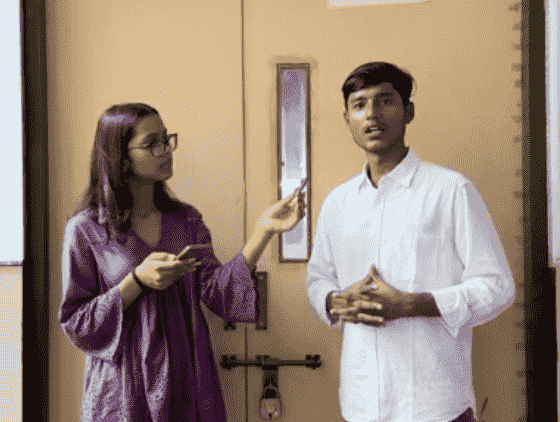
DU Beat in conversation with Sohan Yadav, contesting for the post of Vice President for Delhi University Students Union (DUSU) 2025, from the Students’ Federation of India (SFI), as a part of the AISA-SFI panel. This interview was originally taken in Hindi and has been translated into English.

S: What, according to you, is the biggest challenge that university students face, and how would you work on improving it?

S: There are three to four very common but major issues. Lack of Hostels and privacy are huge issues. Quality food is not available in most colleges, and colleges where quality food is available offer it at such a high price point that it is not affordable for many. At SFI, we believe that just like we succeeded in curbing the issue of fee hikes at Jawaharlal Nehru University (JNU), as a part of DUSU, we will do the same at Delhi University. We will provide metro passes to students, just as we have done at Hyderabad University. Additionally, we want there to be quality and affordable food at all colleges. Another huge issue is the degrading state of academics in the university. Our demands also include making the SEC and VAC papers completely additional and optional to allow students to focus on their main areas of interest.

S: . What are some key points within your election manifesto?

S: Right. So our first point is the democratisation of the Internal Complaints Committee (ICC) in all colleges, which is not the case in many colleges. The second point is the issue of hostels. Our third pointer is the issue of fee hikes. Our fifth pointer is about ensuring the functioning of a quality and affordable canteen in every college, and our sixth is the demand for concessional metro passes for students. Lastly, our seventh point is to increase student safety in and around campus spaces – we observe students being murdered and committing suicides around us, and we would like to take steps to curb this.  Another demand that is closely tied to this is the creation of quality medical facilities within colleges. In many colleges, while a medical room exists, psychiatrists, nurses, doctors and other professionals are not present in those rooms. Especially in today’s times, where so many students are suffering from mental health issues, it is necessary to ensure the presence of mental health professionals within the medical room of each college.

S: With increasing financial pressure on students, what steps would you advocate for better affordability?

S: See, there is only one solution to this. Firstly, the fee hikes that we face have already separated the oppressed classes and alienated them. When I used to study at Zakir Hussain College, every year, I used to fill the fees for at least six students by sourcing and collecting funds through my organisation. I myself have worked part-time jobs to fill the fees for two semesters after the fee hikes. So I fully understand the ripple effect of issues created after the fee hikes. So our main demand is putting a complete stop to fee hikes while simultaneously creating new policies and systems of support to help students from oppressed backgrounds who may not be able to pay their fees due to multiple reasons.

S: With increasing financial pressure on students, what steps would you advocate for better affordability?

S: Basic needs and amenities need to be targeted first. For instance, if a student is able to get affordable hostels and accommodation, costs will be reduced there; if they get concessional metro passes, travel costs will also be reduced; if they can get affordable food within their canteens, costs will also be reduced for food. So our continuous attempt after coming into DUSU will be the creation of a university where students get affordable travel, affordable food, affordable accommodation and affordable education to decrease financial burdens on students. It is our dream to create such a university space, just as we have done in JNU over the years.

S: What specific, achievable changes can you realistically deliver within your one-year term if elected, and how will you show that progress to students?

S: Right, so firstly, one of our immediate steps is to curb a very common issue, which is the lack of clean and functioning water coolers in colleges. This issue has not been settled until now, since coolers in many colleges stop working after every two months. We will also work towards maintaining quality and affordable food in every college canteen. Lastly, South Campus students have been facing this issue for a long time. The administration does not sit in the South Campus building, and as a result, they have to come to North Campus for many administrative issues. We will ensure that an administrative body also sits in the South Campus building, and lastly, we strongly believe that “keval chunaavi vaasi na chalein” (only vote-based actions should not prevail), so the special U buses should run even after the elections, and I will ensure that that happens.

Read Also: Interview with Anjali | AISA Candidate | DUSU Elections 2025

Image Credits: DU Beat

Interview by Sakshi Singh
[email protected]
 

We spoke to Sneha Aggarwal, a recent graduate from Ramjas College, who is currently a student at Law Faculty, DU. Aggarwal is the candidate of the left-wing alliance between AISA and SFI. She is an SFI member. 


Interview took place on September 18, 2024


Question: What motivated you to run for the position, knowing the degree of  money-muscle politics?


Sneha Aggarwal: Everyone has to face this, those who have any ideological bearings. Money and muscle power have always been a part of student politics but as DU deteriorates and students don’t have any alternatives other than ABVP and NSUI – it shows the need for someone to step up. Being a part of SFI has shown me that you need to be present. 


Question: How do you plan on keeping students informed about the union, and taking feedback?


Sneha Aggarwal: SFI has always managed to do so with its mass presence and membership with units across 20 colleges. We also don’t use ideology as a filter for members. Our social media presence, and GBMs or general boarding meetings across colleges is how we communicate. 


Question: What is the biggest challenge students are facing?


Sneha Aggarwal: There are several: fee hike, [lack of] hostel facilities, women’s safety – Union is not representing students’ issues. DU is a central university and a public school, it must continue to  financially alleviate those who cannot afford to do so themselves, DU cannot just be for day-scholar students and the financially privileged 


Question: How will you measure the success of your manifesto’s initiatives, if elected? 


Sneha Aggarwal: If elected, we have a formal platform to put pressure on and communicate with the administration as seen from JNU where we got hostels made and metro paths created


Question: Why did you decide to create an alliance [with AISA] this time?


Sneha Aggarwal: We saw a similar model of left unity being followed in JNU as well, given the need to contest the right-wing influence. The same process is underway in DU – the ABVP has risen because members of the Sangh have entered the administration due to the government’s favour, even the faculty has been affected –  SFI and AISA have lean to the left, we have a shared ideology, shared goals, and more importantly – a need to counter muscle and money. 


Question: NSUI also has a parent national party, the Congress which recently formed the INDIA alliance. Why was the national model of alliance-making not enacted at the  university-level? 


Sneha Aggarwal: NSUI is already in the union so it has already had an opportunity to represent, which has been inadequate. The use of caste politics or muscle power isn’t just limited to the ABVP, NSUI too is becoming similar. We cannot ally with someone simply on the basis of their national party. 


Question: How do you strive to ensure that the students’ demands for hostels are fulfilled without conflict?


Sneha Aggarwal: Being in the Union gives formal channels of communication as well as the ability to put pressure [granted student legitimacy]. We intend on pointing out that there is space for expensive student centres and Nescafe kiosks but not for hostels. There is a need to better utilise space and resources. Like the promise of university special buses is only mentioned during elections, citing that there was an unused COVID fund, misuse of money should not happen, there should be a common student union fund. 


Question: How does SFI plan to make campus more inclusive for all marginalised groups? 


Sneha Aggarwal: There are already many SC/ST cells, WDC, queer cells in DU but the issue is functioning. In my alma mater itself, the SC/ST cells were headed by professors who’d make distinctions according to class. Only Miranda’s [College] queer cell is officially recognised. The Union must get these cells recognised and function effectively. Even with the functioning of CASH committees and ICC, they’re responsible for more than just complaints and cases but also effective sensitisation of the student body towards the issue. 


Question: Why is your stance anti-FYUP and what alternatives do you propose? 


Sneha Aggarwal: There are many issues with the implementation of NEP and the four-year programme – they’re imposing the American which only caters to a few who can afford higher education abroad so why four years? Eventually, they’re trying to make it almost compulsory[B.A. programme requirement to qualify for an Honours degree] yet there are multiple entry and exit –  this is simply education commercialised. UGC scrapped education loans and moved towards privatisation as seen with Hindu’s College, where hostels have been leased out to private contractors. We suggest a survey across the country and especially DU, to see which students are dropping out the most and then implement, in order to encourage these communities to finish their degrees. There is also the  SFI policy of NEP 2.0. 


Question: Parties like ASA and Fraternity all support identity politics yet they do it as a means of representation and criticise left for fielding mostly upper class candidates, how do we make a choice? 


Sneha Aggarwal: Many of our left leaders themselves are from marginalised groups – this time there’s many women on the panel from varying backgrounds. But on the matter of identity, there are many such who do contest. Left believes in overall emancipation, not just that of a singular identity. 


Question: Was there an attempt to ally with these parties like in JNU? 


Sneha Aggarwal: We don’t believe in this, this is not our politics. In JNU,  there was a need for the SFI-BAPSA alliance given the right-wing turn. 


Question: Is the alliance anti-ABVP or ideologically driven? 


Sneha Aggarwal: We are driven by our goals — for the students’ needs to be fulfilled, that is our common ground. Our functioning remains different. 


Question: The Left is criticised for themselves being hypocritical with their stances, particularly when it comes to internal misogyny? How will you fight these forces? 


Sneha Aggarwal: Simply being a communist doesn’t erase patriarchy, given the way society functions and shapes us. This is reality, simply to “de-class” oneself isn’t enough  but must also sensitise oneself. If we make it to the Union, we can only try to self-correct through [constructive] measures but not by boycotting or “cancelling”. The aim is to support growth. 


Read Also: Interview with Dr. Abha Dev Habib


Image credits: DUB Archive


Interviewed by Bhavana and Vedant 

[email protected]

[email protected]