
We are nothing but a collection of anecdotes that crack through the grand historical narratives and subtly place our existence and our identity as a memoir of our lived realities.
Festivals reaffirm a sense of belonging, of threading oneself to a community larger than the self. Anthropologist Victor Turner considers these festivals as anti-structures, that exist out of the regular structure of the society—a time out of time— and the social roles we perform. He believes that when people step out of their ordinary roles, enter the “betwixt and between,” a fleeting sense of oneness, blurring the boundaries and hierarchies, binds the people together. Festivals, thus become the communitas, where we shed ourselves of the ordinary and become a collective.
Festivals with a touch of spectacle exist in Kashmir as well. Eid, Navroz, Urs gatherings, and all that makes up the communitas. But as I traverse through the conditionality of what and how festivals ought to be, I am reminded of the ordinary. I could talk about festivals and rituals that make up the communitas but the liminality of the ordinary that binds me to my homeland overpowers my sense. What am I if not the speck of ordinary rituals that cloud my memories, that arouse my sense of belonging? Of being one of the many souls that carries the grief and peace of the land I will forever hold close?
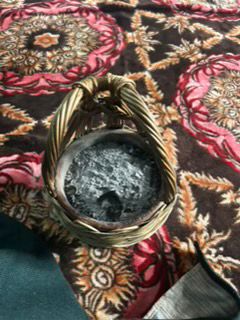
The warmth of festivities can never harbour the warmth that emanates from the rituals that are consciously and unconsciously performed during Chillai Kalan. The harshest part of winters in Kashmir consists of three months which is divided into three periods: Chillai Kalan, Chillai Khurd, and Chillai Bache. Chillai Kalan is the 40-day period of harsh winter that begins from December 21st and ends on January 31st. This period is marked by a collective ritual of Kangers, Pherans and hot cups of Nun Chai. Kanger (earthen pot) softens the winters, as it glows with warmth and keeps the chill at bay. After the 40-days of Chillai Kalan, Chillai Khurd (small cold) takes command. Although shorter than Chillai Kalan, it lingers as if winter can not loosen its hold all at once. It is followed by Chillai Bacche (baby cold), which signals the onset of spring and the numbness of harsh winters melting down. The winter period, more than a season, becomes a festival of forbearance, memory, and patience. The unconscious habit of tugging off the sleeve of the pheran, to hold the kanger inside, is a ritual which continues through generations without ever being taught. Memory, thus, does not limit itself to the individual, it is sustained collectively as an archive of remembrance. And these fragmented anecdotes, that are invisibilised under the spectacle of grand festivals, is what we are made of.
Pierre Bourdieu, a French Sociologist, talks about Habitus, in his theory of practice. This is what I link to the rituals that consciously or subconsciously become a part of us and our dispositions. For him, habitus is a “system of continuous and transferable dispositions”. These dispositions are the individual’s positions and tendencies in ways that he thinks, acts, feels, and which are internalised through socialisation. Dispositions are the non-conscious principles that direct practice and even the reactions of individuals. According to him, the dispositions that we acquire during childhood, become our primary habitus and thus last longer and are decisive. This thus means that our bodies unconsciously carry our history, culture and identity. The body becomes the archive of history threading back memories that can never be erased. We become the sites of memory. The ordinary that we live becomes the steward of belonging. Our existence in the ordinary, conscious and unconscious becomes a deliberate attempt to hold on to each other.
Thus, holding on and carrying these rituals is in no way a passive act. Our collective memory ensures the continuity of collectivities. These memories that we carry through shared rituals and festivals of some sought, might be a recollection of the past but it also a reconstruction of the present. And perhaps, that is the greatest festival of all, one that goes beyond the shimmer of extravagance. It tethers us back to the land that faces the oppression of being rewritten, of erasure. We are just people, a collection of fragments, stitched into the ordinary of everyday life as we find ourselves.
“To be, or not to be, that is the question” and we choose to be.
Image Credits: Reeba for DU Beat
Reeba Khan