Tag

political science department

Browsing

DU’s Political Science department marks 75 years with a Diamond Jubilee event featuring VC Yogesh Singh, alumni felicitations, a new academic journal launch, and reflections on the department’s legacy.

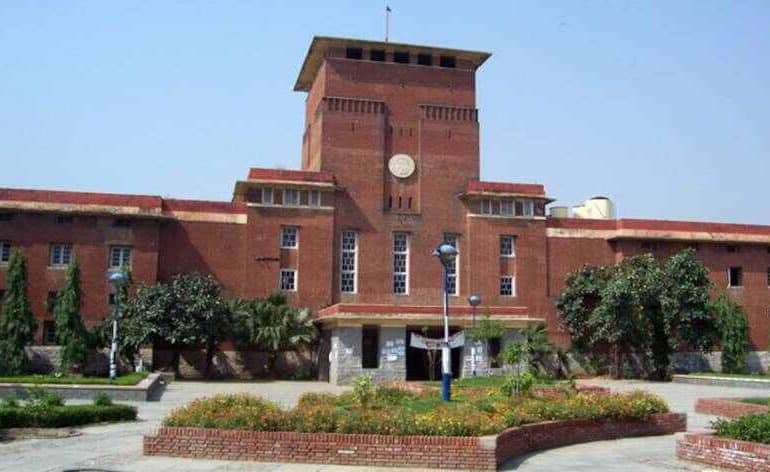
The Department of Political Science at the University of Delhi celebrated 75 years of its existence with a Diamond Jubilee programme held at Vande Mataram Hall, Faculty of Arts. 

Present at the event were current and former faculty, alumni, scholars, and university officials for a day that combined academic discussion with reminiscence and cultural performance.

The program commenced with the ceremonial lighting of the lamp and a rendition of Delhi University’s Kulgeet. Head of the Department and Convenor Prof. Rekha Saxena opened the session by tracing the department’s evolution from a small postgraduate cohort in 1952 to what she called the country’s largest centre for the discipline today, now reaching over one lakh learners annually. She called the department her “intellectual home,” reflecting on her own path from student to its Head, and pointed to its enduring culture of critical inquiry and openness to varied perspectives.

Guest of Honour Prof. Rakesh Sinha, a former Rajya Sabha MP, spoke on the decolonisation of knowledge systems and the importance of nurturing thinkers equipped to shape India’s future, and welcomed the launch of the department’s new academic journal during the inaugural session.

Vice Chancellor Prof. Yogesh Singh, attending as Chief Guest, congratulated the department for its 75-year run, noting that it has produced over 1,200 PhD scholars and has contributed to strengthening confidence in India’s democratic trajectory. Co-convener Bipin K. Tiwary delivered the vote of thanks.

A second academic session, chaired by Prof. M.P. Singh, featured remarks from Dean of Colleges Prof. Balaram Pani, Prof. Rajni Abbi, and Prof. Sushma Yadav, along with a keynote by Prof. Charles Hankla of Georgia State University, who spoke of his long-standing ties with the department. Former faculty members and alumni, including Prof. Neera Chandhoke, were felicitated during the programme, which closed with a cultural segment chaired by Sh. Anup Lather.

Read Also: DU’s Academic Council to Take Up Proposal to Rename SOL as CDOE

Image Source: The Indian Express

Aamna Rehman
[email protected]

ABVP protests against fraud and nepotism in the admission process of a Ph.D./M.Phil. student and violation of UGC regulations by the Department of Political Science of the University of Delhi (DU).

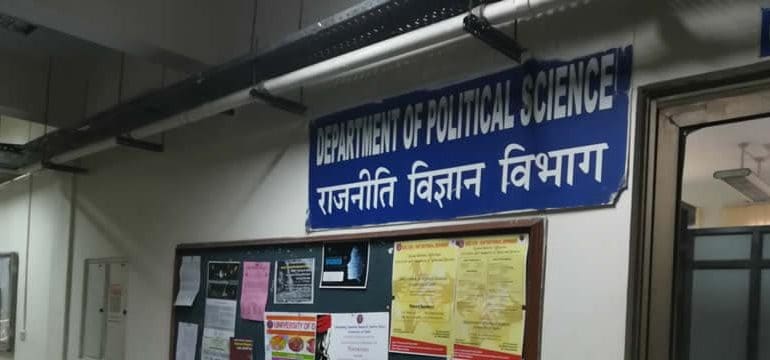
Akhil Bhartiya Vidyarthi Parishad (ABVP) volunteers gathered at the Faculty of Arts and marched to the Department of Political Science on 18th October, 2019, for the second day of their protest against the administration of Political Science Department for the ongoing corruption, nepotism and violation of University Grants Commission (UGC) guidelines in the admission process.

The Department of Political Science has allegedly conducted its Ph.D./ M.Phil. admissions without adherence to UGC regulations and University of Delhi statutes, resulting in favouritism and negligence of merit. ABVP has been protesting since the 17th October, 2019 against the fraud in the admission process in the Ph.D. of this Department, violation of rules and regulations of University Grant Commission, and favouritism in the admission process. According to the Press Release issued by ABVP, a group of Professors, who are ideologically intolerant of liberal ideas, they are denying admission to the meritorious students.

This protest has come after discrepancies in the 2019 admissions. Apparently, on 7th October, the list of the selected candidates was published. However, after two hours, it was removed and a new list was published. The only difference, it no longer had the name of a girl belonging to the Scheduled Castes category. The administration of the Department has not given the reasons for the removal of the name yet. Moreover, only 13 seats out of the 18 available seats were opened for admission.

Ashutosh Singh, State Media In-charge for ABVP, said to DU Beat, “We came to know through the students that the professors tend to give preference to their favourite students in the viva for the entrance exam, neglecting the ones who are also deserving. Last year it came to our notice that even the top ranking students of the entrance exam were not able to get admission after the viva. How is it possible for the top rankers to completely fail in viva?”

ABVP has asked the administration of Political Science Department seven questions regarding the inconsistencies in the admission process and has given the administration an ultimatum to answer their queries by Monday. ABVP claims to also have written letters to the Dean of Political Science Department, Vice-Chancellor of the University of Delhi and Vice President of India for this purpose. Apart from this, the ABVP volunteers have also placed the following demands:

  1. Make admission process to M.Phil./Ph.D. fair and transparent.
  2. The admission process must be centralized and time-bound.
  3. Admission must be conducted in adherence to UGC regulations and the University of Delhi statutes.
  4. All the seats offered by DU prospectus for Ph.D. intake should be fulfilled at the earliest by all the Departments.
  5. The number of seats for the research must be increased.
  6. Social Justice must be implemented in all its constitutional and legal dimensions.
  7. The UGC prescribed 70:30 ratio of written exam to viva-voce must be implemented with all its transparency.
  8. The examination process must be student-friendly and the bureaucratic red-tapism must be curbed.
  9. Steps must be taken to curtail the influence of Teachers’ politics on the admission process.
  10. Address the grievances of those students who have been denied admission on fraudulent grounds.

Siddharth Yadav, State Secretary, ABVP Delhi, said in the Press Release, “Administration of Political Science Department should not think that yesterday we were here only for a symbolic protest, we will continue our protest till the student interests are not secured. Our protest will turn into a revolution if the administration will not listen to our demands.”


Featured Image Credits: University of Delhi 

Satviki Sanjay

[email protected]

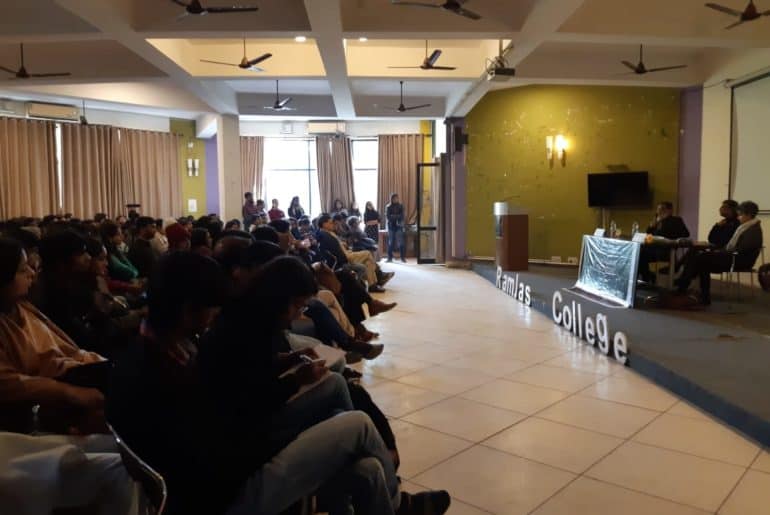
Prof. Nivedita Menon and Zi- Us-Salam talked on the issue of Triple Talaq in Ramjas College on 28th  January 2019.


The Department of  Political Science, Ramjas College organised a talk on Triple Talaq on the 28th January 2019. The key speakers were Zia-Us-Salam, Associate Editor of Frontline, a literary and social commentator, and the author of  ‘Till Talaq Do Us Part’ and ‘Of Saffron Flags and Skullcaps’ and Prof. Nivedita Menon, a professor of political thought at Jawaharlal Nehru University was also one
The talk began with Zia-us-Salam clarifying the term Triple Talaq, and suggested the usage of the term ‘instant Triple Talaq’.  Salam further went on to elucidate on Islamic marriage laws, role of the women in Islamic marriages, and the eight forms of divorce in Islam. He quoted verses from the Quran with respect to the topics. He further added that the role of the media in spreading propaganda, and hate against the Muslims and Islamic beliefs has severely impacted the discourses on Islamic thoughts and teachings.
The discussion then stirred towards the legality of Triple Talaq in context with Muslim laws and the role of maulanas and imams in situations involving the same.“Most incidents of  Triple Talaq are eloquent examples of the failure of Muslim society to instill in its men the teachings of the Quran; instead, they end up relying on the Quran’s interpretation by local maulanas,” Salam said while quoting his  book, ‘Till Talaq Do Us Apart’.

Image Credits:Department of Political Science, Ramjas College

Nivedita Menon asserted on the prevailing patriarchal atmosphere in the country, islamophobia in the context of  mob lynchings, cow-slaughter and ‘love jihad’. Menon brought up the correlation between patriarchy and organised religion. Menon remarked that Islam had been ‘hijacked by the maulanas’. She talked about how marriage laws differ in every religion. According to Hindu Marriage Laws, marriage is a sacrament between two people. Whereas, according to Muslim laws, marriage is a contract and the terms of the contract can be negotiated.

Keeping the Uniform Civil Code in mind, Menon pointed out that it has nothing to do with gender justice, but with a Hindu nationalist agenda. She defined marriage as a civil institution. A two way argument on how Triple Talaq is not given in script was discussed.

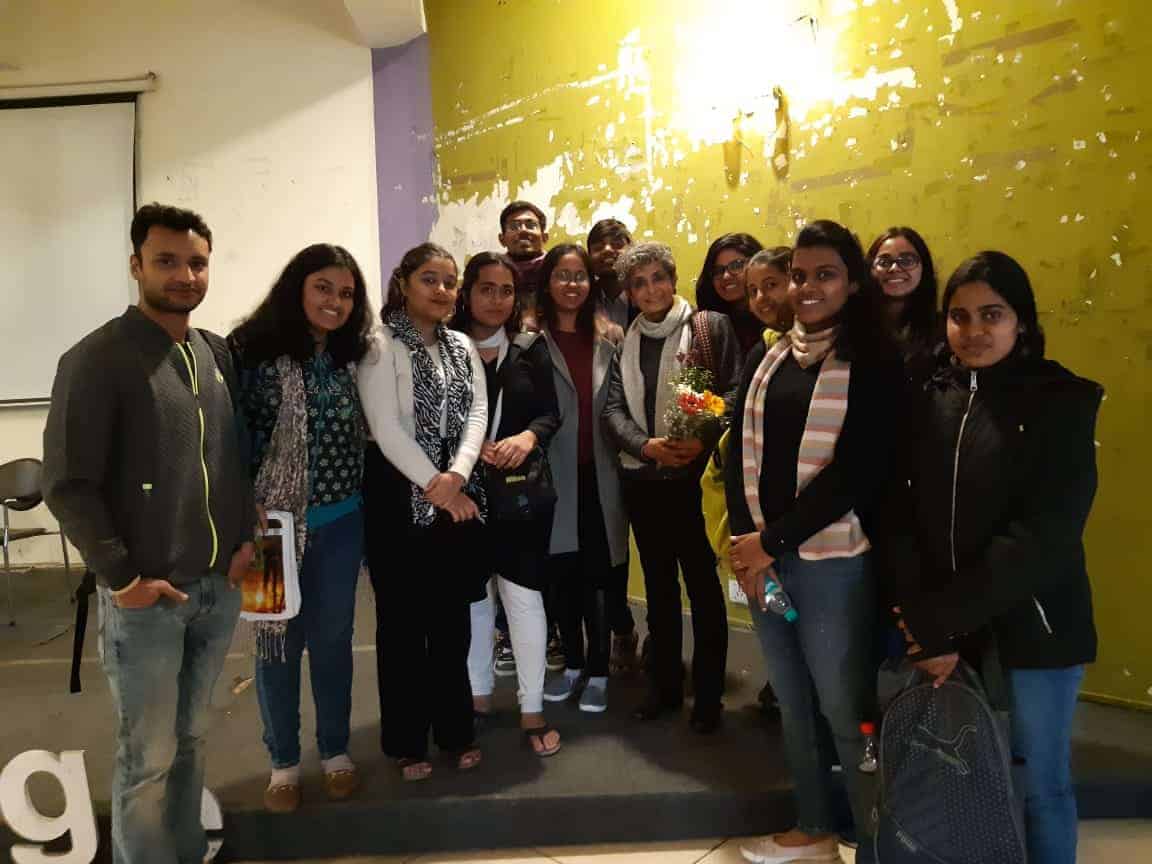
Image Credits: Department of Political Science, Ramjas College

Menon discussed the position of the Muslim women in the society in respect the current political atmosphere. She said, “We need to stop sounding like the patriarchies we’re fighting.” Menon also spoke about adultery laws and the discrepancies in it. She mentioned the Bharatiya Muslim Mahila Andolan and their efforts as women’s rights organisation for the Muslim women who have been victims of instant Triple Talaq, and faced social ostracization as a result.
Both the speakers agreed on the current islamophobic atmosphere and the patriarchal structure of certain Muslim communities, and its influence on instant Triple Talaq.


Feature Image Credits:Department of Political Science, Ramjas College

Jaishree Kumar

[email protected]