
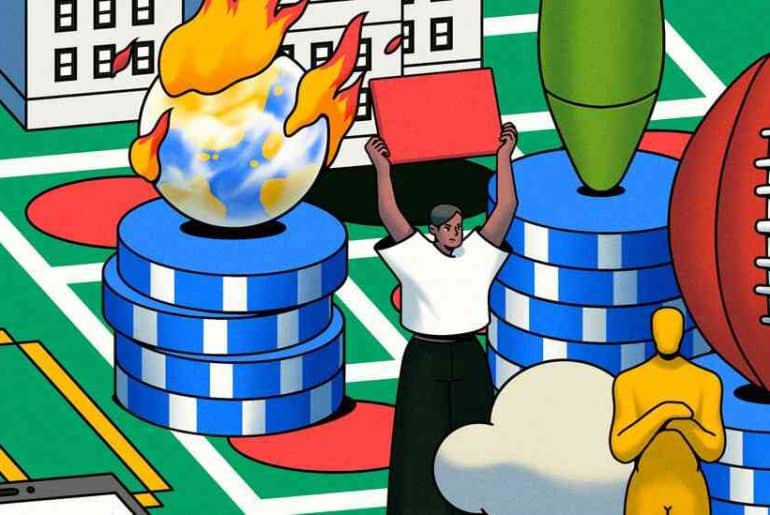
Fear is no longer just felt; in markets, it is priced, traded, and increasingly powerful enough to shape the very crises it anticipates, turning speculation into a force that predicts instability and begins to manufacture it.
Modern economies do not wait for crises to unfold. They react to the anticipation of them. Long before supply chains might be disrupted or infrastructure damaged, markets begin to shift. Pricing in possibilities, hedging against risks, and responding to signals that may never fully materialise. In this sense, fear, beyond being an emotion, turns into an economic force.
At the heart of this lies a simple truth: markets are driven as much by psychology as by data. Investors imagine themselves as rational actors responding to clear signals and curated insights, but in moments of uncertainty, behaviour tells a different story. The possibility of loss weighs heavier than the promise of stability, prompting swift, often exaggerated reactions. Our natural herd behaviour compounds this effect. In a state of confusion, we naturally look to others for cues, and fear spreads collectively rather than independently. What begins as caution quickly escalates into a broader sense of panic.
This is where the economics of fear becomes generative in its nature. The expectation of instability begins to produce instability. Investors withdraw, or over-invest, prices fluctuate, and systems adjust defensively. In doing so, the anticipated risks start to take shape in real terms. The line between speculation and reality blurs, as actions taken to avoid a crisis begin to resemble the crisis itself. Hence, the economics of fear is driven by self-fulfilling prophecies.
The ongoing conflict between the United States, Israel, and Iran offers a striking illustration of this dynamic. Even before sustained, large-scale supply disruptions fully materialised, global energy markets began reacting sharply. Oil prices surged, in part due to fears surrounding the Strait of Hormuz. The mere possibility of disruption in this region was enough to send shockwaves through the commodity markets.
What is striking, however, is that commodities can become expensive without actual scarcity; perceived uncertainty is sufficient. In response to that uncertainty, traders speculate, governments stockpile, and suppliers adjust pricing strategies. In attempting to prepare for disruption, the system begins to create conditions that resemble it. The anticipation of a shortage begins to produce the shortage.
Fear has long shaped markets; what has changed is how it is now measured, priced, and increasingly traded.
Layered onto this is the rise of prediction markets, where expectations themselves are traded. These platforms assign probabilities to future events, such as the likelihood of escalation or prolonged disruption, the results of elections, and economic shocks. In doing so, they transform abstract anticipation into visible signals. When a potential conflict is given a price, it ceases to be a distinct probability and evolves from a belief into a signal.
This creates a feedback loop. Expectations influence behaviour, behaviour influences markets, and market movements reinforce the original expectations. The distinction between forecasting and shaping outcomes becomes increasingly difficult to maintain.
Prediction markets complicate this dynamic further. When the subject of prediction is not a corporate merger but a military operation, the implications shift dramatically. Recent developments suggest that this is no longer hypothetical. Israel has arrested several individuals, including army reservists, for allegedly using classified information to place bets on military operations on Polymarket. According to Shin Bet, the country’s internal security agency, these individuals used insights gained during their service to inform wagers on the timing of Israeli action against Iran.
When markets enable profiting from war, they create incentives to prolong it. … When classified information becomes tradeable alpha, the entire decision-making apparatus of national security becomes vulnerable to corruption.
At its most benign, this system risks indirectly disclosing sensitive information. At its most troubling, it creates incentives that are fundamentally misaligned. If individuals can profit from predicting conflict, the boundary between observing events and influencing them begins to erode. The idea that someone might benefit from escalation even marginally introduces a distortion that is difficult to ignore.
Fear, that was once an internal reaction, has become externalised, quantified, and amplified. Countries far removed from the conflict bear its economic weight, not through destruction but through the pressure of anticipation. Hence, in an economy driven by expectation, fear does not simply follow crises; it precedes it, amplifies it and now, even rewards it.
The modern economy endures conflict while beginning to experience its effects long before the full reality of that conflict is known. As markets grow more capable of pricing belief itself, the question becomes harder to answer: at what point does anticipating war begin to look uncomfortably like participating in it?
If anticipation can move prices, shape behaviour, and leak fragments of what was meant to remain secret, then it carries consequences that extend beyond analysis or forecasting. At some point, drawing a line becomes necessary. Markets can process information, but they cannot be allowed to reorganise the incentives around conflict.
Image Source: The New York Times
Read Also: The Game Theory of Dirty Dishes and Nuclear War
Suansh Dembla