
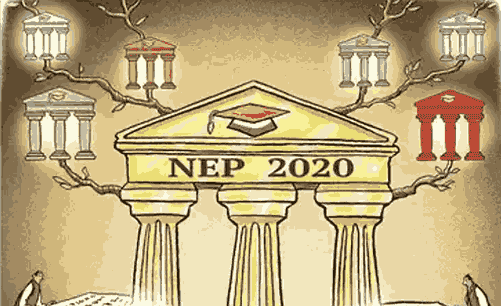
Education Minister Dharmendra Pradhan has asserted that at the core of the National Education Policy lies the goal of “decolonising education and achieving aspirations, creating pride in our languages, culture and knowledge.” As students of critical thinking, we must then pause and ask what this decolonisation means, and how it translates into practice through the much-celebrated Indian Knowledge System (IKS).
In the past few years, the Indian Knowledge System (IKS) has emerged as one of the most discussed features of the National Education Policy (NEP) 2020. Dedicated IKS divisions have been set up under the AICTE, research fellowships and conferences funded in its name, “centres of excellence” announced, and institutes from medical colleges to IITs have introduced courses on ancient sciences, philosophy, and Sanskrit traditions.
Before we engage with its ideological and philosophical implications, it becomes necessary to pause and ask what exactly is being invoked under the label ‘Indian Knowledge System’. The policy framework presents IKS as both a recovery of ancient wisdom and a modern research frontier, but the term itself remains conceptually opaque. What even is a knowledge system? Strangely, if one turns to the official portals or documents, there exists no clear definition of what the term actually means or, more crucially, what it leaves out. After all, the act of defining what can be considered “knowledge” and then further, what can be considered Indian knowledge, demands at least some coherent framework or guidelines.
Broadly speaking, there have existed two dominant ways of understanding knowledge. The liberal-humanist view treats knowledge as universal, objective, and value-neutral, a pursuit aimed at describing what is, rather than prescribing what ought to be. Within this framework, truth stands apart from the knower’s culture, faith, or geography; the scientist in Delhi and the scientist in London, in principle, operate within the same rational order. A person, then, can question the validity of necessarily categorising knowledge as ‘Indian’. Does the vague geographic idea of a place serve an extraordinary function that needs to be specially discussed and highlighted? The liberal imagination of knowledge would argue not. Knowledge, in this view, is meant to transcend the boundaries of nation and identity, aspiring instead to universality.
A student having inherited a postcolonial legacy would intervene here to say that knowledge systems have never been innocent; they have always already been implicated in power. We are all, in some sense, children of the Foucauldian analysis, which taught us that knowledge does not simply describe reality; it creates the conditions through which reality can be known, named, and governed. Building on this insight, thinkers like Edward Said and Gayatri Chakravorty Spivak have shown how colonialism imposed its own epistemic order where the West stood for reason and science, and the non-West for myth and superstition. Within this framework, modern science itself becomes a kind of “local knowledge” of the West, whose dominance owes as much to power as to proof.
This theory has since been expanded and meticulously studied by postcolonial scholars in India after Independence. As a newly liberated nation embarked on its journey of self-actualisation and sought to craft an identity distinct from its colonial past, the question of knowledge remained ever-present. Thinkers like K.C. Bhattacharya, Ashis Nandy, and Partha Chatterjee turned their gaze inward, arguing that political freedom without intellectual swaraj in the realm of ideas remains incomplete. They contended that India continued to think within categories inherited from colonial rule, and that genuine decolonisation required re-imagining the very foundations of knowledge itself.
Placed within this lineage, the contemporary Indian Knowledge System discourse promoted by the NEP presents an intriguing yet troubling paradox. This project of decolonising knowledge seeks to replace Western intellectual dominance with indigenous, Vedic frameworks, grounded in what proponents call “Hindu spiritual exceptionalism”. Its aim is to “decolonise the Hindu mind” and achieve “epistemic decolonisation” by overcoming a colonial consciousness that allegedly obscures India’s true traditions.
The movement’s intellectual core is the promotion of Indian Knowledge Systems (IKS), presented as an alternative to Western epistemology. Thinkers like J. Sai Deepak frame this through the language of “onto-epistemology and theology (OET)”, arguing for a revival of a distinctly Bharatiya OET rooted in Vedic thought and a “reversal of the gaze” that subjects the West to dharmic critique. This discourse blends postcolonial theory with nationalist ideology, borrowing academic terms like “epistemic violence” and “coloniality” to reject Western rationality, secularism, and universal human rights as alien or “Abrahamic”. It also advances pseudoscientific historical claims (e.g., ancient aeronautics or pre-Newtonian gravity) to assert the scientific validity of Vedic “inner sciences”.
However, the one thread that ties the IKS ambassadors and the western power it is supposedly fighting against is the obsessive fascination with the ancient past of the Orient. They both have constructed mythologies that fuel their knowledge production and propagation of a spiritual civilisation frozen in its former glory, the most insidious consequence of which is its denial of its complex social reality. The same discourse that claims to decolonise knowledge often erases caste, gender, and regional differences. Pro-Hindutva scholars argue that the caste system is a colonial hallucination, a Western invention meant to malign Hindu narratives and so on.
Importantly, and this is what worries me the most, the project treats knowledge as fundamentally isolated and self-serving. The debate between the power relations and the objective nature of knowledge is too complex to try to reconcile here, but knowledge has always been a collaborative enterprise. The history of ideas, if anything, is the history of cross-pollination: Indian numerals found form in Arabic transmission, Buddhist philosophy shaped Chinese thought, Greek logic left its traces in medieval scholasticism, and Persian aesthetics coloured our own literary imagination. The IKS narrative, in propagating a rigid, self-contained idea of India, endangers this very fabric of intellectual life.
In claiming to decolonise Indian education, the NEP enacts the opposite by fixing it to a static, glorified past. It leaves no room for self-critique, no space to ask what was excluded, who was silenced, or how our understanding might change. It is as if India’s intellectual peak has already occurred somewhere in the Vedic age, and everything that follows can and should only be imitated. What does that say about our present capacity to think, to add, to question? Can a society that sees knowledge as already complete ever produce anything truly new?
Read Also: DU Cancels a Seminar from DSE’s Longest-Running Colloquiums, Convenor Resigns
Image Credits: The Times of India
Yashika Jain