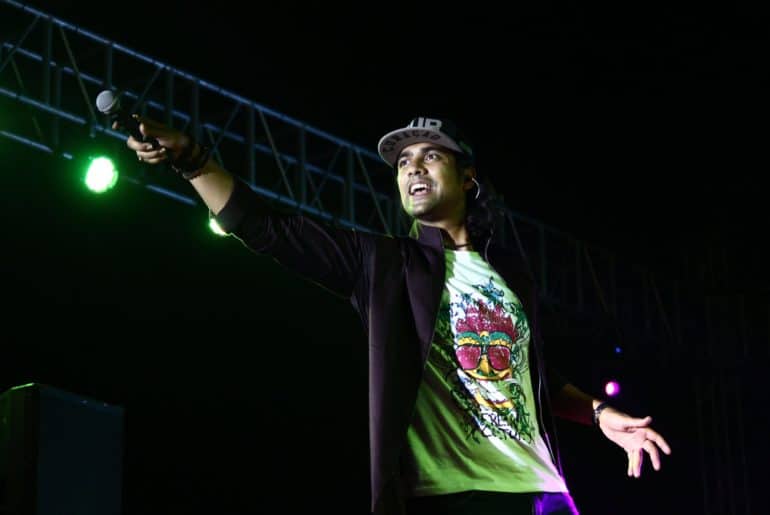
The Department of Journalism at Kamla Nehru College, hosted its annual festival, featuring a keynote address, panel discussion, and student competitions centred on gender representation in media.
The Department of Journalism at Kamla Nehru College, University of Delhi, hosted its annual departmental festival, Journo Junction 2026, on April 16 at the Old Seminar Room of the college. The event centred on the theme ‘Gender Narratives in Media’ and brought together journalists, editors, and writers for discussions on representation in contemporary media. The 23rd edition of the department’s newsletter, Communiqué, was also released during the event.
The programme began with a lamp lighting ceremony led by Ms. Priya Sahgal, Editorial Director at NewsX, alongside faculty members including Dr. Jyoti Raghavan and Dr. Ramesh Aroli. In her keynote address, Sahgal spoke about her experiences across political reporting, feature writing, and television journalism. She emphasised the distinction between objectivity and neutrality, stating that journalism should remain grounded in facts rather than forced balance. She further noted that women in political spaces are often portrayed through limiting stereotypes, suggesting that deeper issues in representation continue despite visible progress.
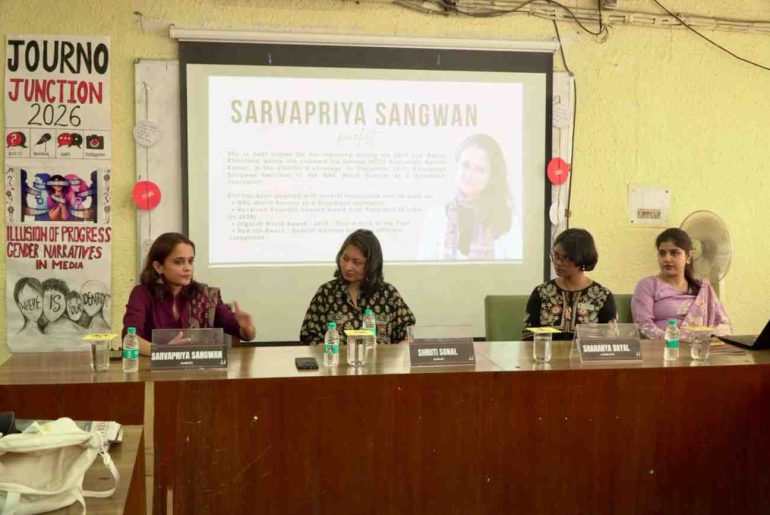
A panel discussion followed, featuring Shruti Sonal, feature writer at The Times of India, and Sarvapriya Sangwan, Editor at BBC News. Sonal discussed the role of cinema in shaping gender narratives, observing that representation extends beyond lead characters to supporting roles and antagonists. Referring to recent OTT content, she stated that storytelling appears to be becoming more nuanced. She also addressed professional realities within journalism, including uncertainty, the importance of networks, and the use of artificial intelligence as a support tool.
Sangwan focused on structural dynamics within media organisations, stating that while more women are entering newsrooms, they remain underrepresented in decision-making roles. She added that women journalists are often directed towards lifestyle and entertainment beats, while political and hard news reporting continues to be male-dominated. She also highlighted the limited representation of Dalit and Muslim women in mainstream media discussions, suggesting that such gaps render the discourse incomplete.
The fest featured a range of student competitions, including live anchoring (Live Desk), photography (Prisms of Perception), and quiz (Les Quizrables), alongside a panel discussion with industry professionals. A debate competition, Mic Drop, was also held on the theme of media portrayals of gender, examining whether such portrayals are breaking stereotypes or reinforcing them.
The event concluded with a prize distribution ceremony, following which the department reiterated its commitment to fostering socially aware journalism and facilitating discussions on media and society.
Read Also: What Happens When a Student Builds a Course That Didn’t Exist at DU?
Image Credits: Department of Journalism, Kamala Nehru College
Suansh Dembla