Tag

genZ

Browsing

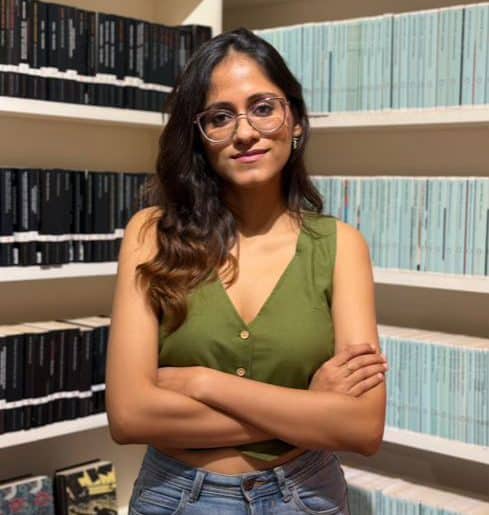
An alumnus of LSR, Ria Chopra is a freelance writer and creative consultant, and (un)officially the neighbourhood internet anthropologist. Chopra’s pop culture trivia reels and the Gen Z analysis essays have earned widespread acclaim. With her debut non-fiction book, Never Logged Out, in the pre-order phase, DU Beat reached out for a conversation about Gen Z and the Internet Culture.

Shikhar: If you had to pick one pop culture moment that stands out as your personal favourite, what would it be? Which one, in your view, has had the strongest influence on this generation?

Ria Chopra:  I have too many favourites to be able to pick one, but a recent one would be Zeenat Aman’s Instagram debut and the posts and writing she would publish on the platform. It was lovely in all aspects: to see an older person engage with social media, to have such a legacy star reveal their innermost thoughts and feelings in moments when they were at the peak of their fame. I think the most influential one would be any of the large-scale changes in the world of internet and social media: the advent of Jio, the launch of Instagram Reels, or even the gradual change in social media from being a space of connection to a space of commerce. I think these have had deep-seated impacts on how Gen Z engages with the world around them.

Shikhar: The internet has increasingly become a “third space” for our generation, especially in the post-COVID world. How do you see this shaping the experiences and interactions of DU students?

Ria Chopra: Should we call it that? I think one of the prerequisites of being a third space is that it should be accessible to everyone, and while it may be easy for us to overlook this, the internet is still out of reach for many women, lower-income groups, etc. It is also an inhospitable place for many people to be their fullest selves. That being said, I do agree that it has become a huge space of interaction and interpersonal engagement—for many people, digital socialising is where it’s at. Amongst DU students, I see a lot of intergroup conversation online; on the r/delhi subreddit, for instance, or Twitter threads and Instagram pages, which have DU students sharing experiences and trying to help each other. Hyperlocal communities of this sort can be extremely useful and supportive, especially for young adults, and I love that this has translated to the digital world too.

Shikhar: Pop culture shapes much of our daily lives, from our outfits to the phrases we use. Do you think internet culture and fandom discourse have begun to replace traditional political and literary forms of expression?

Ria Chopra: I don’t think so. Pop culture, along with literary and political discourse, has always been one of the vocabularies of expression that exist. In fact, I would say that pop culture, internet culture, and literary culture references can all fall under the overarching umbrella of political expression. Something I like to say is that the “personal is cultural”, and as we all know, the personal is political too. There’s a false discourse being created online about internet/pop culture vs literary/artistic discourse, which I think has been overblown. One replacing the other or being good/bad compared to the other isn’t true. I think dissecting pop culture and internet culture can be a very politically expressive act, while it is also entirely possible to uncritically engage with literature (like the ‘Performative Man’ trend) and hence strip it of its depth entirely. As long as we are thinking, we are good.

Shikhar: In recent years, cinephile and pop culture circles have developed a sense of elitism, where people look down on others for not recognising references. This often ties back to unequal access to cultural capital and knowledge. Do you think pop culture is losing its essence as a middle ground between high and low culture? 

Ria Chopra: Our cultural knowledge has always been a function of our privilege—of the language we speak, the money we have, the access we enjoy, and the things we are allowed to engage with. This is why I would rebel against describing anything as ‘high-brow’ or ‘low-brow’—who decides what the ‘high’ and the ‘low’ is? Elitism or snootiness in art domains simply represents a set of people unwilling to accept their own privilege and to try to understand art in other ways. Whenever I see ‘cinephiles’, critics or anyone else looking down on others for not getting references, I just zone out and move on—I can’t bring myself to respect that kind of discourse. 

Shikhar: The revival of Y2K aesthetics and 90s cinema among today’s students comes with varied interpretations. Some call it commercialised nostalgia. What, in your view, drives Gen Z’s fascination with the 90s and 2000s?

Ria Chropra: Multiple factors, the largest one being a huge sense of crisis permeating our existence today, birthing in us a desire to retreat into a warmer, safer cocoon of what feels like a better time—our childhood. Many of us older Gen Zs also remember that time tangibly: the early days of the internet, the early sense of rebellion in OTT, the drive of playfulness on websites and social media, and yearn for that feeling of discovery and curiosity that used to exist in our pop culture and internet culture experiences. It felt more fun, you know? I talk about this in my upcoming book too, but I think there’s also a generational coming-to-terms right now with the effects the internet has had on us. In other words, one day we logged in, and then we never logged out, is the title of my book too. I do think that nostalgia is rose-tinted, though it was a horrible time politically—feminist conversations weren’t as mainstream as they are now, and society wasn’t as progressive as it is now. So we should be careful what we wish for.

Shikhar: One question I love asking everyone: who’s your favourite pop culture icon? And what’s one piece of pop culture you’d recommend everyone experience?

Ria Chopra: I hate this question. How am I supposed to pick one? If you force me, at gunpoint, to say it, then my favourite pop culture icon is Shah Rukh Khan, obviously. Pop culture I’d recommend everyone experience is the entirety of AR Rahman’s Bollywood work (I’m a Hindi speaker, so I connect more with his work which is in Hindi, though his work in other industries is also great), and also the full 16-video YouTube series of the Berklee College of Music’s rendition of his music.


Read Also: Social Media Vilification of the Nerd Archetype

Image Credits: Sanjana Chopra

Shikhar Pathak
[email protected]

In conversation with a Nepali student, we explore how the youth are navigating political turmoil from afar, its effects, and what the future holds for a generation looking beyond their borders.

In an age of instant global connection, news from back home is never far away. For international students, political developments in their native country continue to shape their perspective, even from thousands of miles away. We spoke with Siddhant Pant, a Nepali student pursuing International Relations at Noida International University to understand their unique viewpoint on how the ongoing political and social movements in Nepal affect the life of the students. 

Correspondent: When protests or political movements happen in Nepal, do you usually follow them closely from India?

Siddhant: Yes, I follow them closely because half my family lives there, making it essential to stay updated.


C: Have you or your friends ever taken part in any protests or student movements back in Nepal? Do you feel protests are a good way for young people to express their views, or should there be other ways?

S: Being raised in India in a Nepali family, I used to visit Nepal frequently to meet my grandmother during the summers, but I don’t recall participating in any political protests.


C: How do political strikes, protests, or shutdowns in Nepal affect students’ daily lives, like school, exams, or travel?

S: Political strikes usually result in stalling. No buses, no public transport, or sometimes otherworldly traffic. God forbid if there is a protest on exam day. You’ll probably never arrive on time.


C: Did the condition in Nepal play any role in your decision to come to India for higher studies?

S: The current situation didn’t affect me or my studies. My father is a Nepali immigrant who arrived here in the late 1990s and settled in the area. My schooling happened in Jaipur and Udaipur, and I’m currently in Noida, studying International Relations.


C: Do political decisions in Nepal (like elections or protests) affect your education or career plans in any way?

S: This is not the case for me, but for my counterparts in Nepal, it does. Many Nepalese aspire to study in foreign lands. These were countries like India for decades, but due to rising tension and political decisions, the youth are actively looking at China as an alternative.


C: Do you feel young people in Nepal get enough support and opportunities, or do you think going abroad is a better option?

S: Nepal provides limited opportunities. Many villages are being abandoned, and youth increasingly seek opportunities abroad, much like India did years ago and still does now.


C: Would you encourage more Nepali students to come study in India? Why or why not?

S: I believe that India, if it continues to adopt free market values even more, could be an excellent place to study, especially for Nepalese youth. India is almost similar to Nepal, but still so different. India can offer what I call “the true human experience”—meeting new people who live close but still speak entirely different languages, the local culinary heritage of different regions etc. This isn’t quite possible in countries like China, Japan, or Korea, the top destination for Nepalese students.


C: Is there anything else you’d like to point out or share?

S: Many believed that Nepal’s turmoil was the result of a coup orchestrated by foreign powers. But the students have shown that when the government chains liberty, arms rise against tyranny. 

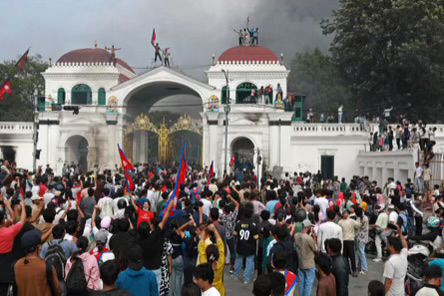
Picture Caption: GenZs started a protest in Nepal hoping for better conditions for them but what about the ones living afar?


Picture Credits: CNN

Juhi Bansal

[email protected]

This analysis compares recent student-led uprisings in Bangladesh, Sri Lanka, and Nepal, highlighting how disillusioned youth challenged corruption, repression, and economic crises, emerging as catalysts for political change across South Asia.

South Asia has been facing unprecedented political instability in recent years. The commonality stems from an observation that these movements or uprisings are unorganised in nature and lack any cohesive organisational support or leadership. This establishes the ground for comparison between these countries besides being from the same region and being postcolonial countries. The role of students in movements has been crucial in various uprisings which have led to transitions of governments throughout the pages of history.

The July Uprising of 2024 in Bangladesh showcased the deeper dissatisfaction of students in terms of the lack of civil liberties, political freedom and robust social security for the majority, which was often overlooked due to the economic and technological progress of the nation. However, as the country’s economy thrived, the government appeared to believe this gave it free rein to suppress civil rights and freedoms, sideline opposition parties, and govern without regard for the nation’s laws or international democratic standards. This led to the creation of political outfits like Ganatantrik Chhatra Sangsad, or Democratic Student Council. Every revolution has an incident which serves as an immediate trigger to a larger uprising; in this case, it was the quota system in jobs giving 30% reservation to the families of freedom fighters that fought for the liberation of Bangladesh from Pakistan in 1971. The manner in which the government at the top, run by Sheikh Hasina, reacted made the situation even worse, which led to the killing of various student protesters, including Abu Salem, who was the lead coordinator of “Students Against Discrimination”.

Skyrocketing fuel costs, rapid depreciation of the rupee, and massive power outages had caused deep disgruntlement among Sri Lankans, especially the younger generation. When the nationwide power cuts reached more than 10 hours a day in late March, mass protests broke out in a number of regions in Sri Lanka, where demonstrators urged for the resignation of the country’s president, Gotabaya Rajapaksa. Sri Lanka’s Inter University Students’ Federation (IUSF) made an important contribution to the people’s struggle throughout the country. IUSF has around 70 affiliated student unions – about 95% of university student unions in the country, including those at all major universities. Youth and students, including the IUSF, played a similar key role in 2015 to defeat Gotabaya Rajapaksa’s elder brother, former president Mahinda Rajapaksa, upending the ‘unshakeable’ Rajapaksa regime during elections that year.

The most recent, widespread protests in Nepal, which are quite literally being termed as Gen Z protests, highlight the young and mostly university-going students as the pioneers of the uprising. The banning of social media apps like Instagram, YouTube,etc, triggered the same; however, it would be a grossly incorrect observation to term it as the key reason for the protest. The youth of Nepal see how their country has suffered from around 2 decades of corruption since the country transitioned from being a monarchy to a democracy and the power rotations between 3 leaders who have allegations of serious corruption cases over them, with their family and children openly enjoying luxurious lifestyles. On the other hand, average youth are suffering with a lack of employment, due to which they have to migrate for better opportunities, and on top of that, the unjust taxing rate is at 39%. 

The students have a bolder voice because their dreams are still fresh and dear to them, and the ability to see hope as the silver lining amidst all the chaos gives them the unique ability to unite their peers and form an effective movement which straightforwardly communicates the grievances that they have and how they would no longer be tolerated. 

Caption- Advocacy of students against injustice. 

Divyanshi Dusad

[email protected]