Tag

Four-Year Undergraduate Program

Browsing

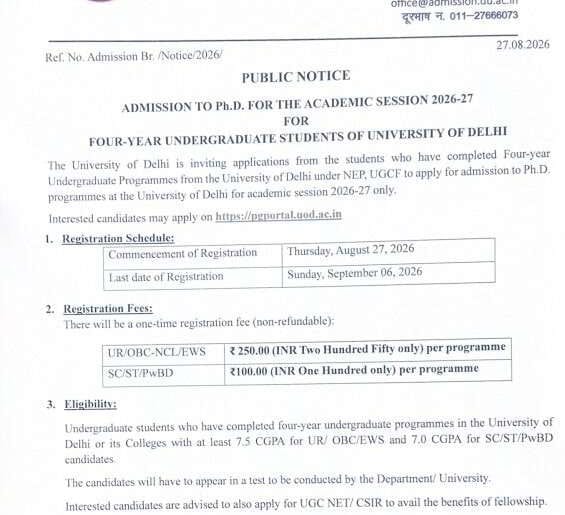
The University of Delhi opened admissions for Ph.D. programmes for the 2026-27 session, extending eligibility to four-year undergraduate students.

Delhi University has opened registration for Ph.D. programmes for the 2026-27 session.

The university has extended eligibility by allowing four-year graduates to apply for their Ph.D. directly after completing their undergraduate degree. The registration portal will stay open until September 6, 2026.

Candidates will have to appear for an exam conducted by the relevant department or the University of Delhi as part of the selection process for PhD candidates under the new eligibility by the National Education Policy (NEP), granting four-year graduates the ability to directly pursue a PhD degree.

The university has also released the minimum CGPA requirement for students from each category. Students from the unreserved category, Other Backward Classes (OBC), and Economically Weaker Sections (EWS) must obtain a minimum 7.5 CGPA in their four-year undergraduate degree to be eligible for admission. Whereas students from the Scheduled Caste (SC), Scheduled Tribe (ST), and Persons with Benchmark Disabilities (PwBD) categories must obtain a minimum 7.0 CGPA to become eligible for admission.

Candidates are required to pay a non-refundable fee while submitting their application; the fee is different for candidates from different categories. Candidates from UR, OBC-NCL and EWS categories are required to pay ₹250 for each programme they apply for. Candidates from the SC, ST, and PwBD categories are required to pay only ₹100.

The university has advised and encouraged students interested in the Ph.D. programmes to also appear for national-level eligibility exams such as UGC-NET or CSIR examinations. Clearing these exams may make candidates eligible for fellowship benefits available for research scholars.

Candidates are advised to constantly check the official portal of the University of Delhi for further updates and details about the programme.


Image Source: University of Delhi

Read Also: Delhi University Allows 4-Year UG Graduates to Apply Directly for PhD 

Vanshika U Singh
[email protected] 

School of Open Learning plans to have new centres after several students complaint about distance and accommodation facilities.

University of Delhi’s School of Open Learning (SOL) has decided to open a new building in Tahirpur, East Delhi. The tentative structure would be a seven storey long building on a 2,100 square metre land at Dilshad Garden. The varsity is also planning to open two other centres in Rohini and Uttam Nagar, to cater students from North West and West Delhi. Around 20,000 students from the area adjoining  Loni in Tahirpur, Rohini and Uttam Nagar are  enrolled for different courses at SOL.

A new examination branch will also be built to avoid delays in conduction of exams and declaration of results. This decision came after first year students protested against the implementation of Choice Based Credit System (CBCS) in SOL after it got approval from Executive Council. The students complained that the current Centre in North Campus did not have enough space to accommodate students who came for the Personal Contact Programme, which endeavoured to equip students with the required infrastructure.

Ramesh Bharadwaj, Officer on Special Duty (OSD), informed the Times of India that SOL will streamline the system. The college has available land in Tahirpur area and it will sign a Memorandum of Understanding (MoU) with Central Public Works departments (CPWD) to erect a seven storey building. He advocated for the implementation of CBCS in SOL as the institute was not recognized by Ministry of Human Resource Development’s Open and Distance Learning for it used to follow the Three Year Undergraduate Programme system that has been revoked from almost all the colleges of Delhi University.

Moreover, he added, “More than 90% study materials have been published and we are inviting students daily in batches of 3,000 to collect it. We have already provided soft copies since 25th August, a week before classes started on 1st September.”

The University Grant Commission launched the CBCS system in 2016 for Delhi University but SOL adhered to the old Three Year Undergraduate Programme till August 2018 when it along with NCWEB switched to CBCS to pace up with other colleges of varsity.

Prior to this, SOL had only 20 classes in a year but now the institute can easily hold 17-20 classes, per semester at 42 centers.


Featured Image Credits: India Today

Priyanshu

[email protected]

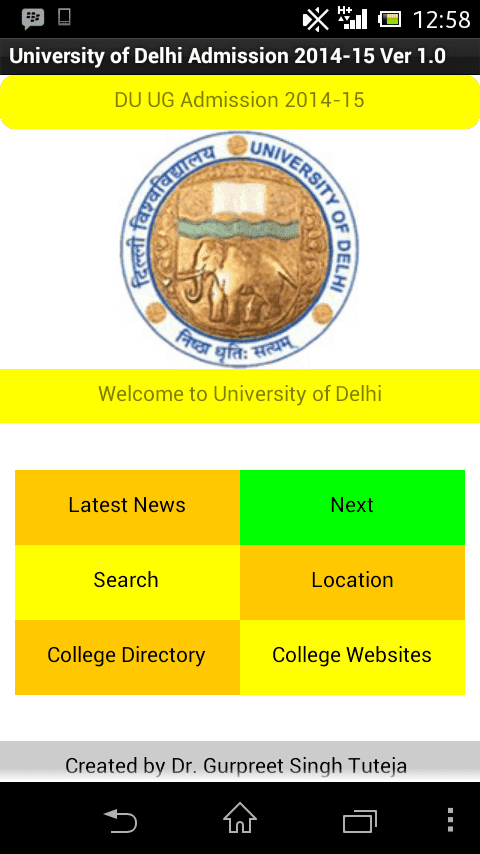
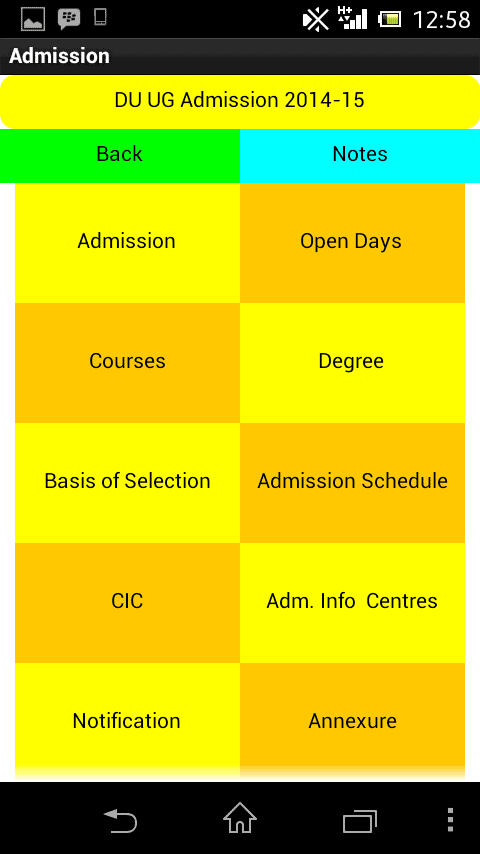
Delhi University in a bid to make the process of admission more easier for prospective students has imbibed technology to devise an app called DU UG Admission 2014-2015. The app has been designed by Dr. Gurpreet Singh Tuteja for Android users and can be downloaded from the University website. The need for the app says Dr.Tuteja was eminent. “When you are on the website, there is a lot of information that you don’t want to see but on app it is specific. Students carry mobiles everywhere and with this app all information related to admission will be on their fingertips,” he says. 1

While it took Dr. Tuteja three months to develop the template, his students helped him check all the URL’s in the app. The salient features of the app are that all the information needed during the admission process has been segregated properly, the facility of Google maps has been employed to provide locations of colleges and the app gets continuously updated with the latest information on admission. ” The app gets its feeds directly from the website and Google, so if there is something on the website then it will be on the app,” says Dr. Tuteja.

2

The app will also provide the students link to directly fill the online pre- admission form. This facility will be released on Monday when the offline pre- admission forms will also release. To download the app: Go to the following link from your phone’s browser:

http://du.ac.in/du/uploads/Admissions/2014/UG/DUUGAdmission2014.apk

The app is only available for Android users.