
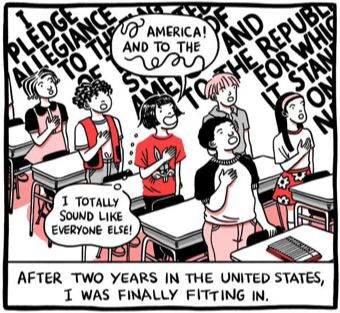
We are slowly becoming children of fragmented intermediaries, the political nature of our feeling of “belonging” consequently revolutionising against the self. What is then the fate of the culturally displaced?
To be so brave as to consider yourself to “belong to a city” is to rely on a notion whose existence oscillates between a spectrum of aggressive spiritual sentiment and almost complete non-existence.
Cultural identities, after all, are themselves functions of constantly reforming institutions, in addition to the very unit of time. I do not generally endorse that the self be subject to the atrocities of socio-cultural servility, except in the case of “belonging”, which both demands it and, quite often, penetrates into the individual that asks for it .
There have been times when I longed for any answer to the preliminary question that enquires after the place affiliated with the self, to a personal or ancestral memory of the lives that led up to ours. The tangibility of this feeling is, unfortunately, unavailable to those who have been taught to live on the margins of cultural plurality, suspended on a line that indulges in its normative nature and constantly tears us away from it at the same time.
I talk of such a paradox because there is no doubt that it is a widely experienced one; the very characteristic of life is such that it craves connection aggressively, and the reality of experiencing it is that it is almost never fulfilled.
Delhi, as an example, may be considered as a refuge for many such seekers of connection. It rescues the ones stuck in the limbo of cultural overwhelm, or the lack thereof, and offers a new schema to which a sense of belonging can be associated. The subjectivity of this rarely derived relationship must not be forgotten, for there are any number of objects or places or people—your family, an old journal—that can act as its source.
We “belong to a city” the same way that lions and tigers identify their territories. The land we exist on is a stolen geographical unit which becomes “home” when we recognise the value of the experiences contained within it.
For the perpetually displaced- culturally, linguistically, geographically, metaphysically- “to belong” is contingent upon a performative assimilation into localities, the ability to ignore the dissonance between inherited memory and the manner of present existence. This liminal experience is therefore, the phenomenological reality that inhabits multiple symbolic universes, without a complete citizenship in any. The cultural limbo that is thus born is not neutral, it’s a perpetual psychic effort to translate our own fragmented identities calibrated to a contextual actuality.
The fear, in my opinion, is not that we may never exit this cultural limbo, but that the epistemic space to narrate ourselves without distortion is ultimately taken away. We ask, in this context, whether we—the ones who have lived with such disjunction—possess legibility in our complexity.
We call the act of belonging “political” because it is never a static achievement. For most, it is a demand to be seen in their own nuanced sense, as a legitimate node in the social fabric, complete with the complexity that is born of fragmentation.
Perhaps the solution is that the goal must shift from “belonging to a city” or to tangible entities, to something more achievable in the larger sense of multiplicity. The conventional relation is thus a gesture of yearning for solidarity—a radical act of hospitality that simultaneously indicates an exclusion of the culturally displaced.
We must, as a species, “belong”. The question remains what we decide to aim this relationship toward. The recognition of this fact is perhaps the ultimate liberator of those stuck in this ill-fated limbo.
Read Also: On Belonging
Image Source: Excerpt from “‘Are You American?’: The Question I Couldn’t Answer,” by Rumi Hara
Manya Marwah