
Tag

eligibility

Browsing

Delhi University has released its UG admissions prospectus for 2026–27, making it clear that CUET UG remains mandatory and subject eligibility rules remain unchanged.


Delhi University has released its undergraduate prospectus for the academic year 2026–27, reaffirming that admissions to all regular undergraduate programmes will be conducted solely through CUET UG 2026 scores. Along with the prospectus, the university has uploaded a detailed information bulletin on its official admission portal. According to the university, there are no major changes in admission rules this year, and the subject eligibility criteria remain the same as the previous cycle.


The university has made it clear that CUET UG 2026 will be the only gateway for admission to its regular undergraduate courses across all colleges. This process, however, does not apply to admissions through the School of Open Learning (SOL), the Non-Collegiate Women’s Education Board (NCWEB), or to foreign national applicants, who will continue to follow separate admission procedures.


Delhi University has reiterated its long-standing policy that candidates must appear for CUET UG subjects that correspond to the subjects they studied at the Class 12 level. Students will not be eligible for admission to a subject they did not study in their qualifying examination. While the CUET UG framework allows candidates to take subjects outside their Class 12 syllabus, the university has clarified that this flexibility will not extend to DU admissions. If a subject was not studied in Class 12, admission to that subject will not be granted, regardless of CUET performance.


The prospectus also emphasises that Delhi University’s admission rules will prevail over general CUET UG provisions. As participating institutions are allowed to set their own eligibility norms, DU’s criteria will be final and binding for its undergraduate programmes.

In cases where a Class 12 subject is not directly available in the CUET UG 2026 subject list, candidates are required to choose a closely related subject or language paper. For example, students who studied Biochemistry in Class 12 must appear for Biology in CUET UG 2026. To establish subject equivalence, the university will assess whether there is at least a 50 per cent overlap between the Class 12 syllabus and the CUET UG paper. The authority to determine such equivalence rests solely with Delhi University, and its decision will be final.


The university has also confirmed that the subject combinations listed under List A and List B remain unchanged from the previous admission cycle. Applicants have been advised to carefully review these lists before finalising their CUET UG subject choices.


With the release of the prospectus, Delhi University has once again underlined that CUET UG 2026 is mandatory for undergraduate admissions and that no significant policy shifts have been introduced this year. Candidates are encouraged to thoroughly consult the official prospectus and information bulletin on the university’s admission website to avoid errors related to subject selection and eligibility.


Read Also: Over 700 DU Applicants Yet to Receive Refund Months After Cancellation


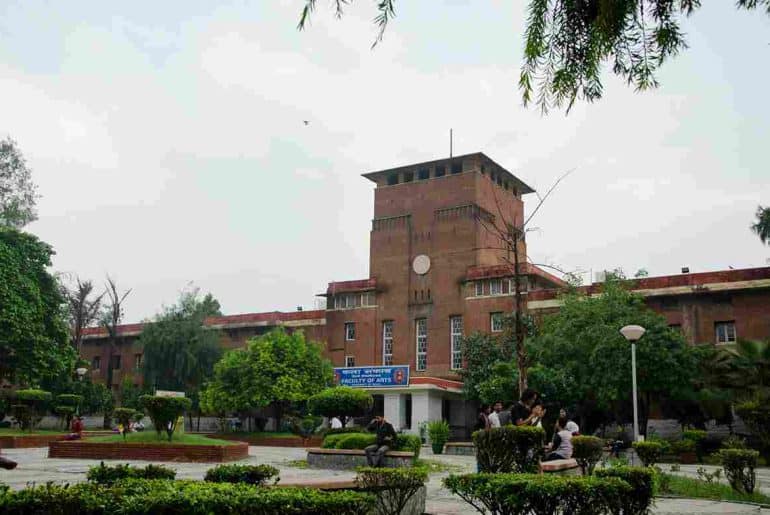
Image Credit: Devesh for DU Beat


Anjali Kumari Jha

[email protected]

The writer complains about the scholarship not being advertised in the papers.

The Rhodes Scholarship is one of the most coveted awards for international study. It opens the door to the University of Oxford for post -graduate courses ranging from Master’s programme or a research degree to a second undergraduate degree. Innumerable students from all over the globe aspire to win recognition and financial aid through this medium. Initiated in 1902, with the vision of Cecil Rhodes, it has been extended to Commonwealth countries including India.

The selection process for Rhodes begins in the month of august by which candidates are required to submit their applications. These applications must include an essay mentioning the aspirant’s strengths, weaknesses, goals, career aims etc. The application should include recommendations from six close acquaintances, three of whom the applicant ought to have studied under. One passport size photograph, age certificate, evidences of courses taken and other academic distinctions obtained are also required.

While nominating the committee regards the qualities and ethos that Cecil Rhodes held dear. A Rhodes scholar is expected to posses an exemplary academic record complimented by striking sport skills. Character, compassion, leadership ability, morals and ethics are indispensable tools of their armory. Short listed candidates are then called for a preliminary personal interview, after which the selected candidates face another interview in December which forms the final leg of the selection. The chosen candidates join the esteemed club consisting of dignitaries such as Bill Clinton and Bill Gates. The essence of Rhodes Scholarship is the promise of a life full of opportunities!

With the results having been declared a week ago, students across the university are now aiming to migrate to better colleges. However, migration can be tricky if you don’t know exactly how to go about it. DU Beat gives you a lowdown on the process.

1. Aspirants seeking migration to another college are first required to check the criteria of the college they wish to apply to, the information regarding which is available with the respective Head of Department of that college.

2. If the criteria are fulfilled, the candidate needs to submit the following documents to the Section Officer (Administration) or the Head of Department:-

o an Application for migration

o a copy of the Statement of Marks of passing First Year Under-Graduate Examination

o a ‘No Objection Certificate’ from the former college

3) The candidate will then be granted a No Objection Certificate from the college to submit to the former college to obtain Transfer Certificate, after which admission to the new college can be applied for.

4. The following documents/ certificates ( original and attested copies) are to be submitted to the Section Officer at the time of admission/ migration into the college-

* Statement of marks of first year undergraduate course

* College leaving certificate

* No objection certificate from parent college ( if not already submitted)

* Class X Board Examination certificate and mark sheet

* Class XII mark sheet and provisional certificate.

* Hindi passing certificate ( VIII/ X/ XII class)

* SC/ ST/ OBC certificate in the name of the candidate, only issued by the designated authority/ declaration/ undertaking by the OBC candidates ( for OBC candidates only)

* 3 non- attested passport size photographs

MINIMUM ELIGIBILITY CONDITIONS:-

1. Candidates seeking migration into II Year Programme Courses are required to have passed I Year Under-Graduate Examination with the required percentage as per the college’s criteria.

2. Should have passed Main Papers, Subsidiary Subjects/Concurrent Courses and Qualifying Subjects.

3. Candidates are required to submit a copy of Provisional Certificate/ Statement of Marks of passing Class XII Examination.  The Candidate must have passed 12th class examination in five subjects.

NOTE:-

Candidates, whose result has not been declared so far, can submit the Application within a week after the declaration of their results. The same should be confirmed from the administration of the college of preference as well.