Tag

DU protest

Browsing

The Delhi University Teacher’s Association (DUTA) held an emergent meeting at Tuesday, 24th October 2019 to discuss the varsity’s twin move to create an “Institute of Eminence” within it and replace its various statutory bodies like Executive Council by an all-powerful Board of Governors.

DUTA had a meeting wherein recent issues of key importance were discussed. The meeting’s main motive was to formalise the arguments against the decision and submit the same to the University Administration expressing their concerns while also highlighting the possible consequences.

The concept of the institute of eminence is taken as a pathway for better education, however, a thorough understanding of the label is required. Here is an explanation of the same.

The status of institute of eminence will take place with the formation of 9 autonomous centres and the replacement with a separate board of directors. The exercise in creating a separate list of Institutions is geared towards promoting a special economic zone for Higher Education brands that may pursue commercial aims with impunity and without any public accountability, said DUTA. The organisation was responding to the Human Resource Development (HRD) Ministry decision to grant ‘Institutes of Eminence’ status to 6 institutions.

Along with the University of Delhi, the government granted ‘Institutions of Eminence’ (IoEs) status to IIT-Delhi, IIT-Bombay and the Bengaluru-based Indian Institute of Science (IISc) in the public sector, and Manipal Academy of Higher Education, BITS Pilani and Jio Institute by Reliance Foundation in the private sector.

Talking about IOE, to give the institute of eminence within the University of Delhi (DU) will lead to disintegration. DUTA’s discussion was pointed towards how currently, the entire University has been awarded the status of IoE, and it is shared by all the institutions, faculty members and stakeholders jointly. But once an independent parallel structure within it is declared as IoE, it will receive the entire limelight and government patronage leading to disintegration of unity among the institutions.

The DUTA is also opposing the University Administration’s decision to do away with the current administrative or statutory bodies of the university such as the Executive Council and Academic Council with an all-powerful Board of Governors. University has decided to advance the timeline of setting up a Board of Governors in line with the New Education Policy 2019, because of the following reasons:

The new Board of Governors will not be accountable to anyone within the university. Instead, the Board of Governors will only be accountable to the Rashtriya Shiksha Aayog, which is a cause for concern. In addition to this, the members of the Board of Governors will be nominated and not elected, from outside the university, which again calls for caution.

Talking about the advancement of plans to implement the Draft New Education Policy from 2020 to October 2019 itself, DUTA said, “This timeline seeks to do away with the statutory bodies like Executive Council, Academic Council, departmental councils and college staff council by the constitution of all-powerful BOGs (Board of Governors).”

DU is going to implement this BOG-ruled autonomous structure within the varsity in the  garb of eminence, where this institute would receive a grant of INR 1000 crore in 10 years from the Centre directly and their matters will never undergo the critical scrutiny from the EC, AC or Finance Committee which raises a bigger motive for privatization.

“The ’eminence’ tag is being used to dismantle the university when the government money should have benefited the entire university and improved its infrastructure” DUTA said allegedly.

The question is hand is why the university administration is taking such dire steps, going against their unions to implement this.

In a conversation with Abha Dev Habib, Office bearer, DUTA, she told DU Beat, as an answer to the above question, “It’s all just a big facade for privatization, commercialisation and corporatization of education. Whether they call it graded university, new education policy or institute of eminence, it’s just privatization, where there will be fee hikes, all in the name of profit.” She also said, “There will be a serious loss of accountability and greater disintegration.”

DUTA also criticized the way some private institutions have been selected as Institutes of Eminence.

The Government had received more than 100 applications for the grant of IoE status. Under Public Sector, the following have applied for the scheme-

  • 10 central universities
  • 25 state universities
  • 6 deemed to be universities
  • 20 institutions of national importance
  • 6 standalone institutions

As for the private sector, 9 private universities and 16 deemed to be universities have applied in the Brownfield category and 8 institutions have applied in the Greenfield category.

Existing standalone institutions which are not universities or deemed-to-be-varsities were allowed to apply under Greenfield category for Institution of Eminence status to avail greater autonomy and get a world-class reputation.

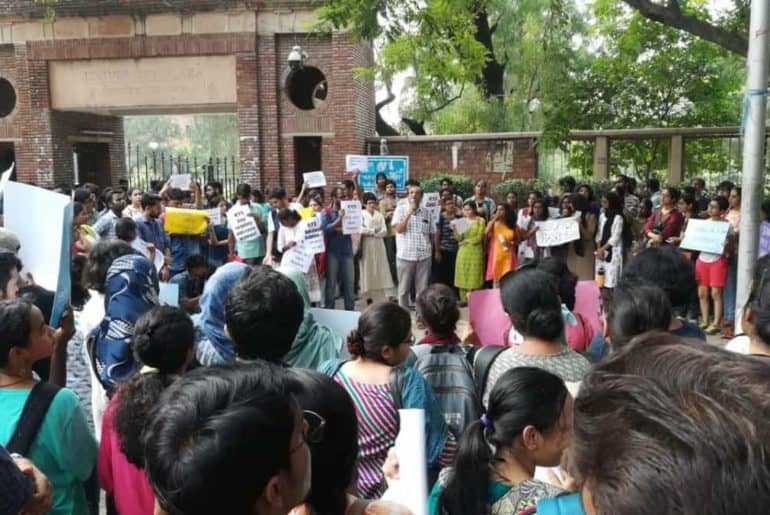
DUTA has been quite vocal in presenting their resentment against the proposal. Many staff associations along with students throughout the varsity have protested against this proposal and the new education policy.

Where colleges like Ramjas college went on a ten-day dharna, other colleges like Gargi college and Kamla Nehru college formed a human chain to show their resistance.


Staff association and students of Gargi college and Kamala Nehru College come together and form a long queue of protest against the privatization of University of Delhi with slogans like “Education is not for sale”. Video by Avni Dhawan for DU Beat

After the emergent meeting that took place on Tuesday where all the arguments were formalised, DUTA has rejected the proposal. It was rejected on the grounds that it involves a push towards privatisation of education as confessed by Mr. Prakash Javadekar while announcing it for the first time as Graded Autonomy for universities and grant of IoE status. He had confessed that these steps constitute the initiation of liberalisation in the education sector.

“It also gives the University the freedom to determine fees for domestic students subject to one meaningless rider. The rider is a principle that no one will be turned away for his/her incapacity to pay. In the absence of any guideline on how high the fees are and the means criteria to be entitled to fee waiver/scholarship. Loans binding their future would become the only effective mechanism.” said DUTA in their press release.

The DUTA Executive also took a decision to call for a Total Shutdown of the University on Friday, 25th October 2019 and a Dharna from 1 p.m. to 3 p.m. outside the Executive Council meeting to protest against this move and also to demand the withdrawal of the 28th August 2019 letter asking for guest appointments to be made against all new vacancies.

Feature Image Credits: Abha Dev Habib

Chhavi Bahmba
[email protected]

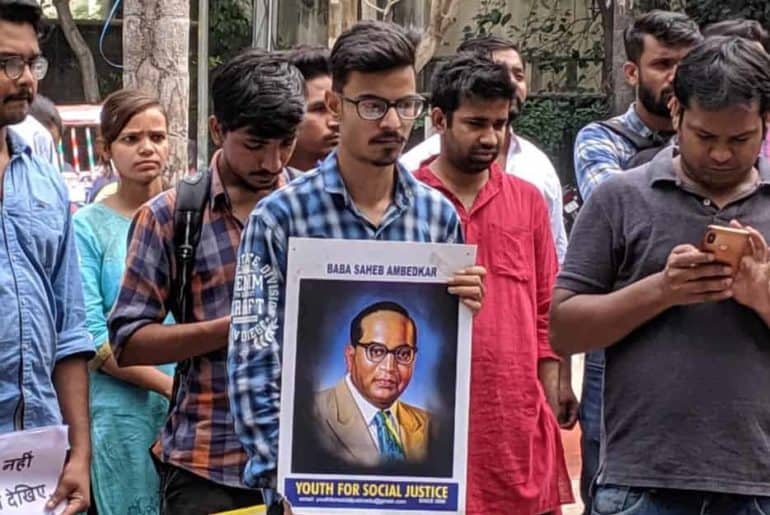
In solidarity with the Department of Hindi, the Students’ Federation of India (SFI) organised a march against the caste discrimination within the department, joined by other student organistaions like All India Students’ Association (AISA), and Krantikari Yuva Sangathan (KYS).

The post of the Head of Department (HoD) in the Department of Hindi at Delhi University (DU) has been lying vacant for the past three weeks after the end of the tenure of the last HOD on 12th September. Two veteran members of the department, Professors Sheoraj Singh Bechain and K N Tripathi, have both staked claim to the post. Essentially, there are two ways in which someone can become a Professor — either by direct recruitment to the post, or by promotion under the Career Advancement Scheme (CAS).

In the case of the Department of Hindi, Mr. Singh was a direct recruit whereas Mr. Tripathi comes under the CAS bracket, which has led to a contest.

As stated in a Press Release by SFI, despite the completion of all official formalities, and submission of a memorandum and a letter to the Vice Chancellor, as a reminder for the urgency of a new head, there has been no progress for an appointment. The Vice Chancellor had already completed all formalities with the last HoD with respect to appointing the next Head, and yet there is an unexplained delay. There has been no communication initiated with the department, and no official announcement has been made with respect to the appointment.

Professor Sheoraj Singh Bechain, the senior-most faculty has been appointed to be the head. He is also one of the very few Dalit professors in DU.  He has actively contributed to Dalit Literature, and is a renowned personality in the anti-caste writing sphere. It is to be noted that there has been no Dalit member to have been appointed as a HoD in DU.

SFI members along with College professors marched from the Faculty of Arts to the Vice Chancellor’s office demanding the appointment of Professor Bechain with respect to the seniority clause. Hansraj Suman from Academic Forum for Social Justice, told The Times of India, “We demand the department release the seniority list and based on that, professor Singh should be given the charge of HoD without delay.” The student wing SFI condemned the Vice Chancellor’s lethargy being due to the Professor’s low caste.

There has been no response with respect to the March from the Vice Chancellor’s office.

Feature Image Credits: Noihrit Gogoi for DU Beat

Stephen Matthew

[email protected]

On Tuesday, 10th September, the Pune Police searched the residence of Hany Babu, an Associate Professor in the Department of English of the University of Delhi (DU), in relation to the Elgar Parishad Koregaon Bhima case.

On 11th September, students from the Department of English organised a protest near Faculty of Arts, to express their anger and condemn the “illegal raid” at the residence of an Associate Professor from their department, Professor Hany Babu. Professor Babu has been a professor in the varsity for over a decade and has come under the scrutiny of the Pune Police due to his alleged links with the Maoist ideology that incited violence in Koregaon Bhima villages of Maharashtra in 2017.

In his public statement, Professor Babu said, “The search went on for six hours, at the end of which they said they (the Pune Police officials) would be seizing my laptop, my hard disks, my pen drives, and books. They made me change the passwords of my social media accounts and my e-mail account. They have complete access to my accounts now through the changed passwords and I no longer have access to these accounts. I would like to state that as a teacher, my work is heavily dependent on what I’ve saved in my laptops and external hard disks. It also contains the research work that I’ve been pursuing for years. This work is not something which can be duplicated in days. These are years of my hard work. I don’t understand how a government agency can seize my work without providing me the reasons for it, or the basis on which a search was conducted at my residence. They did not have a search warrant with them and they did not explain further as to why they don’t possess the same.”

The Delhi University Teachers’ Association (DUTA) condemned the act. In two separate statements, signatories including staff members and teachers of the varsity have criticised the Pune police and wrote, “The fact that legally obtained and publicly available documents may be imagined by the state as containing traces of one’s culpability is worse than declared attempts at censorship. It effectively means that any text may now become a pretext for the state to snoop into and invade our homes, our bookshelves, our lives and our families. Is the act of reading itself proscribed in what is numerically the world’s largest democracy?” Further, Professor Babu’s students also released a statement aptly titled “Professor, He is Our Professor” which reads, “While we feel that the law must take its own course, we also make it clear that these surprise searches without warrants are illegal and amount to extreme harassment. It is incumbent upon legal institutions to oppose such arbitrary raids and prevent/oppose the misuse of inherently dangerous laws such as the UAPA (Unlawful Activities Prevention Act).” Importantly, the statement also noted, “Hany Babu’s demand for language equality is allied to his demand for breaking caste exclusions in how knowledge is organised,” as Babu is also a part of the Alliance for Social Justice, a forum for opposing caste discrimination in the University.

The subjugation of voices, the strong opposition of ideas, and vulnerability of those who are knowledgeable becomes a trend in the times when a country’s strong voices are subdued to pave way for the façade of calmness and democracy. A professor explicitly claimed in one of their classes that with this advancement, most of the academicians who, over the years, have developed the intellect and voice to speak out, are afraid. Professor Babu’s case hits home in every regard. As respectable figures in the Department, both he and his wife, Mrs. Jenny Rowena, amass strong support, but most of it is under the protective layer of secrecy and confidentiality. For, even the ones with knowledge want to stay safe from the starkness of this dangerous world of misinterpretation and hypocrisy.

Feature Image Credits: Sabrang India

Bhavya Pandey

[email protected]

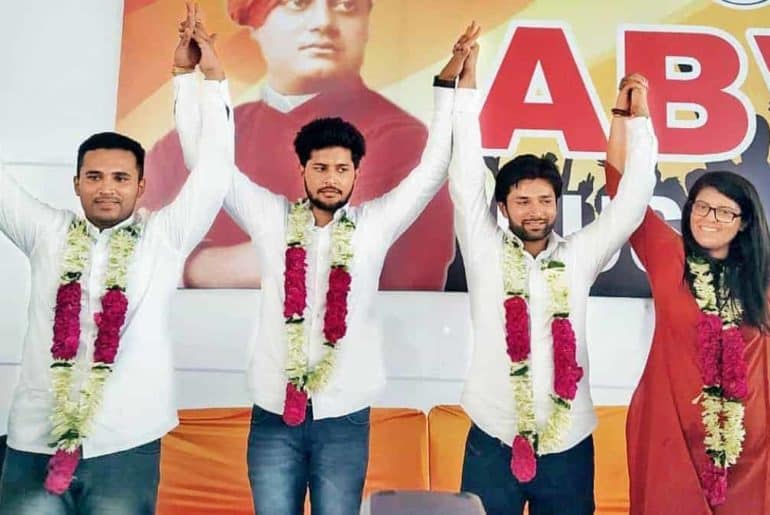
The campaigning for Delhi University Students’ elections 2019 took an eventful turn in  Miranda House as Akhil Bharatiya Vidyarthi Parishad (ABVP) and All India Students’ Association (AISA) came in to present their manifesto.

On 9th September 2019, Miranda House conducted its official manifesto reading, where it allowed the DUSU candidates to present their manifestos and carry out campaigning in the college. The students of Miranda House gathered in the college auditorium to attend the manifesto reading. However, it did not go as expected.

The Vice-Presidential candidate from ABVP, Pradeep Tanwar, came to address the students and present the manifesto of the party but he was met with chants of “ABVP! Go Back!”. The students of Miranda House led the chants for about seven minutes until the representatives of the party finally left.

Amidst the loud chants, the candidates tried to speak in favour of the party. Tanwar asked the students to let him speak for five minutes but on not being given any chance to speak, the representatives showed their ballot numbers and left.

This was followed by a scuffle between the ABVP members from Miranda House and the other Miranda students where the girls could be heard saying, “nahi chahiye humein ABVP (We don’t want ABVP)”, while the administration tried to control the situation.

ABVP’s departure was followed by AISA’s manifesto reading. When AISA’s Presidential Candidate, Damni Kain, came on the podium, most of the students from Miranda House started cheering for AISA, while, the ABVP members of Miranda House were heard chanting “AISA! Go Back!”.

Aapka yeh response na ki sirf humare liye encouraging hai, but har us bacche ke liye encouraging hai jo DU ka common student hai; jo university mein sirf padhne ke liye aata hai, aur jo gundagardi ko tahe dil se reject karta hai (not only is your response encouraging for us, but also for every person who is a common student of DU; who comes to DU to study and rejects all forms of hooliganism)”, said Kain in her speech as a DUSU Presidential Candidate.

However, after Kain’s speech was over, an ABVP student member could be heard saying, “Manifesto reading mein manifesto toh bolte hi nahi ho. karne kya aaye the bhaisahab? (You didn’t talk about your manifesto in the manifesto reading. What were you even here for then?)”

As reported earlier, the members of ABVP had disrupted the Tempest’19, the Annual Cultural fest of Miranda House, and had demanded entry, banging and pushing the gate in lieu of then relevant, Hindu College’s V-Tree protest. Hence, the dissent against them came stronger.

Video Credits: Priya Chauhan for DU Beat

Video Caption: Chants of “ABVP, Go Back!” could be heard in the auditorium at Miranda House during ABVP manifesto reading.

Feature Image Credits: DU Beat Archives

Satviki Sanjay

[email protected]

Priya Chauhan

[email protected] 

The effigy burning, along with a rally, organised on 14 June, came as a follow-up to the protests of 11 June.

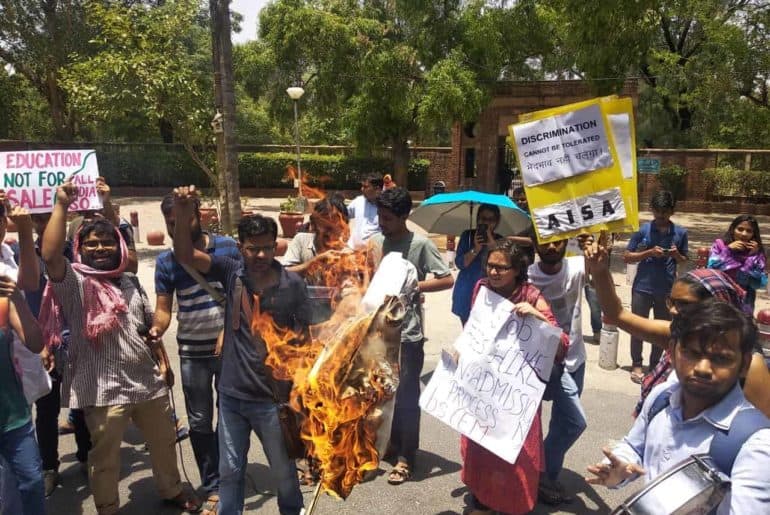
On the morning of 14 June, student organisations gathered at the Gate No. 4 of the Arts Faculty building to protest against “fee hike and faulty admission process in Delhi University.”

Over ten student organisations – among them, All India Students’ Association (AISA), Bhagat Singh Chhatra Ekta Manch (BSCEM), Collective, Krantikari Yuva Sangathan (KYS), Parivartankami Chhatra Sangathan (Pachhas), Pinjra Tod, Students’ Federation of India (SFI) – organised a protest rally and burnt the effigy of the University Vice-Chancellor to raise their demands.

The rally began from the Arts Faculty building and went around the North Campus of the University. The proceedings ended with a public meeting and the effigy burning. This came as a follow-up to an earlier protest by these organisations, raising the same issues, on 11 June.

The protesting students demanded the following:

1. Decreasing the registration fee for Other Backward Classes (OBC) to Rs. 300 and apologizing for the “inconvenience caused.”
2. Decreasing the fee for unreserved category students from Rs. 750 to Rs. 500.
3. Refunding the “extra fee” collected from students.
4. “Immediately resolving” the technical problems in the online registration form.
5. Giving two days to applicants to make corrections in their form after filling it up.
6. Setting the entrance exam question paper in Hindi as well.
7. Providing “proper facilities” should be at the exam centres.
8. Revoking the fee hike in Ramjas College & Bharati College.
9. An “unconditional apology” from the Dean of Students’ Welfare (DSW) for giving “false information” regarding the eligibility criteria for OBC and Economically Weaker Sections (EWS) reservation.

The University had set the registration fee for undergraduate admissions at Rs. 250 and Rs. 100 for OBC and EWS students respectively. The ‘additional registration fee for each entrance-based course’ for the former was Rs. 750 and Rs. 300 for the latter. The same distinction of Rs. 750 and Rs. 300 also applies to the application fee for the postgraduate, MPhil and PhD courses. Even though one of the demands of the protesters was refunding the “extra fee collected from students”, the admission guidelines of the University mention that the registration and entrance exam fees are non-refundable.

The first eight demands had been raised in the previous protests as well. A memorandum had been submitted to the Dean by the protesting organisations, which detailed their position. The protesting students had argued that since the income cut-off limit for both the ‘non-creamy layer’ OBC category and the EWS category was similar; and that the former had been given reservation on three bases – social, economic and educational backwardness – while the EWS was given reservation only owing to their economic backwardness, the fees charged from OBC students should not be higher than that of the EWS ones.

According to some protesters who had met the Dean on 11 June, they were allegedly given wrong information by him about the reservation criteria of the OBC and the EWS categories. Upon discovering the alleged falsehood of the information, the protesters had begun a dharna outside the Dean’s office. Hence, the protesting parties this time demanded an “unconditional apology” from the Dean for the alleged false information as well.

According to Amarjeet Kumar Singh, the DU Law Faculty In-charge of AISA, “The Dean refused to meet today and we were informed that he will response (respond) only on Monday.”

A statement issued by SFI alleged, “Before the rally could even start, the police started manhandling SFI activists and detained several protestors. Seeing pressure mounting from the student community, the police was forced to immediately release the detainees.”

Sumit Kataria, Vice President of SFI Delhi, told DU Beat that he and Ravi Shankar, also an SFI member, were “manhandled” by the police, but didn’t suffer any bruises.

Pachhas also issued a statement which read, “Protest ke dauran police ne apna tanashahi roop dikhate hue Pachhas ke sathi Deepak aur BSCEM ke sathi Ujwal ko maarpeet karte hue giraftar kar liya. Baad mein chhatron ke dabav ke baad unhein chhod diya gaya” – during the protest the police showed their dictatorial nature and arrested Deepak of Pachhas and Ujwal of BSCEM. Later, the police released them due to the pressure of students.

Speaking to DU Beat, Deepak Gupta said that he and Ujjwal were arrested by the police and taken to the Maurice Nagar Police Station. There they were allegedly detained for around half an hour. As the rally approached the police station, the police were brought under pressure to release both of them. He also alleged that he had suffered bruises from the encounter with the police.

We also spoke to Ujwal of BSCEM, the other person who was detained by the police. “SI (sub-inspector) Rohit of Maurice Nagar police station started tussle with a comrade named Deepak who is from PACHAAS (Pachhas). SI was trying to bully him by saying that you don’t have the permission to meet the DSW. I intervened in the conversation and said that we are students of the university and we don’t need police permission to meet the administration officials. I also asked him to show me the notice/permission by the university administration that lead (led) to the entry of police in campus. At this he got ignited and pushed me in the van. He asked another policeman to arrest us. I and Deepak were pushed into the van, we were beaten up by the policeman. Deepak’s slipper also got torn. In a van we were carried to Maurice Nagar police station, the police illegally detained us and ensured that we (do) not join the march. (Afterwards) when the protesting students started approaching the gates of (the) police station they released us,” he said.

The protests are expected to continue in some or the other form if the protesters don’t receive a satisfactory response from the Dean by Monday.

Image credits- Sumit Kataria from SFI

Prateek Pankaj
[email protected]