Tag

du law faculty

Browsing

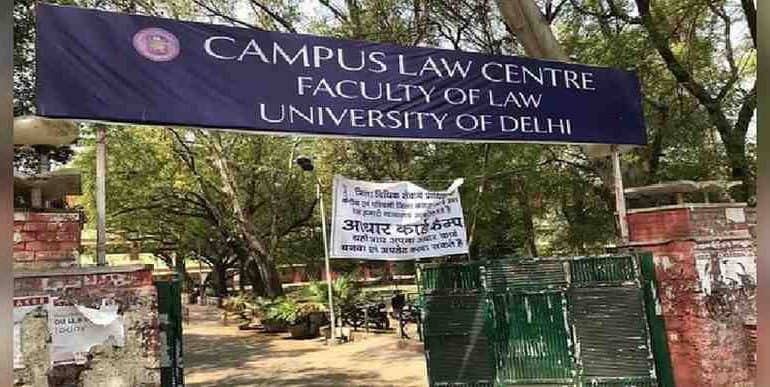
Law Centre II invites submissions for the `National Capital Law Journal 2025’,  its yearly publication, releasing details, guidelines and steps for publication. 

Law Centre II, the widely acclaimed Law School of Delhi University, is back with its annual National Capital Law Journal. The college, being a part of the esteemed Faculty of Law of DU, offers a full-time LLB curriculum. 

The publication of NCLJ began in the year 1996 in an attempt to spark debates on legal issues in our country and to encourage research. It is an endeavour to bring together a diverse group of audience with their shared interest in politics. The journals also carry comments on legal issues, articles, and case comments from renowned researchers and academicians.

The call for papers for NCLJ has officially begun, and interested applicants are requested to adhere to the rules and deadlines for submission. There is no restriction made to any particular field of law, and the papers can be written on any theme of contemporary areas in law and legal education. As the paper is blind peer-reviewed, individual confidentiality is maintained. 

The deadline for submissions is 10th August 2025.

A few instructions from the organisers:-

  • The first page of the manuscript should only contain the title of the paper. The body should begin from the corresponding page.
  • All submissions must be made in .doc or .docx format. No PDF formats will be accepted.
  • Plagiarism of any kind will lead to immediate disqualification.
  • Only the submissions from academicians and professionals will be accepted.
  • The submissions, along with the footnote, should be in Times New Roman and with appropriate spacing.
  • The headings must have uniform formatting.
  • Only in the case of Long and Short Articles, co-authorship of up to 2 authors is allowed.
  • Co-authorship is not allowed for Notes and Comments.
  • Copyright over the published papers should rest only with Law Centre-II.


A Covering Letter is required along with the mailed submission. The Letter should contain the following information:

  • Name and Designation of the author(s).
  • Institutional Affiliation
  • Contact Number
  • Title of Paper
  • Type of Submission
  • A declaration that the work is original and has not been or should not be published to any other journal while under review with Law Centre-II.


Categories for the manuscripts are:-

  • Long Articles- 8,000- 10,000 words, including footnotes.
  • Short Articles- 4,000-6,000 words, including footnotes.
  • Short Note and Case Comment- 2,000- 3,000 words, including footnotes.


The name of the author or institutional affiliation must not be mentioned anywhere in the manuscript to ensure transparency and fairness in the review process.

All submissions must be made to [email protected] along with the subject `Submission of Research Paper’ in accordance with the deadline.


Read Also: DUTA Elections 2025-27: Timeline Revealed for Key Leadership Positions

Featured Image Source- The New Indian Express

Ananya Agarwal
[email protected]

Despite its high brand value, DU’s limited financial aid creates a privilege bias, preventing many talented students from middle and lower-class backgrounds from participating in international competitions. The Dean Students’ Welfare has existed since years, but how much of ‘actual welfare’ has it offered to the students in need? 

Founded in 1922, the University of Delhi has evolved through various eras since its inception. The education system has modernized, with the university keeping up with updates like the implementation of the NEP. However, outdated traditions and a lack of liberal mindset still prevents a lot of students from pursuing and succeeding in competitions they only can dream of. While the authorities celebrate university’s major jump to 328th position in the QS World Universities rankings, a lot of cards are still left to be explored. Research plays an integral part when it comes to university rankings. But are the students on campus receiving the benefits and research opportunities they really wish to pursue? 

My own experience illustrates the broader issue of inadequate financial aid at DU. In July 2024, I received an acceptance letter to HPAIR’ 24 Asia Conference (Harvard Project on Asian and International Relations). Lacking a dedicated funding cell in my college (ILC, Faculty of Law), I sought assistance from the Dean Students’ Welfare (DSW). Unfortunately, the officials informed me that no financial aid was available,

We don’t have any such provisions for funding students.

The situation becomes even more significant to address when almost Rs. 16,980 are being extracted as the “University Welfare Fund” and Rs. 10,000 are extracted as “Faculty/ Department/ Student Welfare Fund” (According to the prospectus of BA/BBA LLB 2023-24). As a law student in the five-year integrated program, it was shocking to find when the application for financial aid was rejected, with the department citing a lack of provision for funding university students. Ironically, despite extracting substantial amounts from student fees, the department has not yet established a scheme to provide financial assistance to students. Another student from Faculty of Law adds,

As per my knowledge, there is no source of funding here in Faculty of Law. There is a common budget that DU divides amongst its colleges which is further distributed among the college societies and administration. We hardly get anything.

Similar observations can be noticed in the case of Faculty of Technology where students pursuing B.Tech  are paying the same amount for welfare fund.

It is well-known that student societies and cells at DU often struggle with insufficient funding. As a result, these societies often have to rely on their own initiatives, such as hosting inter-college competitions and conferences to raise funds for annual events. On speaking to a few students and alumni of Delhi University, results reveal how the majority doesn’t even know what DSW is. 

Is this something that exists in every college? To be honest, I didn’t even know that something like that exists. As far as competitions and events are concerned, we don’t receive any financial aid from JMC.

-Anonymous (Jesus and Mary College)

While colleges like Hindu have established scholarships for academic achievers, support for competitions and events remains limited.

No, the college doesn’t have a separate society that looks over financial aid for students and we did not reach out to DSW for any help regarding the same.

-Jogaram, a student from Hindu College

While some colleges do offer financial aid, the question remains: Is this support genuinely effective, or is it merely a facade of administrative formality?

Venky has a financial cell, though I don’t know its name. We didn’t need to approach the dean; a Google form was circulated for the application. The freeship is granted based solely on financial conditions such as family income and the death of a father, so there is no competitive process. A friend of mine received the aid, but only half of the fee was waived—despite having no father. The assistance ranged from 30-45% based only on family income. 

-Azmat, a student from Sri Venkateswara College

Research is a crucial factor in university rankings. Delhi University, with its diverse student body, faces a pressing need to enhance financial support tailored to the specific requirements of each academic discipline.  Law students encounter substantial costs for participating in international moot court and negotiation competitions, while commerce students require significant funding for start-ups, incubation programs, and other competitions. Each academic discipline has specific financial requirements. In enabling students to achieve global recognition and enhance the university’s prestige, Delhi University still struggles to provide adequate financial aid and support mechanisms to students.

Read also: DU’s Trend of Collapsing Ceilings Follows St. Stephen’s

Featured Image Credits:  Abhishek Kumar (Google)

Samvardhan Tiwari

[email protected]


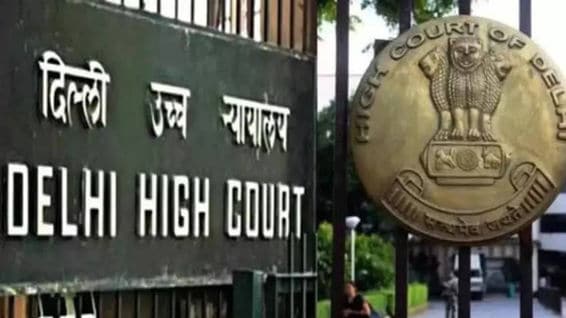
The Delhi High Court has taken significant steps to address concerns raised by law students regarding the inadequate availability of basic amenities and infrastructure at Delhi University’s Faculty of Law. The court has instructed DU to convene a meeting with all relevant stakeholders within a week to evaluate and improve the situation.

In a recent order, Justice Amit Sharma directed the university to hold a meeting involving key stakeholders, including the Dean of Students’ Welfare, the Dean of the Faculty of Law, the petitioners, and the amicus curiae, advocate Rajesh Mishra, who was appointed by the court. The focus of this meeting will be to assess the facilities, particularly the provision of water coolers, purified drinking water, and Wi-Fi services.

The petition was filed by three law students, Ronak Khatri, Umesh Kumar, and Ankur Singh Mavi, who cited severe deficiencies in the basic amenities on their campus. One of their primary concerns was the lack of air conditioning in classrooms, which makes the learning environment unbearable during Delhi’s extreme summer temperatures, which can reach up to 48 degrees Celsius. The students noted a stark contrast between the air-conditioned administrative offices and staff rooms and their own poorly ventilated classrooms.

Additionally, the petition highlighted that one of the campus buildings, constructed with tin roofs and asbestos-lined walls, exacerbates the heat issue, creating an uninhabitable learning environment. They reported instances of heat strokes and fainting, illustrating the dire need for improved infrastructure.

Moreover, the student petitioners argued that the inadequate infrastructure and lack of essential amenities constitute a violation of their fundamental rights under Article 21 of the Indian Constitution, which guarantees the right to life and, by extension, the right to education. They stressed that the current conditions pose significant safety risks and are not conducive to learning.

Justice Sharma’s bench issued notices to the Secretary of the Bar Council of India (BCI) and DU’s Dean of Students’ Welfare, seeking their responses to the petition. The court emphasized the necessity of a detailed assessment and required a report on the current status of facilities to be submitted before the next hearing on July 4, 2024.

The court also pointed out the importance of this meeting being well-coordinated by the respondents’ counsel to ensure a comprehensive evaluation and prompt improvement of the facilities.

While the respondents’ counsel informed the court that provisions for water coolers and drinking water are in place, the court’s directive underscores the need for a thorough review to confirm that these amenities meet the required standards and adequately serve the student population.

The forthcoming report from the stakeholders’ meeting will be critical in determining the actions DU will take to address these significant concerns and uphold the students’ rights.

Read Also: Dalit Student Faces Online Harassment and Threats Over WhatsApp Status

Featured Image Credits: The Times of India

Kavya Vashisht

[email protected]