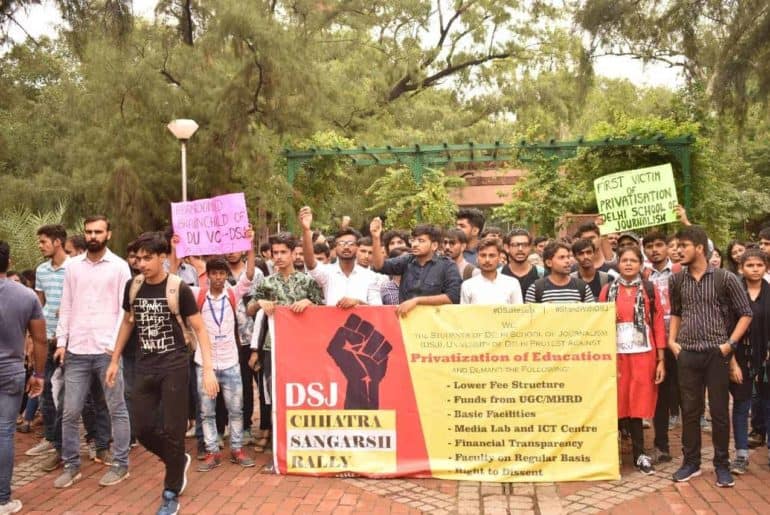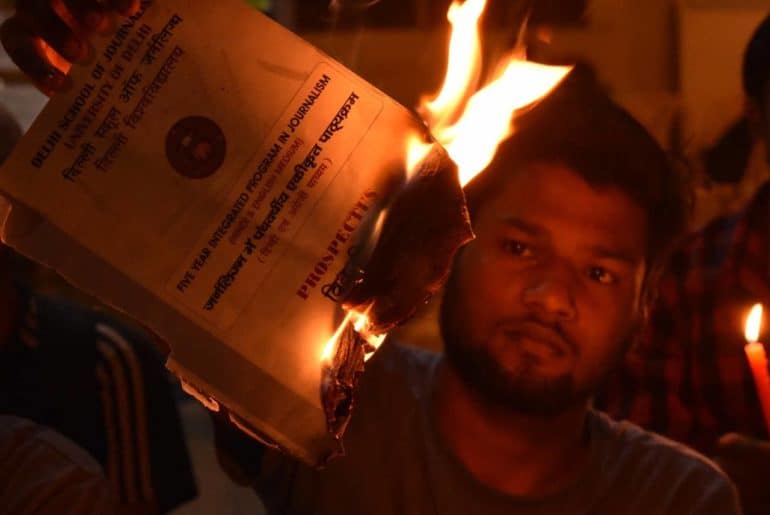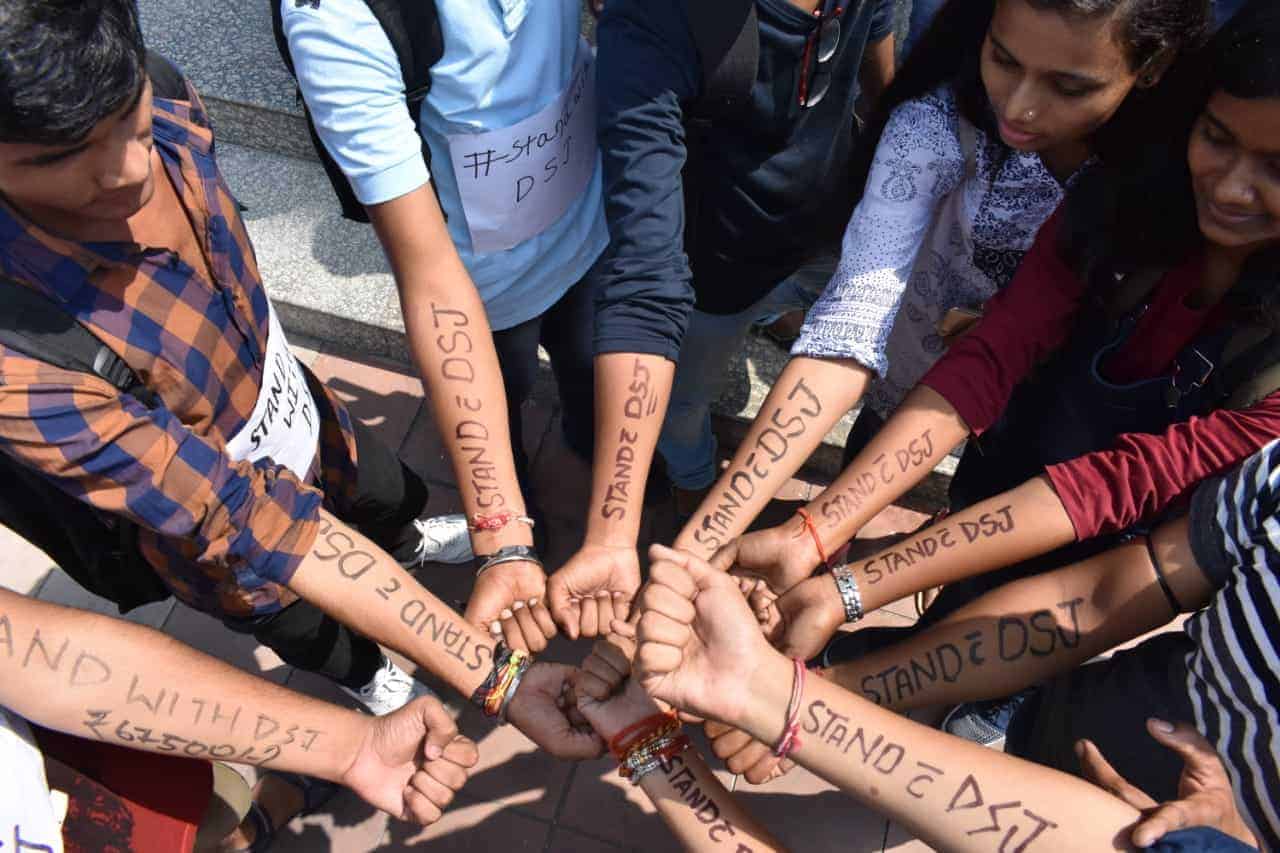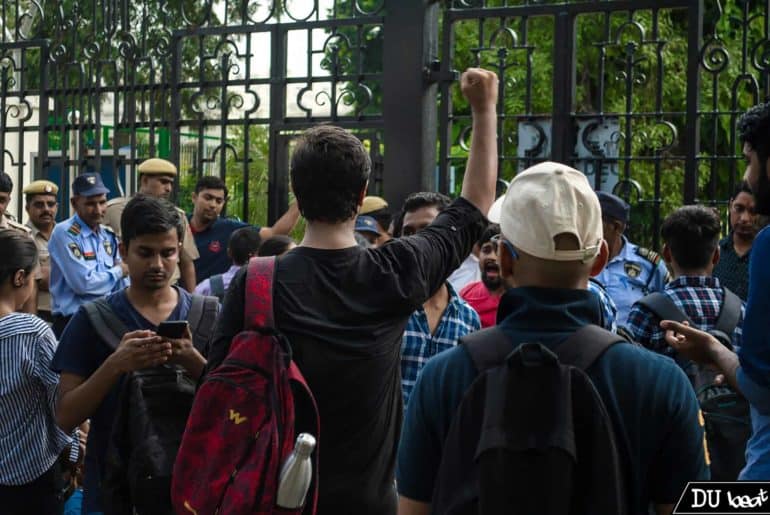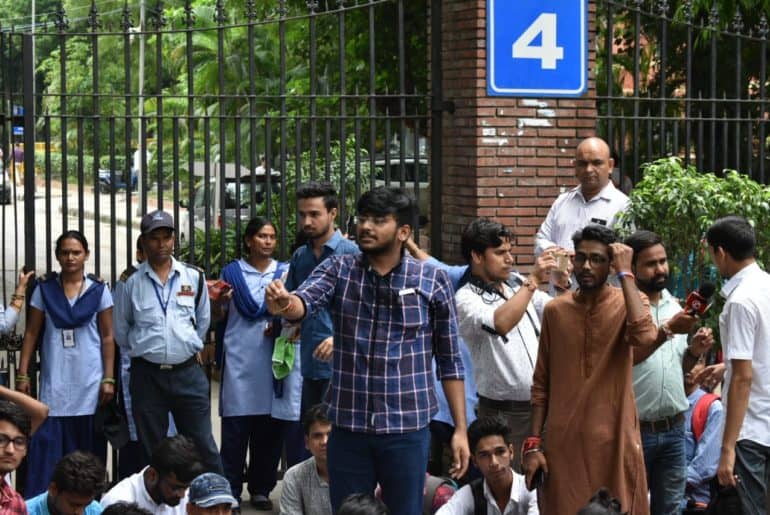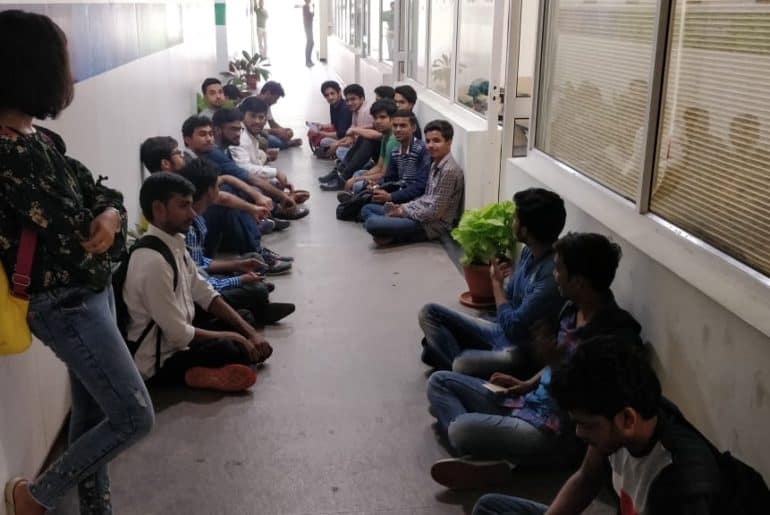
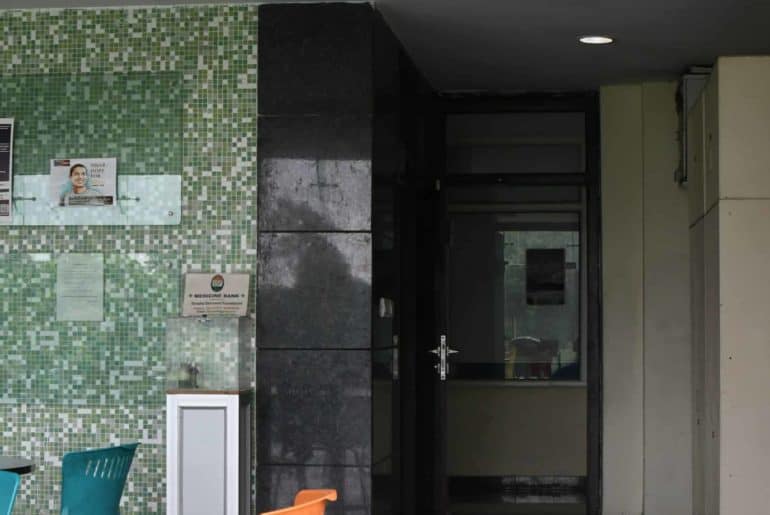
As Delhi School of Journalism (DSJ) completes a year of existence in the University of Delhi, the students protest against privatisation of education and demand appropriate infrastructure facilities and quality education.
The rally was flagged off from the Faculty of Arts at 1:00 p.m. The rally was organised as a protest against privatisation of higher education. The students demanded a lower fee structure, funds from the University Grants Commission, basic facilities, media lab and ICT Centre, financial transparency, faculty on regular basis, and the right to dissent.
The rally covered seven colleges of North Campus namely- Shri Ram College of Commerce, Daulat Ram College, Kirori Mal College, Hindu College, St. Stephens College, and Ramjas College. Along with this the rally also covered Campus Law Centre and Faculty of Law. The protesting students appealed to the students of above mentioned colleges to join them in their struggle. The rally culminated at Delhi School of Journalism itself.
Support for the movement came from various organisations and political parties. The members of National Students Union of India (NSUI) were amongst the first ones to show solidarity to the movement. Aakash Chaudhary of NSUI, also the Secretary of Delhi University Students’ Union (DUSU), extended his solidarity to the students. He said, “I have visited DSJ before the protests. The condition there is very bad. The students are denied basic facilities like a proper canteen and library.” He assured that NSUI will support them in every way possible.
Kawalpreet Kaur, President of Delhi University’s wing of All India Students Association (AISA), along with other AISA members also joined the movement. A number of students from organisations like Krantikari Yuva Sangathan, Pachaas, and Democratic Students’ Union also joined hands with the agitating students. Students from Bharti College and Jawaharlal Nehru University were also seen in huge numbers. The rally concluded in DSJ campus. Shakti Singh, Vice President of DUSU from Akhil Bhartiya Vidhyarathi Parishad was also present in the campus.
After 4 days of hunger strike, protesting day and night, being denied entry in their own campus, and heated discussions with the administration, the students of Delhi School of Journalism called off the protest on 21st September 2018.
On 17th September 2018, violence broke out in the campus of Delhi School of Journalism after the talks with the officials of the University regarding the poor infrastructure facilities reached no conclusion.
The protest took a different turn when a second-year student, Ambuj Bhardwaj was arrested by the Delhi Police. He was dragged by his neck openly in the college premises and was brutally thrashed by them. On speaking to DU Beat, Ambuj said, “We were protesting peacefully near the gate of our college. When we tried to protest near the gate of the Vice Chancellor’s office, the security guards manhandled us, one of my friends was also slapped by the guards. The moment I tried to defend him, the police caught hold of me and thrashed me. I was taken into custody for six hours.” The police was called by the administration to curb the protest. However, the students complained of being manhandled by the police.
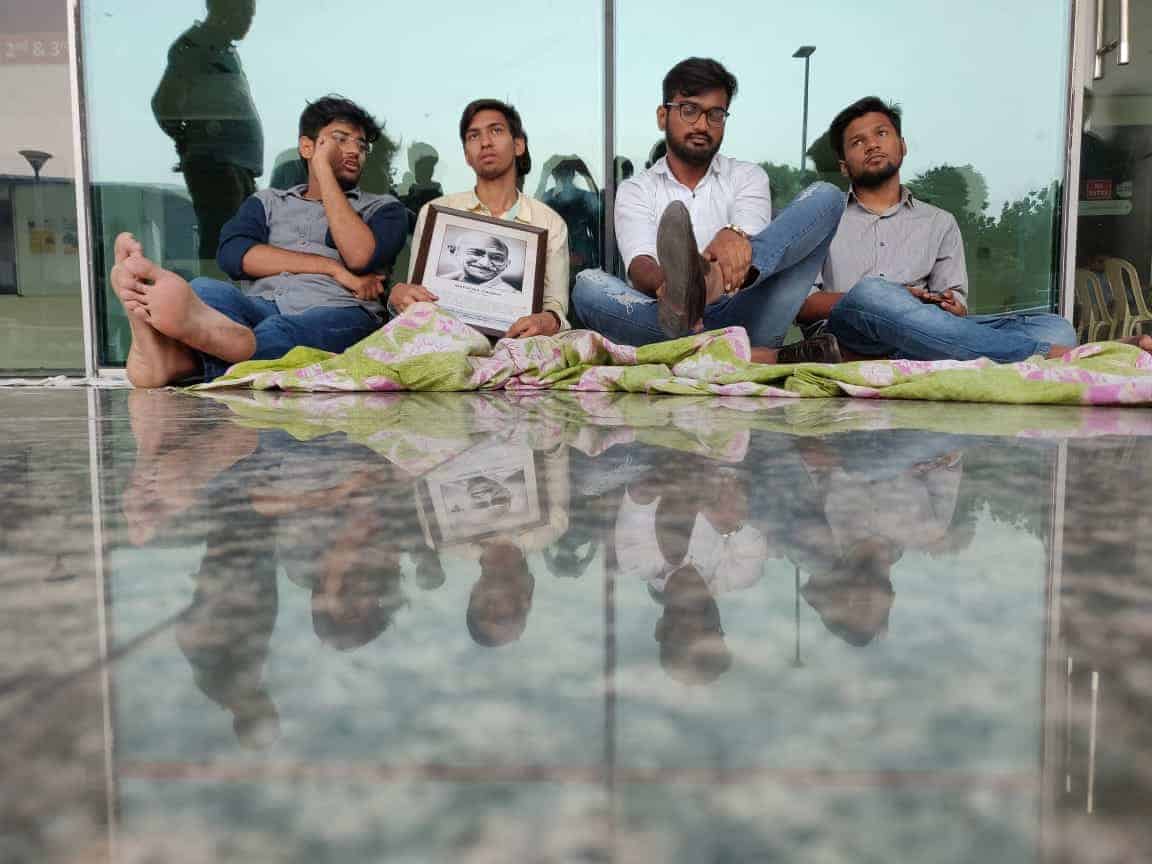
When the discussion with the administration of the college and officials of the University didn’t prove feasible, six second-students, namely Ambuj Bhardwaj, Mohammad Ali, Prashant Yadav, Roshan Kumar, Vipul Sharma and, Suman Shekhar went on an indefinite hunger strike. They were supported by both the students of the first and second year. The administration responded by issuing a warning to take disciplinary action against the students who were protesting in the campus. This was ineffective as the students continued their agitation. Continuous health checkups of the students on hunger strike were done by the WUS Health Centre. Vipul Sharma, one of the six students on hunger strike said, “We tried many different methods of protest in the last few months, but the administration did not bother. We could not reach a proper solution to the problem. At the same time, the students were facing huge academic loss. Therefore, we had to take such a radical step. The hunger strike was a pure Gandhian step.”
The hunger strike by DSJ students
The students of first and second year also went to different colleges and departments and appealed to them to support and extend their solidarity with them in the cause. Support for the protesting DSJ students came from various students, organisations, political parties, leaders, and teacher associations. On 20th September 2018, Delhi University Teachers’ Association members including the President, Rajib Ray and Treasurer, Najma Rehmani visited the students and appealed to them to end their hunger strike. They spoke about the initial problems associated with implementation of the course and how DUTA was against privatisation of higher educational institution as it would lead to a violation of our democratic and socialist values encompassed in the Indian constitution. While addressing the dissenting students, Rajib Ray talked about the streak of fire the students have evoked in the education industry, which has transcended from the walls of Lutyens Delhi to the entire nation. He underscored how he and his friends used to perform hunger strikes back in their days and how we remind them of the zeal and energy the youth should possess. They extended support and also promised to be present in the rally being organised by the DSJ students on 25th September 2018 against the privatisation of education and high fees. Rajya Sabha MP, Manoj Jha also met the students and understood their grievances. Members of DUTA in their individual capacities extended their solidarity to the students. Abhishek Dutta, Congress leader, Professor Abha Dev Habib, Professor Ratan Lal, Professor Suraj Yadav, students from the Law Faculty, Sunny Chillar and Akshay Lakara and other members from NSUI, newly elected DUSU Vice President Shakti Singh, Kawalpreet Kaur and members of AISA , CYSS, ABVP, SFI, Disha Student Organisation also stood with the agitating students. The members of Academic Council and Executive Council of the University also appealed to the students to end their hunger strike. They also assured that the issue will be raised in their next meeting with full force and no one will be spared. One of the members of the Academic Council promised to make DSJ the best institute for studying journalism.
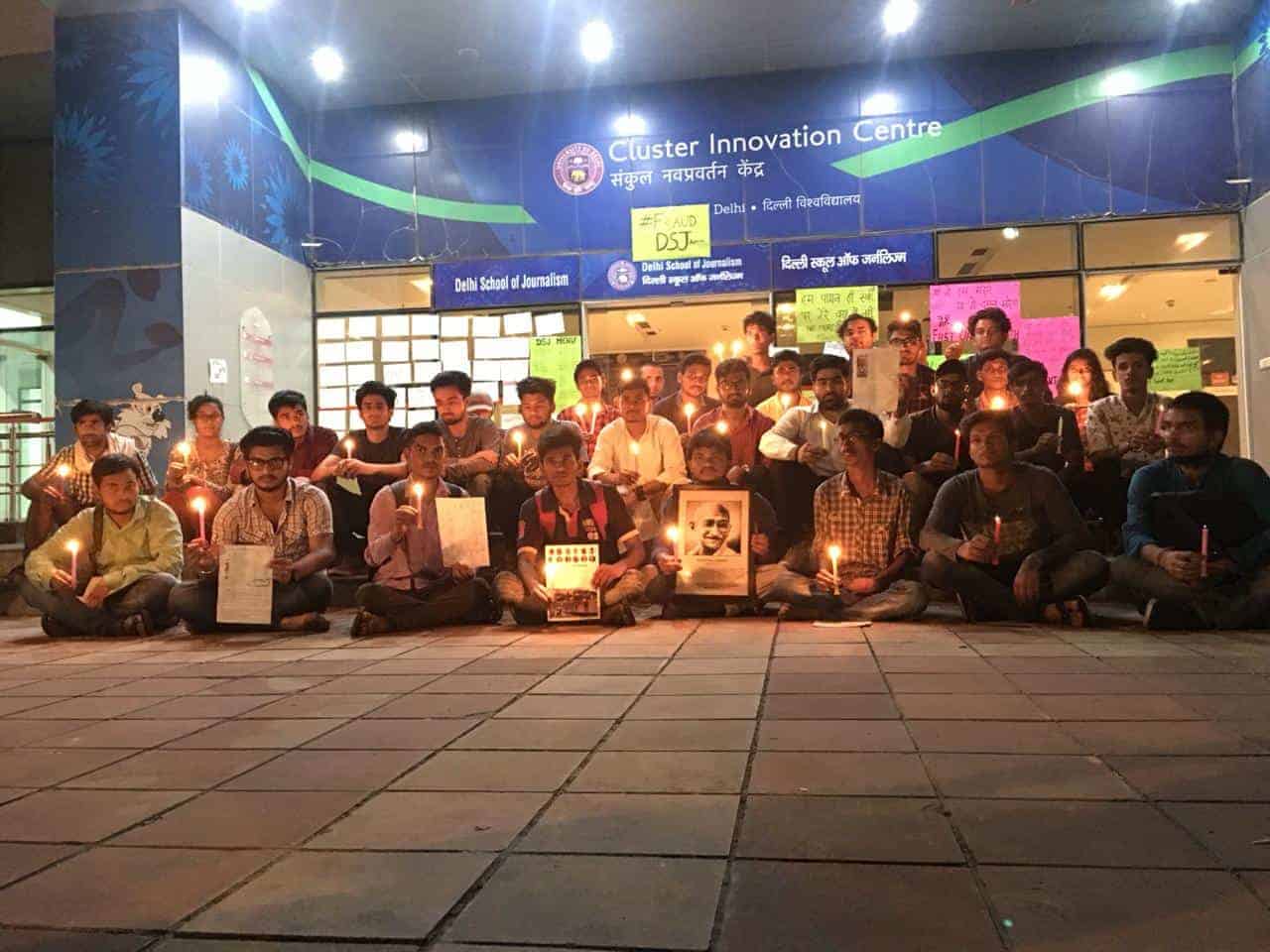
Support by members of DUTA and NSUI to the protesting students
On 21st September 2018, conditions worsened as Roshan Kumar, one of the students on hunger strike was advised urgent medical help. Ms. Neeta Sehgal, Proctor of the University of Delhi visited the students to resolve the matter. After a series of discussions, the administration and the students settled the matter. Deadlines along with proper details were provided to the students failing which the students demanded the resignation of the administrative authorities- Dr. Manasvini Yogi, Officer on Special Duty and Professor J.P. Dubey, Honorary Director of Delhi School of Journalism. The students called off the hunger strike at 8:00 p.m. in the campus in the presence of the college authorities and fellow students.
On speaking to DU Beat, Mohd Alishan Jaffri, a second-year student of DSJ said, “This is a moment to cheer, not for complete celebration. In all these eight months of protests, the students have fought remarkably with grace. DSJ is an isolated place in North Campus, where half of the colleges in North Campus don’t know about our existence. It’s an island of misery in a fortune called North Campus. We need the world to follow this example and ensure that academic discourses are conducted properly in every public institution. We hope that Delhi School of Journalism becomes the next Columbia School of Journalism. Through DU Beat, I would also like to invite all students, teachers, organisations to be a part of the rally being organized on 25th September.”
Students stood united
The students are organising a DSJ Chhatra Sangharsh Rally on Tuesday, 25th September 2018 at 1:00 p.m. in Arts Faculty. Many organisations and students are expected to be present in the mass rally against privatisation of education.
A couple of days back, the administration of the University of Delhi (DU) speculated the establishment of nine institutions which would impart specialised courses. However, the student community claims that before opening new institutions, the government must look at the infrastructural issues that the recently opened institute, the Delhi School of Journalism (DSJ), has been facing ever since its inception last year.
Located in the University Stadium Campus, the college has been at the locus of violent student agitations. The major cause of resentment amongst the student fraternity is the alleged lack of infrastructure that the administration had promised them. The institute, belonging to the self-financing genre, charges exorbitant sums of money as tuition fee from the students with amounts reaching well beyond INR 65,000. The pupils allege that even after paying such stupendous sums of money, they’re not being provided the infrastructure that had been promised to them. Following this, an agitation had broken out in the last week of August 2018, wherein the students had reportedly remained on a strike against the administration for two days, and it was alleged that the students had been locked inside the campus during the night hours.
The management at the Delhi School of Journalism had also suspended 8 students in this connection, which was then revoked in response to the withdrawal of the students from the protests. This reportedly came subsequent to the intervention of the OSD and the VC. Only after the student community was assured that a concrete solution shall be found to the problem, the protests were called off.
The administration, however, seems to have had put the case aside once the agitations were over. The DSJ student body alleges that the Vice Chancellor neither met with the student body nor addressed their issues. Fresh protests in order to have the demands met, however, broke out in DSJ on 18th September 2018. The furious student fraternity stood as a united front against the administration. It is said that a meeting held with the Proctor on 14th September 2018 turned out to be a conduit of dispute and agitation. Allegedly, the Proctor shook her hands off the earlier promise, stating that she can’t promise the redressing of even a single of the demands on the student manifesto, be it the construction of a library, construction of a hostel, or even the Media Lab which is considered ‘food’ for students pursuing journalism.
The students claim that they find the college area too cluttered. They add that in the absence of a library, it becomes tough for them to access adequate resource material pertaining to their discipline, and the absence of a reading room in the already cluttered campus makes it difficult for the students to engage in any productive self-study at the college.
The situation, however, took a different route altogether, when, during the newly erupted volcano of protests, a second-year student and agitator, Ambuj Bharedwaj, was arrested by the Delhi Police, which had been called in by the DSJ administration to curb the protests. It is claimed that the student was dragged by his neck openly in the college by the policemen and was brutally thrashed by the police while in custody. The students feel that the management is adopting the use of force and physical penuries to curb their right to something they have already paid for in full. Thus, according to the student fraternity, their upsurge wasn’t trampled upon by the false promises made on the management’s end. In fact, it gained a new impetus because of the use of police force. Hence, the students have decided to remain in DSJ’s campus through the night on protests, with eyes looking desperately for a solution to their problem.
DU Beat tried reaching out to the administration at the Delhi School of Journalism, but that didn’t prove feasible. Hence, their take on the matter shall be updated here as and when it is procured.
After more than 48 hours of continuous protest and withdrawal of the suspension of 8 students by the administration, students have been assured that their grievances will be addressed on 14th September 2018.
On Monday, 27th August 2018, the students of Delhi School of Journalism staged a protest outside the Arts Faculty demanding a meeting with the Vice Chancellor of the University of Delhi. The protest began when Professor JP Dubey on Friday, 24th August 2018 told the students that the administration cannot give a deadline to any of the demands of the students and they should do whatever they want to in their capacity. The students have time and again protested about the poor infrastructure facilities, unavailability of the media lab and the high fees and wanted to meet the VC regarding the same.
Image Credits – DSJ students
The protest was then shifted in the DSJ campus where the students protested against the administration and their behaviour towards the charter of demands issued by the students on 2nd August 2018.Mohd Alishan Jaffri, a second year student of DSJ says, “We launched a complete non co-operation movement against the DSJ administration and organized a sit-in in the college premises. The whole act was peaceful and Gandhian in nature. The administration tried to move us, but since no written assurance was provided, we continued the protest.”
On the same day, a meeting was organized by the administration to look into the matter again, but the meeting ended in a deadlock. The students continued their sit in demonstration in the evening and few stayed inside the college campus overnight.
DSJ students
The agitation continued on 28th August 2018. The administration agreed to send a delegation of 6 students to meet the VC and present their grievances to him. However, in the evening, this proposal was rejected. The students were also locked inside the college campus. The situation worsened when the students were manhandled by the security guards of the college. Ambuj Bhardwaj, a second year student was hit by one of the guards. Delhi Police was called in to intimidate the protestors both in afternoon and in the evening.
DSJ students
A suspension letter was issued to 8 students of DSJ around 8 p.m. on 28th August 2018 for repeatedly violating the discipline of the Delhi University while disrupting the classes since August 27 and not letting administration to carry on their official work by blocking the entrance to the Director’s room. However, the revocation to the suspension came in half an hour after protest was called off by the students. The same was conveyed to the students through an e-mail late at night.
Neeta Sehgal, Proctor, University of Delhi came and discussed the matter with the students. She also gave a written assurance to the students to look into the matter and solve the grievances of the students. She has promised to meet the students on 14th September 2018.
DSJ students
Manasvini Yogi, OSD, Delhi School of Journalism informed the students on 29th August 2018 that a media lab has been arranged for the students in the School of Open Learning. The practicals will be held in the lab from 15th September 2018 onwards.
Students staged a peaceful demonstration against the lack of basic amenities, non-availability of a media lab, and failure of the administration to allocate all General Elective options.
The students of Delhi School of Journalism (DSJ) on Monday staged a sit-in in their college against the administration. They alleged that the promised media lab was never established and they were not given options in the GE paper. The students refused to attend the classes because of the heated ‘greenhouse’ like classes which lack ventilation. The air conditioning has been repeatedly breaking down since the last six months. The administration has responded by suspending the classes till the air conditioners are repaired.
The students of DSJ have been protesting for quite a long time now. There have been a number of protests in the recent months. A student recently wrote a letter to the Vice Chancellor about the problems they have been facing. However, many of them have alleged that the administration is not being serious about their demands. Some students have also alleged that they are being targeted for speaking against the administration.
“I have been writing against the VC for not being able to solve our problems. I posted a few memes on Facebook. I was later called to the office by Manaswini M. Yogi, the Officer on Special Duty (OSD), and was reprimanded for writing against the VC. The OSD said that I should leave the college if I don’t like it here. I topped the first semester and I was told by the OSD that I won’t top in the second semester. I feel threatened,” said a student of the Hindi medium at DSJ, on the condition of anonymity.
Alishan Jafri, another student from the English medium said, “DSJ started as a so-called dream project of the VC. However, it is turning out to be a nightmare for the one hundred twenty of us. The classes have been suspended in order to fool the students who are coming to the campus for admission these days. They don’t want them to know the terrible state of affairs in here.”
The honorary director of DSJ, Prof. J.P Dubey, had earlier held a meeting with the students to listen to their grievances. However, he refused to give a deadline for the establishment of a media lab. In the past, the students were told that the lab would be ready by the third semester but that never happened.
DU Beat spoke to the OSD of the college about the issues faced by the students. She said that the water cooler was not working properly from a past few days and it has been repaired. The AC stopped working twenty days ago and engineering department repaired it but it again malfunctioned. She explained, “There are some technical glitches and the engineering department has assured us that they will be fixed in a couple of days. We are in a constant touch with them.”
The state of infrastructure at the year-old Delhi School of Journalism (DSJ) has been a cause of concern for the students studying there.
In response, Mohammad Ali, State Media Coordinator of the National Students’ Union of India (NSUI) and a student of DSJ has come out with a press release describing the worsening condition of the facilities in the institute. The press release describes the low library capacity of 10-15 students, the lack of access to sports grounds by the sports quota students, as well as the administration’s bid to take away the laptops given to students. The press release mentions that these, among others, seem to be grounds enough for not starting an M.Phil and Ph.D. the programme at the institute.
The Delhi School of Journalism (DSJ) which was started last year, came up with a recent announcement to start MPhil and Ph.D. level courses by 2020. Currently, the college offers a five-year integrated journalism course that is entrance-based. It also offers an exit option for students who wish to pursue professional work after three years whereupon they would be given a Bachelor’s Degree. According to a recent report at The Asian Age, the college also plans to introduce short-term courses in photography, video editing, documentary filmmaking, sports, and science journalism by October this year. But, the press release by the NSUI is bound to put a question to such grand-laid plans.
When DU Beat asked Mohammad Ali if the students have ever conveyed their grievances to the administration he said, “We have had a lot of talks with the administration. We even submitted our complaints to the Director in writing, but it has been three to four months and we have seen no change. All we hear are false promises of the fulfillment of our demands.”
According to an anonymous source at the DSJ, the students who were given laptops at the beginning of the first semester for their journalistic assignments were asked to return the laptops at the end of their second semester. “They refused to even issue admit cards to us if we didn’t return the laptops. Not every student can afford to own a laptop and even less so when there are no computer facilities at the institute. In such a scenario, I don’t know how they will manage to open M. Phil and Ph.D. courses,” the source said.
Prashant Yadav, another student of DSJ said, “The press release points correctly to our problems. In the name of self-financing, we have been asked to give fees for everything from desks to chairs. The media lab that is going to be essential for our future curriculum has still not been set up. We do not have any permanent faculty and even those who teach us are not qualified enough to do so. While the campus gets closed at 4:30 pm for us, the students at Cluster Innovation Centre can access it till 7 p.m. As far as the laptops are concerned, I think the DU might reissue the laptops for us in the third semester. However, it is true that we were given no prior intimation before they gave us our laptops.”
Manaswini Yogi, the Officer on Special Duty at DSJ remained unavailable for any comments. However, the last time DU Beat spoke to Prof. Yogi she assured the DU Beat correspondent that the Media Lab will be established by the time curriculum reaches the point where the use of Media Lab becomes necessary. Feature Image Credits: DU Beat Sara Sohail [email protected]