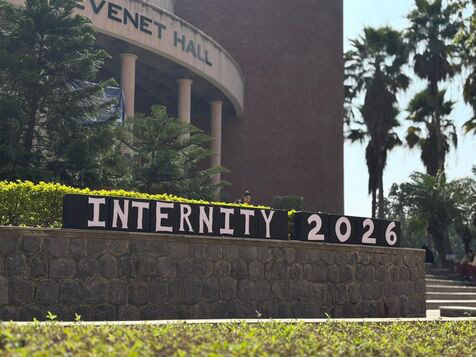
With the vision of enhancing their students’ career prospects and providing practical experience, the Placement Cell at Jesus and Mary College brought a variety of internship opportunities under one roof at Internity, JMC’s annual internships expo.
On Thursday, 26 February, the Placement Cell at Jesus and Mary College hosted Internity, the annual internships expo. It was organised under the second edition of Momentum, the flagship career summit of Jesus and Mary College. Intending to provide students with a platform to build expertise, practical skills and a professional network that enables them to excel in their careers, Momentum brings together industry leaders, recruiters and students to discuss career growth, evolving industry trends and skill-building, thereby “bridging the gap between academia and industry”. It also connects students with a strong alumni network of 900+ members, offering mentorship and career guidance.
Internity provides students with direct access to internship opportunities across multiple industries, enabling them to select roles that complement their academic backgrounds and career goals. This opportunity was open to all students from all disciplines and course combinations at JMC who had registered via a Google form. A few seats were also available for non-JMC female college students on a first-come, first-served basis. Thirty four companies took part, with the majority setting up stalls on campus while others joined virtually. It was worth noting that there was a highly diverse pool of recruiters, ranging from startups and established corporations to non-profit organisations. Ventures working in areas such as vegan snacking, neuroscience, mental health advocacy, education, finance, environmental sustainability and cybersecurity participated, looking for enthusiastic content writers, social media managers, web developers, community engagement and public relations interns, research interns, as well as finance and marketing interns, among others.
Internity witnessed massive participation, with many students dropping off their resumes at recruiters’ stalls. Recruiters also took the time to patiently explain the nature of the work and the roles and responsibilities and engage in meaningful discussions with students. All tables also featured QR codes, which, when scanned, directed the interested students to a Google Form-based application, thereby streamlining the process. Many organisations, especially non-profit ones, offered unpaid internships but promised a certificate of completion and a letter of recommendation, while others offered a stipend of up to even Rs. 10,000. Most of these internships were for one to three months and offered on-site, remote and hybrid working experiences.
Reflecting on their event, the president of the placement cell stated,
Right now, we’re still upscaling our event—it is only the second edition. Last year, we focused on the number of companies, but this time we are more quality-orientated. We aim to help students become future-ready for upcoming placements and the evolving job market. The good thing is that this in-person experience is better than having to apply from group chats and links… Last year, around sixty to seventy students got offers from various companies.”
This shift towards quality and inclusiveness was also mirrored in student feedback. Speaking about their experience, a psychology student shared that for the first time, they encountered numerous psychology and mental health-related internships. They added, “There was inclusiveness—at most internship fairs, the companies that come are mostly commerce-orientated…for finance roles or for recruiting data analysts. But this time I saw that there were many NPOs and mental health organisations. Many students also described the opportunities as “flexible” and recruiters as “friendly, approachable and good to talk to”.
Students appeared genuinely enthusiastic about the expo, stopping by tables that interested them and looking forward to securing internships, gaining work experience and building strong resumes. Beyond simply seeking internships, Internity also served as a platform to build professional connections and gain access to valuable networks. In such competitive times, hands-on experience in the field is indispensable. Rather than independently searching for internships, it is immensely beneficial when the college itself brings these opportunities directly to the students.
Nasheta Zaidi
[email protected]