
Tag

BAP

Browsing

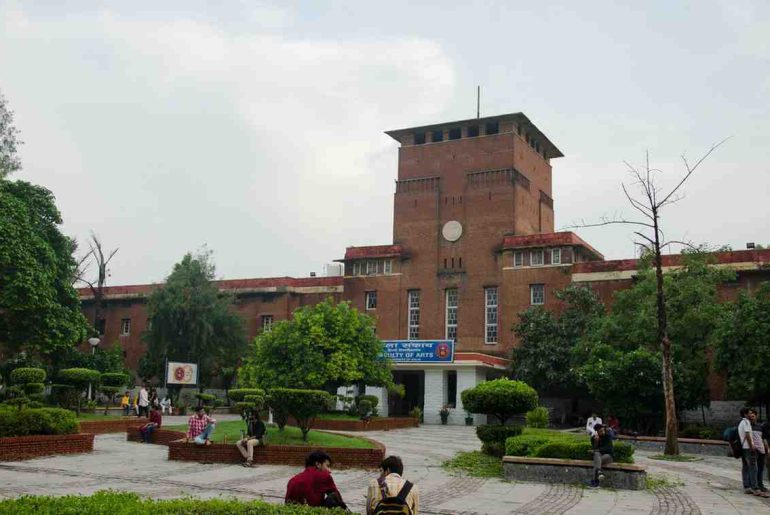
Delhi University Executive Council to vote on April 30 regarding BA Programme restructuring that could quietly push India’s minority languages off campus. 

Delhi University Executive Council (EC) is meeting on April 30 to decide the future of the BA Programme (BAP). The changes, if approved, will come into effect from the academic session 2026–27.

The proposal follows recommendations made by DU’s Academic Council on April 15, and was prepared by a committee that includes key university officials such as the Dean of Colleges, Registrar, Dean of Admissions, and principals of colleges like Shaheed Bhagat Singh College, Miranda House, and Daulat Ram College.

In respect of the restructuring, Delhi University colleges have been asked to look at BA Programme combinations where student demand is low or seats remain empty, and consider merging certain disciplines into broader combinations. For example, languages like Urdu, Arabic, Persian, Bengali, and Telugu may be offered as a single BA Programme combination with just one other subject. Similarly, subjects like Social Work or Sociology may be paired with more popular disciplines. 

Suggested changes in the document include replacement of courses like OMSP (Office Management and Secretarial Practice) by plain Commerce as a discipline. Subjects like Food Technology and Human Development and Family Empowerment (HDFE) may similarly be merged under a broader Community Science category. 

Importantly, the document suggests that no new programmes will be introduced and no existing programmes will be discontinued. Colleges will also not be allowed to change their total sanctioned intake capacity, though they may increase seats within an existing programme if they have enough faculty and infrastructure. 

These recommendations came out of a series of meetings held with multiple college principals at the Vice Regal Lodge earlier this year. The Executive Council took this decision to cure the problem of many empty seats in specific BA Programme combinations where there wasn’t even one applicant for every two seats.

A presentation made before college principals showed that while commerce courses had over 110% seat utilisation, language courses had the lowest fill rate, just 81.22%. This is where teachers and elected council members raised loud objections about combinations involving Indian languages like Bengali, Tamil, Telugu, Punjabi, and Urdu being unfairly targeted even though these courses already have very few seats to begin with.

Tamil professor Uma Devi pointed out that the real crisis is a shortage of teachers, not a shortage of students. Across DU, there are only two permanent Tamil teachers in colleges, three in the department, and only one teacher each for Kannada, Malayalam, and Marathi. “Whenever a teacher retires, the university simply does not recruit a new one,” she said.

Imtiaz Ahmad, a faculty member in DU’s Department of Urdu, described the situation bluntly:

Urdu was offered in many colleges earlier. It did not shut down overnight. It was closed one by one, over a long period. Today, it is available in only about nine colleges.”

The Executive Council meeting isn’t only about BAP. The council is also set to consider infrastructure proposals worth hundreds of crores, including ₹174.20 crore for a new building for the Institute of Nano Medical Sciences at Maurice Nagar, and a revised estimate of ₹233.35 crore for studio apartments at Dhaka Complex, partly funded through a HEFA loan. 

Separately, DU’s Academic Council has already approved one-year postgraduate programmes and a new Semester Away Program (SAP) that would let DU students spend a semester at foreign universities in line with the National Education Policy (NEP) 2020. If the Executive Council approves the BAP restructuring on April 30, the changes will be put in place from the 2026–27 academic session which means students applying this year through CUET-UG could be the first batch to experience the new structure.

On one side, the university says it is simply making the programme more efficient. On the other, teachers and students warn that what looks like an administrative fix could quietly erode decades of language teaching and cultural diversity from one of India’s oldest universities.

As EC member Mithuraaj Dhusiya’s dissent note put it: “When languages disappear, cultures disappear.”


Image Credits: Devansh for DU Beat

Read Also: What Happens When a Student Builds a Course That Didn’t Exist at DU?


Arshia Sharma 
[email protected] 

The Department of B.A. Programme at Lady Shri Ram College invited retired diplomat Dr. Deepak Vohra for a speaker session focused on India’s progress and future. Despite high expectations, the event sparked significant criticism due to Vohra’s divisive and bigoted jokes, causing widespread unrest on the college campus.

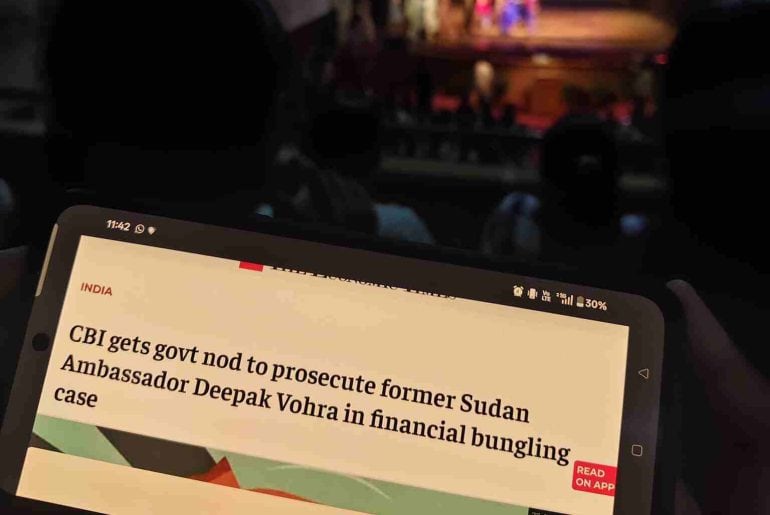
On Thursday, 11th September, the Department of B.A. Programme at Lady Shri Ram College hosted Ambassador Dr. Deepak Vohra, a retired Indian diplomat with postings in Armenia, Poland, and Sudan. Invited to deliver the inaugural major speaker session of the academic year, Dr. Vohra spoke on the topic “Unstoppable India 2047.” The event held special significance on campus, with the auditorium booked and students’ schedules officially adjusted to encourage maximum attendance, a rare measure for speaker sessions.

For many, this signaled that the event was meant to be an intellectually significant moment, particularly for UPSC aspirants and students interested in public policy and diplomacy. Dr. Vohra is a well-known public figure, often appearing on TED Talks, interviews with media outlets and sessions on college campuses, and his views are widely accessible online.

The auditorium was jam-packed with attendees exceeding the capacity of 780 when he arrived. Ambassador Vohra adopted a highly informal persona, immediately engaging the audience with humour. His presentation included frequent plugs of Bollywood songs that acted as punchlines. The audience, for the most part, was receptive and applauding, up until one his first ‘jokes,’ where he said to the audience at large, “Mera naam Muhammad Deepak hai, abhi toh ek hi (biwi) hai, main chaar rakh sakta hoon [My name is Mohammed Deepak, and while I have only one (wife) right now, I can keep four].” 

On a similar religiously-charged note, Vohra proceeded to clarify that he considered Hindu religious texts Ramayana and Mahabharata as history, not mythology; adding that Lord Krishna from the Mahabharata was ‘the greatest diplomat in human history.’ For many attendees, the final nail in the coffin was his division of the Indian independence into four stages, with the fourth one being ‘the independence of the soul’ after the formation of the Ram Mandir, the hindu temple in Ayodhya endorsed by the incumbent leadership that was built following the demolition of the Babri Masjid.

This string of controversial remarks was followed by another that centred on gender, where he asked the female-only populace of the college’s student body to tell their children to protect the nation “when they become wives and mothers,” and referred to the country in it’s yesteryears using words like ‘napunsak (impotent)’. His speech narrowed in on the military, economic and infrastructure features that shows India’ s superiority over other countries like China (whose military was referred to using slurs like ‘Ch*ng Ch*ng’ that poked fun at their language). While some students hailed him as a ‘true patriot’ and called the session ‘fun and energizing,’ after it ended, many others felt differently.

Vohra presented an overwhelmingly triumphant, jingoistic and exceptionally optimistic view of India that deviated a lot from the current state of things and bordered on delusional chest-thumping. Critical perspectives or difficulties within India were not addressed; instead, the narrative focused solely on achievements and overcoming ‘external adversaries.’ ”

The session has since garnered significant criticism from the student body, with many expressing disappointment with the organising committee and the overall response from students and faculty. Another student that DU Beat approached stated:

To reduce the entire populace of a women’s college to roles in relation to men is simply unacceptable. He openly proclaimed support for the current Prime Minister, and after cracking a slew of islamophobic jokes, asked the audience members whether the government can be anti-Muslim if eight Muslim countries have given Modi their highest honour. The fact that there was a crowd of students and faculty who were present and cheering for misogynistic, racist and Islamophobic jokes and perceived his propaganda as a sort of patriotic act is just disheartening to see. Are there any values we can say our college stands for anymore?

Students also pointed out that last year, when renowned writer and political scientist Nivedita Menon, a former professor of Political Science at Lady Shri Ram College was scheduled to have a session in the college, she was denied entry due to her political views, with the college citing its apolitical stance. Yet, Vohra was allowed to pledge allegiance to Prime Minister Narendra Modi with little interference. A student added:

Our private group chats are exploding. This seems like a breaking point for everything that has been going on throughout this year. The overt expression of Hindutva rhetoric and misogynistic language being celebrated is disturbing to many of us. We demand action, and we demand it now.”

The organizing committee has been criticised for not conducting a thorough background check and for not allowing walkouts during the session as a form of silent protest. Since the outrage, one of the members of the committee shared that they have been told not to share photos or videos of the session, and access to the recording has also been removed.

An official statement has not yet been released by the the College Administration, Students’ Union, or the Department of B.A. Programme. There were discussions about a more formal general body meeting to be held in the future, but all have declined to comment any further.

The speaker announcement post for this session phrased it as an opportunity to ‘hear from one of India’s most renowned diplomats on what the next century of our nation will look like.’ If this was a preview of that future, then it seems that the students of LSR are asking: whose century, whose nation, and at what cost?


Image Credits:
Anonymous

Anonymous
Read More: The DDA-DU Collaboration: Seven Green Lungs Help Delhi NCR Breathe