
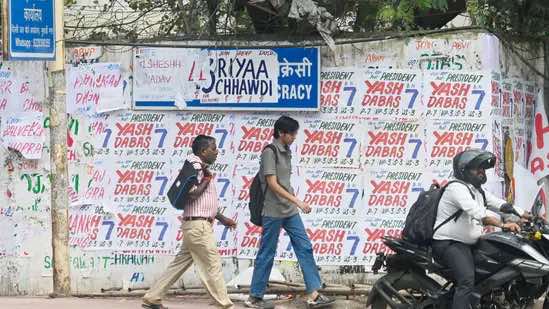
The Delhi University Students’ Union (DUSU) elections might be the liveliest time of the year for students. Every September the colleges turn into a battle ground (both symbolic and literal). Campaigners flood the streets of north campus with a plethora of expensive cars. The sidewalks, completely covered with pamphlets. Getting celebrities to campaign for the candidates, offering free food, even liquor bottles to students in exchange of their votes, are just to name a few.
Despite all these efforts, the voter turnout in the past three to four elections has struggled to keep up to even 40%. That means that not even half of the eligible students show up to caste their vote. Observing the trends of past five DUSU elections, there is an evident drop in the 2024 elections where the turnout only reached 35.2% reaching the lowest ever turnout in the past decade, with the 2018 having a voter turnout of 44.46%, the highest voter turnout in the past 13 years.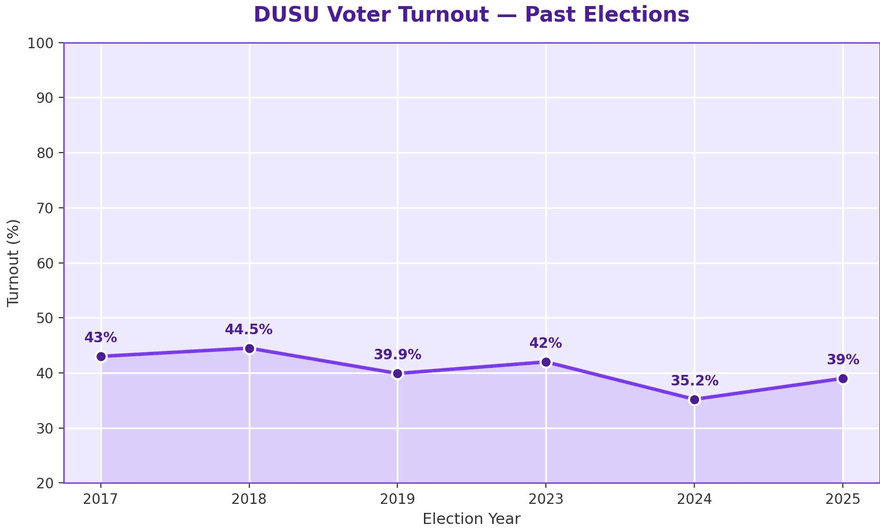
DU BEAT SURVEY DATA
Three things stand out. First, 2018 marks the high point, after which the turnout could never reach that figure. It is also a fact worth noticing that even the highest turnout is lower than 45%. Second, the three-year gap (2020–22) likely disrupted continuity. Although the election in 2023 saw a partial rebound to 42%, but, 2024’s collapse to 35% suggests the rebound didn’t hold. Third, 2025’s uptick to 39% still sits below every pre-pandemic hinting that this might be the new normal for the next few elections.
One common explanation for this is the way polling day is treated. It is declared a university holiday, which many students treat as a day off. Outstation students often prefer travelling home for the weekend rather than queuing to vote, while others spend the day with friends.
In a survey conducted among Delhi University students, DU Beat sought to identify the key factors for the low voter turnout and the reasons why students do not show up to vote in the DUSU elections.
WHAT STUDENTS SAY
DU BEAT SURVEY DATA
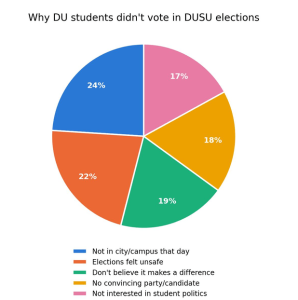
The students gave multiple reasons for not showing up to vote. Out of those responses, the 5 most popular responses were:
- Not in city/campus that day – 24%
- Elections felt unsafe – 22%
- Don’t believe it makes a difference – 19%
- No convincing party/candidate – 18%
- Not interested in student politics – 17%
Out of these, the most popular response was that the students were either not in the city, or in the campus. To be fair, treating the election day as a day off is quite common, but this reason can also be seen as a way of students trying to be apolitical and very well linked to all other factors, that one of the reasons students decide to not come to the campus, that day might be because of the other reasons, such as being unconvinced by the candidates, or feeling unsafe.
The most serious and publicly documented reason for low turnout is that students feel unsafe coming to campus to vote. A recent example is the clash at Satyawati College during campaigning on Tuesday, where two students were injured and hospitalised and two vehicles were damaged after a quarrel broke out between rival groups. Correspondents from DU Beat also witnessed a violent clash that occurred outside the faculty of arts on Wednesday. Violent outbreaks are not an isolated occurrence, they recur in election after election. In one instance, then-DUSU President Ronak Khatri was accused of storming Kirori Mal College with nearly 40 outsiders, causing chaos and panic among students and triggering further violence. Such incidents raise serious questions about enforcement—despite stricter election guidelines being introduced year after year, violent clashes remain largely unaffected. The result is a climate of fear in which many students feel that showing up to vote is not safe.
For the other three reasons (i.e. “Doesn’t make a difference” (19%), “No convincing candidate” (18%), “Not interested in politics” (17%)). These reasons all point to one common structural issue, that the DUSU elections are highly perceived as a proxy battle of national political parties rather than student representation.
The Lyngdoh Committee, set up on Supreme Court direction, tried to disassociate student elections from political parties and capped candidate spending at ₹5,000, but these rules are widely and openly flouted, with student leaders themselves calling ₹5,000 insufficient even for petrol. Actual campaign spending is reported to run far beyond official limits allegedly reaching in crores, being a clear indicator of the money and muscle power and the massive political backing of the candidates. Students described being offered alcohol, movie tickets, water park passes, and makeup in exchange for votes, which reinforces the “no convincing candidate” sentiment.
Besides these factors, we also asked students who voted in the elections what motivated them to do so. The most popular response, cited by nearly 80% of respondents, was that they “wanted to practice their democratic right.” While this reflects a sense of democratic responsibility among students, it also raises questions about their motivations for participating in elections. The finding suggests that, for many students, voting may be driven more by the desire to exercise a constitutional right than by the expectation of bringing about meaningful change. This could point to a degree of scepticism about the ability of student elections to deliver tangible change.
The turnout numbers tell only half the story. A dip in these turnout numbers is not just a statistic but instead it reflects, as several students put it, a growing belief that DUSU elections change little in their day-to-day academic lives, and a sense that campaigning has replaced governance were recurring themes in almost every conversation. If DUSU wants to reverse this decline, the fix may lie less in security arrangements and EVMs, and more in giving students a reason to believe their vote outlasts the campaign season.
Aridaman Singh