
A student at Satyawati College was attacked with a wooden stick after refusing a caste slogan. The assailant was expelled, and an FIR under Section 308 was filed. However, there is dissatisfaction with the lack of security within the college premises.
On Monday, 13th October, a student from Satyawati College got beaten up by a fellow student within the college premises. The victim is a third-year student of Political Science. He was attending a society event, and after its completion, he was wrapping up the event and its arrangements; this is where he encountered a few students from the college who were recording a video. On getting accidentally recorded in the video, the students coerced him to say ‘Jai’ (caste name), to which he refused. After repeated exchanges of them forcing him to say the same, a person from the group snapped and hit him twice on his head using a wooden stick. The group, after committing the assault, immediately fled from the college.
The college staff took him to the hospital, where he got treated and sustained eight stitches. The friends and batchmates of the victim further reported about the incident to the Professors and Staff association, for which they received full support. It is alleged that those students had a history of committing unruly acts in the college where they got rusticated as well. However, it is also alleged that there is a faction of teachers, who give their support to these students because of ‘caste reasons’.
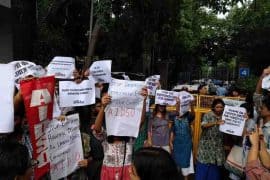
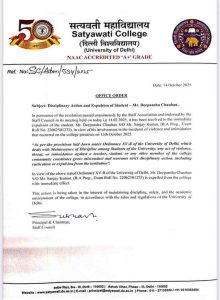
The college authorities, including the professors, the Proctoral Committee and the Principal, assured the students that effective disciplinary and legal action would be carried out against these students. On 14th October, the whole department of political science from across the years protested near the staff room to proceed with this matter urgently. Following which, the Staff Association had a meeting and expelled the student. The person who propagated violence and got expelled, Deepanshu Chauhan, is a habitual offender and has chargesheets filed against him in previous cases, but there was no strict action taken against him.
The notification of his expulsion stated that “As per the provisions laid down under Ordinance XV-B of the University of Delhi, which deals with Maintenance of Discipline among Students of the University, any act of violence, threat, or intimidation against a teacher, student, or any other member of the college community constitutes grave misconduct and warrants strict disciplinary action, including rustication or expulsion from the institution.”
The students, along with the teachers, held a march towards the DCP (Deputy Commissioner of Police) office to get immediate legal action against the offender. After deliberation an FIR was lodged against the student on the grounds of Section 308 (attempt to culpable homicide). The protestors received multiple threats from people who stated that they won’t shy away from assaulting other students as well.
Our source, who requested anonymity, quoted, “This incident raises a larger concern of student safety within the college premises; it further made the parents of the victim insecure about the potential dangers within the campus. Due to this large lapse, we will proceed to boycott the college for 2-3 weeks.”
Read More: Delhi University Palestine Solidarity March Turns Violent
Image Credits- Official Expulsion Order by the college, Satyawati College