The NCWEB has commenced the admission process for B.A. (Prog.) and B.Com. programmes for the 2026–27 academic session. Eligible women candidates residing in the National Capital Territory (NCT) of Delhi can apply online until 24 July.
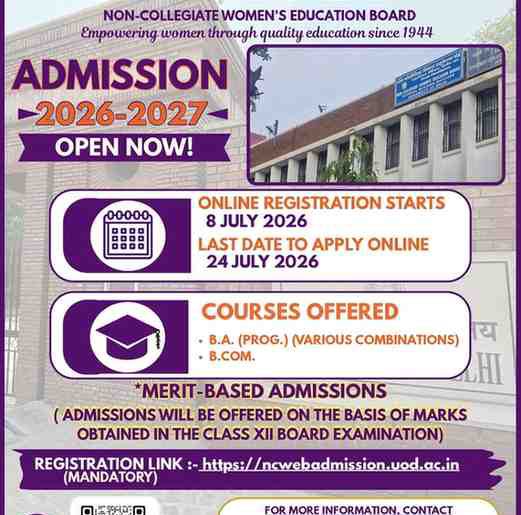
The Non-Collegiate Women’s Education Board (NCWEB) has opened admissions for its B.A. (Prog.) and B.Com. undergraduate programmes for the academic session 2026–27. Online registrations began on July 8 and will remain open until July 24.
NCWEB is inviting applications for two undergraduate programmes: B.A. (Programme), with various subject combinations on offer, and B.Com. Admissions will be granted purely on a merit basis, determined by the marks obtained by candidates in their Class XII board examinations. No entrance test has been announced for the process.
Applications are being accepted exclusively through the official NCWEB admission portal. The registration process is entirely online, with applicants required to register using a valid Email ID, create a password, and complete the CAPTCHA verification before proceeding.
The admission portal notes that candidates should not wait until the final day to pay the registration fee, as applications will only be considered complete after successful payment. Candidates registering on the portal are considered for merit-based courses at NCWEB alone, subject to eligibility criteria. Applicants have also been advised to read the detailed Bulletin of Information, available in both English and Hindi, before filling out the form.
Applicants are advised to keep their Class XII board examination mark sheets and other required documents ready before beginning the registration process. For admission-related queries, applicants may contact NCWEB’s Tutorial Building at the Faculty of Arts, University of Delhi, email [email protected], or call 011-27667866.
With the registration window now open, eligible candidates are advised to complete their applications well before the July 24 deadline to avoid potential technical issues caused by heavy traffic on the admission portal.
Following the closure of the registration window, NCWEB is expected to release merit lists and subsequent admission schedules on its official website. Applicants are advised to regularly check the portal for updates and further announcements regarding the admission process.
Kaustubh Dwivedi
[email protected]
Read Also: DU Colleges Launch Pre-Admission Outreach Programmes Ahead of UG Admissions
Image Source: X (NCWEB_Official)