
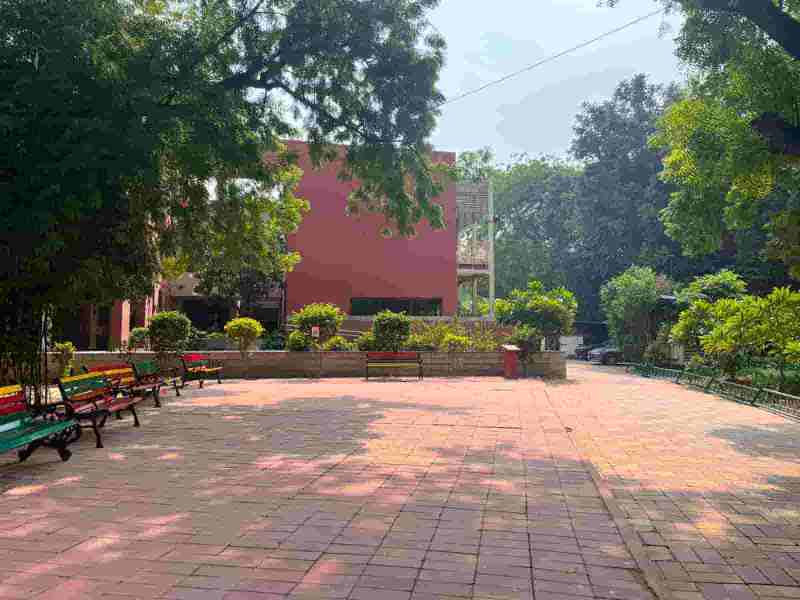
It seems that every semester, the girls’ colleges of Delhi University are doomed to go through one such event that erodes the very narrative of feminist utopia that has been sold over generations sold to the bright, young women who enrol there. Though the narrative is well-past its retirement stage, a closer look should be taken at what sustains it in the first place that makes it so rooted in the mythology of our college grounds. What is it about the space that allows us to imagine it as feminist? What are the boundaries that make this imagination possible? And what happens when those very boundaries are disrupted?
A gendered space, by its very virtue, isolates itself from its surroundings. By entering the gates of such colleges, one is immediately changed by the space and by what it offers. It has something that you would never find elsewhere—young women claiming space. They are walking, talking, wandering, eating, fighting, sleeping, dancing, playing, running, and most importantly, laughing. It is easy to look at the scene and conclude that this is the definition of “empowered women”.
The location of most such colleges are in one of the more affluent parts of the capital and its rather off-campus nature helps further this illusion. There is no contact or intermingling with people from other DU colleges, to the extent that most of them do not even participate in the elections! It seems that the DU tag is almost decorative for these colleges who have a league of their own; it has serious students who do not participate in, or have time for, the chaos of student politics. There is a sense that the college exists slightly apart from the larger university. This separation makes it easier to imagine such colleges as a space unto itself, one that does not have to constantly engage with the messiness of the university around it and what makes its students different from, say, Miranda House.
Thus, there are hard lines drawn between the outside and the inside, even though the failure to provide full accommodation to students does result in a pseudo-extension of “campus space” into the neighbourhood areas. However, these spaces, be it the the back gate lanes, the PGs, the shops, or the roads, are still seen as distinct from the actual institution, even though they form such a significant part of everyday student life and become a reason that the student body has had to ceaselessly fight for years to even get basic safety measures
The metro route too evolves into an everyday part of students’ experience of the college, but its problems do not seem to fall within the same boundaries of institutional responsibility. So, clearly there is a divide in how students perceive their college experience as a continuous and complex network and the institutions that operate within fixed and formal boundaries.
Now, imagine within this feminist utopia, just a few metres outside the premises, a police encounter of an accused in a gang rape case of a minor, that too not more than 2.5 kilometres away. This incident exposed the cracks of the narrative. No longer can the institution detach itself from its surroundings. The subsequent response of suspending classes, shifting them online, postponing events, all in lieu of “safety” can be read as an attempt to restore this separation.
The institution’s most immediate response to violence becomes a withdrawal from the spaces in which women move. One must question why safety is so easily seen as restricting access? Why does the response to violence so often become a question of where women should go, whether they should travel, whether they should gather, whether they should remain on campus, whether they should come to campus at all?
It is important to clarify that this is not a story of an institution forcing women to stay indoors. Students themselves feel unsafe coming to college and choose online classes because given what has happened, staying away feels like the safer and more rational choice. That choice should not be dismissed. However, that choice equally speaks of the environment created by the power structures that make withdrawal appear to be the most rational form of safety when violence occurs. It also exposes a contradiction within the fantasy of the feminist institution. The space can appear empowering precisely because the dangers surrounding it are experienced as external to it.
In the seminal text Why Loiter?, Shilpa Phadke discusses how narratives of danger can have the effect of “making women anxious, compelling them to strategise and negotiate every square foot of public space they access, all the while constantly looking over their shoulders, stalked ceaselessly by the ghost of past crimes.” She argues that such accounts can reinforce women’s anxieties in public and normalise their lack of access to public space, while also sanctioning restrictions on women’s mobility by rationalising them in the name of safety and well-being.
If every instance of violence produces another reason for women to reduce their movement, withdraw from public space and wait for the danger to pass, then the space itself remains unchanged, and the burden of adaptation continues to fall on women. The response of withdrawal may restore a sense of immediate safety, but it risks restoring the very boundary that the incident has exposed as inadequate.
The question of feminist space, therefore, cannot therefore be reduced to a protected island within a patriarchal city.
Yashika Jain
yashikaj638@gmail.com
Image Credits: Rishika for DU Beat
Read Also: DU Women’s Colleges Call for Solidarity March to Reclaim the Streets; Hundreds of Women Take Part




Comments are closed.