
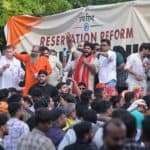
What do you call a movement that begins by demanding “Reservation Hatao”, borrows Dr B.R. Ambedkar’s language of resistance, and then quietly discovers the softer vocabulary of “reform” the moment its politics become uncomfortable?
Perhaps the answer is simpler than its organisers would like.
It was never a Reservation Hatao Andolan. It was a Swarn Uthao Andolan—an upper-caste mobilisation that rediscovered the language of merit only after centuries of inherited advantage became vulnerable to constitutional correction.
A Movement That Knew Its Moment
This movement did not arise out of nowhere. In July and August, India had already witnessed the extraordinary mobilisation around the CJP protests, where students and young people showed how quickly digital anger could turn into physical protest. The Reservation Hatao Andolan (RHA) appeared to absorb the lesson: build online first, mobilise offline later.
By August 21, hundreds had gathered at Delhi’s Jantar Mantar demanding changes to caste-based reservation, and more than fifty protesters were detained after the gathering went ahead despite police objections. Days later, Union Minister J.P. Nadda met with representatives of the movement and called the discussions “cordial”.
That meeting matters. A movement does not acquire political confidence merely because an Instagram account goes viral. It acquires confidence when it believes someone powerful is listening.
Reservation Was Never a Poverty Scheme
There is a convenient lie at the heart of the anti-reservation argument: that reservation exists because some people are poor. It does not. Reservation exists because caste, for centuries, determined who could enter institutions, who could own land, who could be educated, who could perform which occupations—and who could be treated as human at all.
Poverty can be measured in rupees. Caste cannot. And the caste system has not disappeared simply because India now has smartphones, coaching centres and competitive examinations.
Even this year, a 65-year-old Dalit man in Lucknow was allegedly beaten and forced to lick his own urine after he urinated near a temple while unwell. In Uttar Pradesh, a Dalit teenager was allegedly stripped and beaten and reportedly made to lick spit off shoes for touching a water bucket. This is the society in which reservation supposedly became unnecessary. The question answers itself.
The Ambedkar They Can Quote
The irony is almost theatrical. The movement’s digital ecosystem freely invokes Ambedkar’s famous command—”Educate, Agitate, Organise”—while campaigning against the very safeguards his politics produced.
Ambedkar did not spend his life merely encouraging education. He fought the social structure that made education, employment, and dignity inaccessible to millions in the first place. The Constitution’s affirmative-action framework grew out of that fight. You can borrow his words. You cannot selectively inherit his politics.
The Great Rename
Then came the rebranding. “Reservation Hatao” quietly became “Reservation Reforms”. The shift is politically revealing. “Hatao” is blunt—it says exactly what it means: remove it. “Reforms” sounds reasonable. It creates room for income criteria, creamy-layer exclusions and sunset clauses, without ever explaining why the original movement was framed around abolition in the first place.
The movement’s own materials now speak of income-based criteria, “one family, one reservation”, minimum standards and a sunset clause. The policy proposals can be debated on their merits. But the linguistic gymnastics deserve scrutiny in their own right: when a slogan becomes politically expensive, changing the slogan is easier than changing the constituency behind it.
The Politics Behind the Politics
The movement’s public face has drawn familiar voices from the wider right-wing digital ecosystem. YouTuber Ajeet Bharti, for instance, appeared at the August 21 protest, arguing that a “developed India” could not compromise on merit, and called for a white paper on reservation policy.
Bharti’s presence is not an incidental detail. It reveals how quickly an argument about quotas can slide into an argument about identity—who belongs, whose grievance counts, whose presence gets treated as an intrusion. Caste hierarchy and communal majoritarianism are not identical projects. But they understand one another remarkably well.
When Merit Became Brahmanwaad
For years, the respectable vocabulary was simply “merit.” But merit is never just a number beside a candidate’s name. It is shaped by schooling, nutrition, geography, parental education, money, networks, social confidence—and by the presence or absence of discrimination. The mythology of pure merit becomes especially fragile when inherited privilege is mistaken for individual achievement.
That is where Brahmanwaad enters the picture. The deepest problem with this movement is not that every participant is personally driven by caste hatred. It is that the politics can function as a defence of hierarchy while presenting itself as a defence of neutrality. The slogan changes. The hierarchy does not.
The BJP’s Uncomfortable Mirror
For the ruling establishment, this is a double-edged sword. The movement may consolidate upper-caste anxiety, but it risks fracturing the wider coalition by sharpening the divide between privileged-caste grievance and the accumulated anger of historically marginalised communities.
Nadda’s meeting with RHA representatives raises an uncomfortable question: if the government is not considering the dismantling of caste-based reservation, why does an anti-reservation movement receive such direct political engagement? And if reform really is on the table, what happens to the communities whose constitutional safeguards are being questioned? The government can postpone that question. It cannot make it disappear.
The Mirror
Only days earlier, the CJP protests offered a glimpse of something rarer: students discovering solidarity across difference, turning frustration into collective action. The Reservation Hatao Andolan offers the darker image—how quickly grievance can curdle into entitlement, how easily privilege can disguise itself as victimhood, how the language of “merit” can become a respectable wrapper for an older anxiety: what happens when those who once occupied the top are finally asked to share the ladder?
India does not need a society where caste stops mattering on paper while it continues to decide lives in practice. It needs the opposite: a society in which caste finally matters so little that reservation can genuinely become unnecessary.
Until that society exists, abolishing reservation is not the destruction of caste. It is simply the restoration of the old order, without having to call it by its name.
Mayank Scripts
[email protected]
Image Credits: The Print

Comments are closed.