Author

DU Beat

Browsing

Hansraj College administration has gone on a spree of suspending multiple students to allegedly silence their voices and prevent future protests, taking any form of online criticism as “defamation” and participation in protests as “indiscipline”.

The administration of Hansraj College, University of Delhi, has issued orders of suspension for multiple students across departments and years on the grounds of alleged violence, indiscipline, defamation, and misconduct. Among those suspended include the former Students Union President, Parth Srivastava, as well as the current Students Union. 
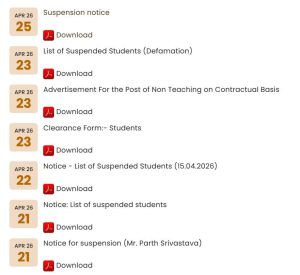
In the past week, Hansraj College has issued 5 orders of suspensions for nearly 30 students

The series of suspensions released by the college administration from 21st April onwards has been issued to nearly 30 students, with the first order released against Mr. Parth Srivastava on grounds of “acts of indiscipline, including defamation of the institution and use of derogatory language against Teaching and Non-Teaching Staff.” The notice further read that Mr. Srivastava was allowed “multiple opportunities to appear before the Committee along with his parents which he failed to attend” in light of which he shall not be permitted to enter the college campus nor participate in any academic or related activities.

The second list of suspensions were issued to nearly 14 students in light of the chaos that ensued at Hansraj College annual fest, Confluence 2026. The notice alleges “violence, misconduct, and breach of discipline” by the list of students and pronounces the suspension as interim.
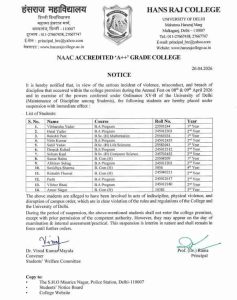
Suspension order issued to students in light of the violence during Hansraj’s annual fest

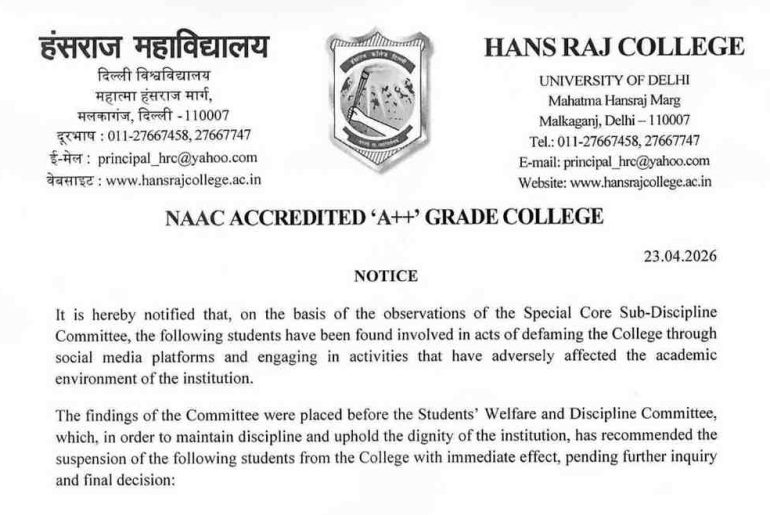
Following this, the college issued an additional order of suspension for 4 students alleging ” physical violence, misconduct, and breach of discipline” in light of incidents on 15th April. On 23rd April, the college released a follow-up list suspending nearly 7 students for “acts of defaming the College through social media platforms and engaging in activities that have adversely affected the academic
environment of the institution.”

A student facing suspension, in a conversation with the Editorial Team of DU Beat, said,

“The administration did not inform us of our suspension either by mail or a show cause notice. We found out that we were suspended from a notice circulated in college. The suspension seems intentional considering most of the suspended students were probable candidates for the upcoming election, especially those with 70% and above attendance. The administration justifies the suspension on grounds of public defamation of the college on social media, which seems to be nothing but a hindrance of our democratic rights”.

He however clarified that students were not targeted by their political affiliations as common misinformation is alleging. He added that students across parties like SFI and ABVP had been suspended, however, the protests by ABVP led to the setting up of an emergency committee for inquiry.

The final list of suspended students released on 25th April include the current Students Union members of Hansraj College. The notice prohibits their entrance on college premises but allows their appearance for all examinations and internal assessments.

Abhijit Singh, the President of Hansraj Students’ Union, in an exclusive interview with DU Beat, prior to his suspension said, 

These suspensions are intentional and are aimed towards curtailing the democratic rights of the students. Most of the suspended students were probable candidates for the upcoming Union election, and the administration’s suspension was a move to prevent them from being elected and continue the voice of dissent for the students’ rights. Many more students were more actively involved in the protests; however, they have not been suspended as they were not probable candidates for the election.” 

He adds,

The administration said that a committee was set up to select the students for suspension; however, no such notice was sent to either the Union or the suspended students, and the orders of suspension were directly rolled out.”

However, Singh declared that a show-cause notice had been issued to the officer bearers of the Students Union which led to him believing that they too would be suspended, which took place within the upcoming days.
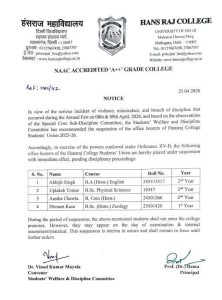
Suspension notice issued to the office bearers of the Students Union

This series of unrest among the student body and dwindling trust between the college authorities and students can be traced back to February 2026, when campus infrastructure was used for the wedding of the principal’s son. This use of public resources for a private event became the starting point for a long series of events that continued to generate unrests amongst the student body. The second wave of controversy was sparked by allegations of NIRF data manipulation. Parth Srivastava, a student from Hansraj, filed an RTI for the sameAs Hansraj’s annual college fest, Confluence 2026, approached, further chaos erupted, as strict regulations, including a restriction on inviting external artists and an early conclusion of the fest were imposed sparking an outrage that involved 20 hours of overnight protest demanding that the administration uphold its previous commitments. Eventually, the administration gave in, however, on Day 2 of the fest, poor crowd management led to physical violence, harassment, and uncontrolled chaos which led to police intervention.

After the fest, the administration took action and issued these series of suspensions that has left the student body of Hansraj College bewildered and in fear. In a conversation with a student from Hansraj she says, 

If actions of alleged physical violence and online “defamation” are given the same degree of punishment by the college authorities then the future of student democracy and freedom of expression within the campus is in question. This process of protests and followed suspensions has become cyclical as students are constantly threatened with suspension and no internal marks if they participate in such protests.


Read Also: Hansraj College Fest Witnesses Chaos; Alleged Stabbing and Fights Ensued

Image Credits: Hansraj College Website 
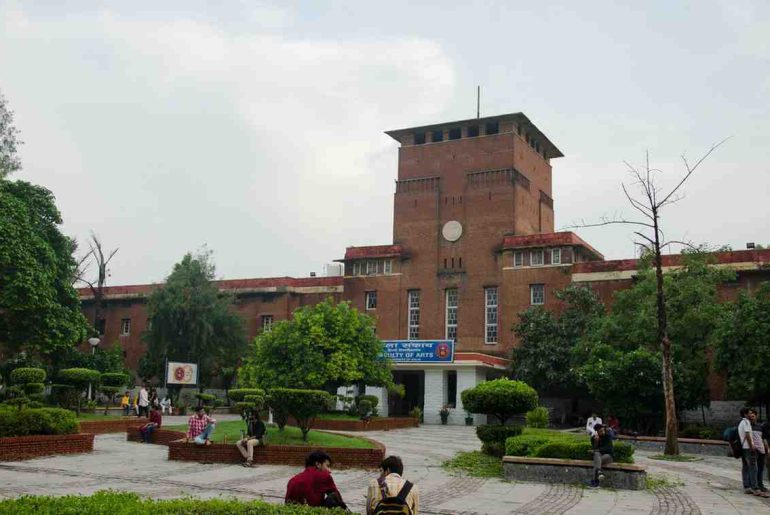
Delhi University Executive Council to vote on April 30 regarding BA Programme restructuring that could quietly push India’s minority languages off campus. 

Delhi University Executive Council (EC) is meeting on April 30 to decide the future of the BA Programme (BAP). The changes, if approved, will come into effect from the academic session 2026–27.

The proposal follows recommendations made by DU’s Academic Council on April 15, and was prepared by a committee that includes key university officials such as the Dean of Colleges, Registrar, Dean of Admissions, and principals of colleges like Shaheed Bhagat Singh College, Miranda House, and Daulat Ram College.

In respect of the restructuring, Delhi University colleges have been asked to look at BA Programme combinations where student demand is low or seats remain empty, and consider merging certain disciplines into broader combinations. For example, languages like Urdu, Arabic, Persian, Bengali, and Telugu may be offered as a single BA Programme combination with just one other subject. Similarly, subjects like Social Work or Sociology may be paired with more popular disciplines. 

Suggested changes in the document include replacement of courses like OMSP (Office Management and Secretarial Practice) by plain Commerce as a discipline. Subjects like Food Technology and Human Development and Family Empowerment (HDFE) may similarly be merged under a broader Community Science category. 

Importantly, the document suggests that no new programmes will be introduced and no existing programmes will be discontinued. Colleges will also not be allowed to change their total sanctioned intake capacity, though they may increase seats within an existing programme if they have enough faculty and infrastructure. 

These recommendations came out of a series of meetings held with multiple college principals at the Vice Regal Lodge earlier this year. The Executive Council took this decision to cure the problem of many empty seats in specific BA Programme combinations where there wasn’t even one applicant for every two seats.

A presentation made before college principals showed that while commerce courses had over 110% seat utilisation, language courses had the lowest fill rate, just 81.22%. This is where teachers and elected council members raised loud objections about combinations involving Indian languages like Bengali, Tamil, Telugu, Punjabi, and Urdu being unfairly targeted even though these courses already have very few seats to begin with.

Tamil professor Uma Devi pointed out that the real crisis is a shortage of teachers, not a shortage of students. Across DU, there are only two permanent Tamil teachers in colleges, three in the department, and only one teacher each for Kannada, Malayalam, and Marathi. “Whenever a teacher retires, the university simply does not recruit a new one,” she said.

Imtiaz Ahmad, a faculty member in DU’s Department of Urdu, described the situation bluntly:

Urdu was offered in many colleges earlier. It did not shut down overnight. It was closed one by one, over a long period. Today, it is available in only about nine colleges.”

The Executive Council meeting isn’t only about BAP. The council is also set to consider infrastructure proposals worth hundreds of crores, including ₹174.20 crore for a new building for the Institute of Nano Medical Sciences at Maurice Nagar, and a revised estimate of ₹233.35 crore for studio apartments at Dhaka Complex, partly funded through a HEFA loan. 

Separately, DU’s Academic Council has already approved one-year postgraduate programmes and a new Semester Away Program (SAP) that would let DU students spend a semester at foreign universities in line with the National Education Policy (NEP) 2020. If the Executive Council approves the BAP restructuring on April 30, the changes will be put in place from the 2026–27 academic session which means students applying this year through CUET-UG could be the first batch to experience the new structure.

On one side, the university says it is simply making the programme more efficient. On the other, teachers and students warn that what looks like an administrative fix could quietly erode decades of language teaching and cultural diversity from one of India’s oldest universities.

As EC member Mithuraaj Dhusiya’s dissent note put it: “When languages disappear, cultures disappear.”


Image Credits: Devansh for DU Beat

Read Also: What Happens When a Student Builds a Course That Didn’t Exist at DU?


Arshia Sharma 

[email protected] 

Out of 7,000 applicants last year, only around 100 were selected for the Vice Chancellor Internship Scheme. This internship offers students a chance to work closely with the major departments at the University of Delhi.

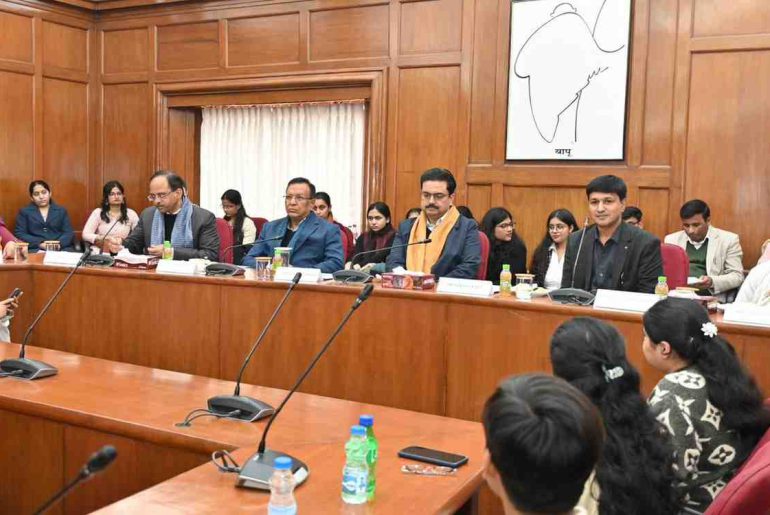
The Vice Chancellor Internship Scheme (VCIS) for students of University of Delhi was recently announced for the Summer of the upcoming 2026-27 academic year. Under the leadership of the current Vice Chancellor, Yogesh Singh, this scheme hires nearly a hundred interns across all courses to work with university administration.

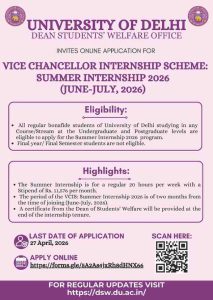
The programme is open to “all regular bonafide students of University of Delhi” currently enrolled in any course across the university, provided they meet specific eligibility criteria. Applicants are required to submit a Letter of Recommendation (LOR) signed and stamped by the college authorities on or after 13th April. Final-year students appearing for end-semester examinations are not considered eligible for the scheme. Further, students can only avail of this opportunity once during their time at the university. 

Official Internship Application Call for VCIS

The internship is offered in two formats: a regular part-time internship during the academic session and a summer internship during the June to July break. Interns are expected to commit approximately 15–20 hours per week. The scheme is paid, with regular interns receiving ₹5,000 per month, while summer interns will receive ₹11,576 this year. The stipend is subject to an annual increment of 5 percent.

The selection process has been highly competitive over the years. In the previous year, over 7,000 students applied, out of which around 100 were selected and placed across various university offices and departments. These include the Vice Chancellor’s Office, Pro Vice Chancellor’s Office, Deans’ Offices, School of Open Learning (SOL), Department Labs, Equal Opportunity Cell, and the Examination Department. For the current cycle (as of 22 April 2026), approximately 2,000 students were shortlisted and invited for the next stage of selection. These shortlisted candidates were called to the Multipurpose Hall at the DU Sports Complex over four days, from 13 to 16 April, for a General Discussion.

Applications to the scheme remain valid for six months, allowing flexibility in consideration for different internship cycles. The primary objective of VCIS is to equip students with administrative, organizational, and professional skills by exposing them to the internal functioning of a large public university. Interns are meant to gain insight into governance, policy implementation, and institutional processes, which can be beneficial for careers in public administration, academia, and related fields.

Upon successful completion, interns are awarded an official experience letter, enhancing professional profiles. The scheme serves as a sort of internal engagement system, meant to make university administration familiar.

Currently, the Vice Chancellor Internship Scheme for the Summer of 2026 is open for the two month period of June to July with the final application date as 27th of April.


Read Also: Gender Narratives in Media Take Centre Stage at Journo Junction 2026 by Kamla Nehru College

Image Credits: Dean Students’ Welfare Official Website


Anjali Paruvvu

[email protected]

Delhi University approves one-year PG courses, SWAYAM credit integration, and global semester exchange, but faculty dissent highlights concerns over academic impact, accessibility, and curtailed deliberative processes within the Academic Council.

The Academic Council of Delhi University approved the introduction of one-year postgraduate programmes in several departments; these courses will be integrated with the Postgraduate Curriculum Framework 2024 following the National Education Policy 2020. 

The council also sanctioned guidelines which authorise students to earn up to 5% of their total credits through courses offered on SWAYAM and other MOOC (Massive Open Online Course) platforms. The guidelines generated criticisms:

The decision to proceed in a manner that curtailed debate and foreclosed meaningful engagement with dissenting views reflects a disregard for established democratic norms and collective decision-making,”

the note stated, as cited by PTI.

Monami Sinha, an elected Academic Council member, commented on the proceedings of the council by stating, ‘We were dissenting, and the meeting was abruptly ended.’ We have no clarity on what decision was finally taken.”

Registrar Vikas Gupta further added that the proposal had been passed and would be placed before the Executive Council of Delhi University and stated,

Teachers have dissented against the proposal. However, we are only suggesting introducing 5 per cent of total credits through the courses, and we should encourage students to learn from all types of portals that can contribute to their education.” 

The Council also approved a proposal to introduce a ‘Semester Away Programme’ in ties with some foreign higher education institutions that remain undisclosed at the moment. The initiative will allow students to complete one semester abroad with adequate credits according to their respective degrees. 

Additionally, the vice-chancellor directed departments to compile a list of the top 20 journals in their respective fields within 30 days.

He stated that departments should establish specific criteria for these journals and assign a point system to them. Based on this evaluation, a priority list of journals is to be prepared by assigning scores accordingly,”

a press statement issued after the meeting said, according to PTI.

Self-learning study material for School of Open Learning courses in line with the Undergraduate Curriculum Framework 2022 was also approved. Additionally, programmes including the Master of Journalism and Mass Communication at the Delhi School of Journalism, MSc Mathematics, and the second-semester curriculum for MA Hindi Journalism were cleared, along with courses in computer science and other subjects.


Read Also: What Happens When a Student Builds a Course That Didn’t Exist at DU?

Image Credits: Devesh by DU Beat


Divyanshi Dusad

[email protected]

The Department of Journalism at Kamla Nehru College, hosted its annual festival, featuring a keynote address, panel discussion, and student competitions centred on gender representation in media.

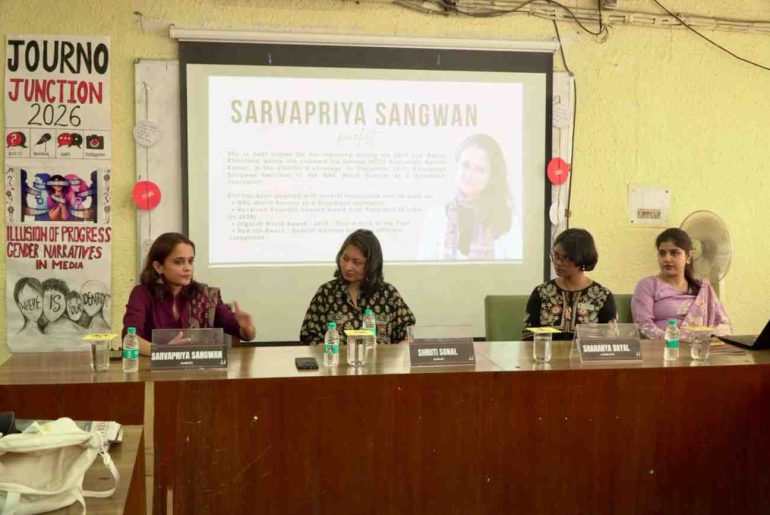
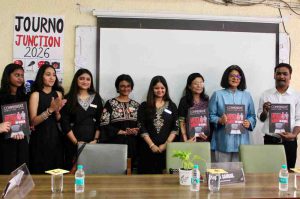
The Department of Journalism at Kamla Nehru College, University of Delhi, hosted its annual departmental festival, Journo Junction 2026, on April 16 at the Old Seminar Room of the college. The event centred on the theme ‘Gender Narratives in Media’ and brought together journalists, editors, and writers for discussions on representation in contemporary media. The 23rd edition of the department’s newsletter, Communiqué, was also released during the event.

Release of the Department of Journalism’s annual newsletter, Communiqué

The programme began with a lamp lighting ceremony led by Ms. Priya Sahgal, Editorial Director at NewsX, alongside faculty members including Dr. Jyoti Raghavan and Dr. Ramesh Aroli. In her keynote address, Sahgal spoke about her experiences across political reporting, feature writing, and television journalism. She emphasised the distinction between objectivity and neutrality, stating that journalism should remain grounded in facts rather than forced balance. She further noted that women in political spaces are often portrayed through limiting stereotypes, suggesting that deeper issues in representation continue despite visible progress.

A panel discussion followed, featuring Shruti Sonal, feature writer at The Times of India, and Sarvapriya Sangwan, Editor at BBC News. Sonal discussed the role of cinema in shaping gender narratives, observing that representation extends beyond lead characters to supporting roles and antagonists. Referring to recent OTT content, she stated that storytelling appears to be becoming more nuanced. She also addressed professional realities within journalism, including uncertainty, the importance of networks, and the use of artificial intelligence as a support tool.

Sangwan focused on structural dynamics within media organisations, stating that while more women are entering newsrooms, they remain underrepresented in decision-making roles. She added that women journalists are often directed towards lifestyle and entertainment beats, while political and hard news reporting continues to be male-dominated. She also highlighted the limited representation of Dalit and Muslim women in mainstream media discussions, suggesting that such gaps render the discourse incomplete.

The fest featured a range of student competitions, including live anchoring (Live Desk), photography (Prisms of Perception), and quiz (Les Quizrables), alongside a panel discussion with industry professionals. A debate competition, Mic Drop, was also held on the theme of media portrayals of gender, examining whether such portrayals are breaking stereotypes or reinforcing them.

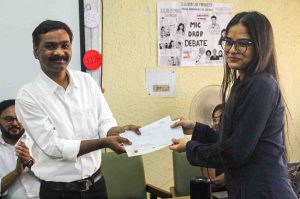
Winners receive awards during the Prize Distribution Ceremony

The event concluded with a prize distribution ceremony, following which the department reiterated its commitment to fostering socially aware journalism and facilitating discussions on media and society.


Read Also: What Happens When a Student Builds a Course That Didn’t Exist at DU?

Image Credits: Department of Journalism, Kamala Nehru College


Suansh Dembla

[email protected]


While protests at LSR continue for the removal of the Principal’s video featured on BJP’s official Instagram page, debates spark on institutional identity, political freedom, and the student’s right to dissent. 

After the protests staged at LSR on the 15th of April over the Principal’s video on Nari Shakti Vandan Adhiniyam being featured on the official Instagram page of the Bharatiya Janata Party came to an inconclusive end, the Principal, Dr. Kanika K. Ahuja issued an official statement to The Indian Express. She stated,

The views were shared in the video in an individual capacity. While I hold the office of the Principal, it is important to distinguish between personal intellectual engagement with a social subject and a formal institutional communique.” 

Addressing the college’s reiterated commitment to maintaining the ‘apolitical’ stance, she said, “The college’s commitment to an apolitical environment refers to an absence of partisan affiliation not a detachment from critical social discourse.” She further addressed the alleged “saffronisation” on campus through selectively inviting speakers by adding,

The selection of speakers and the organisation of events are decentralised processes at LSR. These decisions are primarily driven by the respective student societies in consultation with their faculty advisors.”

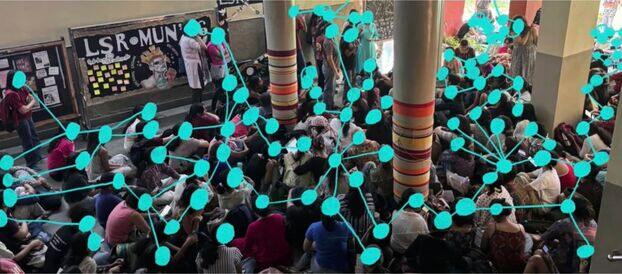
These clarifications come in the wake of the student-led protest held on campus where students across departments and years organised sit-ins at the lower foyer—the immediate area outside the auditorium, adjacent to the Principal’s Office—along with the adjoining corridors, staircases, and outdoor spaces to raise concerns regarding the circulation of this video, which they believed to be in direct opposition to the college’s stated ‘apolitical’ stance that has been reiterated to close down exhibitions, refuse approval of speakers, and hinder free political expression on campus.

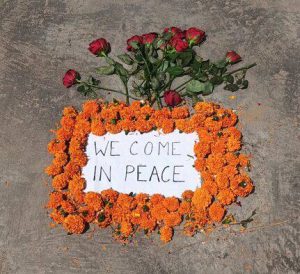
In a clarification issued by the students through a statement they refute accusations of being against the Women’s Reservation Bill. The statement published through an anonymous Instagram account reads, “Contrary to the disinformation at the moment—the students of LSR are not mobs protesting against the Women’s Reservation Bill which was talked about by Principal, Ms. Kanika K. Ahuja. The students are conducting a PEACE PROTEST at the moment against the hypocritical stance on apoliticality that our Principal uses to dismiss the girls when they attempt to talk about critical discourses, creative freedom…”. To the students of LSR who stress on their protest as peaceful—one that they reasserted with a floral arrangement reading “We Come in Peace” against the accusations of being a “mob” as asserted by a faculty member—their primary cause of dissent is the featuring of the Principal’s video where she is identified not in an individual capacity but as the Principal of Lady Shri Ram College on the official Instagram Page of BJP. 

Image of the floral arranged shared by anonymous source.

While Ahuja reported to the Indian Express that, “I, staff advisors, faculty and others in the administration have remained in active dialogue with students to address campus concerns”, students report otherwise. During a brief interaction with students on the day of the protest, which multiple attendees reported as lasting less than fifteen minutes, Ahuja reportedly presented documents of communication and stated that the video was originally recorded for the Ministry of Women and Child Development but was uploaded by the BJP without her permission.

When asked if any actions had been taken to get the video removed, the students reported that no such action had been initiated, and that the Principal informed that gathering that she would “consider” sending an email for removal of the video. Similarly, on the second day of the sit-in, that is 16th April, she allegedly did not show up to the auditorium after her presence was requested by the protesting students, who complied with her initial request of an audience at the Auditorium instead of the Lower Foyer. 

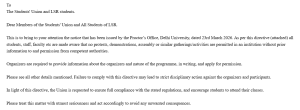
Following the protest on 15th April, which ended in the Principal walking-off in lieu of what she termed as “disrespect”, the administration of the college sent an email quoting a directive issued by the University of Delhi’s Proctor’s Office on March 23, 2026. The notice emphasised the need for prior approval from the concerned authorities for organising protests and demonstrations on the institution’s grounds. It further said that failing to comply with these requirements could result in disciplinary action, and asked students to follow the directive and continue attending classes. 

Screenshot of Notification from LSR Administration.

Multiple students reported that the administration  had been calling their guardians and parents to report their involvement in the protest, which they viewed as a clear violation of their rights. Additionally, the Students’ Union of Lady Shri Ram College of 2025-26 and 2026-27 issued a joint statement across liaison groups: they wrote,

We the Student Union of Lady Shri Ram College, wish to state unequivocally that we are not the organisers, convenors, or leaders of the protest currently taking place within the college premises…As elected representatives, our role is limited to facilitating communication and ensuring that the concerns of the students are conveyed appropriately to the relevant authorities.”

As news channels and social media pages continue a widespread reporting on the protest, the students of LSR involved in the sit-ins released a statement through the anonymous Instagram Page to “please represent the truth of our protest to the public so it doesn’t have the false narratives attached to it.” This request comes in light of multiple accounts on X accusing the protestors to be “Left-wing students (backed by terrorist org SFI) [who] not only made the Principal captive but also almost tried to lynch her and her daughter, just because she made a video supporting the women’s bill.”

Multiple such statements trying to relegate the protests to a political party have been actively refuted as the students’ demand remains the same—removal of the video, issuing a public clarification, avoiding external speakers on campus without proper background checks, ensuring all political engagements remain strictly non-partisan on campus, and ultimately reaffirming the institution’s commitment to secular and democratic values. 

Multiple students have reported that during the first day of the protest, that is 15th March, a certain faculty member had been recording videos of the protesting students, many of whom were minors, without their consent. On informing the Principal regarding the same, including a case of alleged manhandling by the aforementioned Professor, the Principal reportedly stated that she would believe her colleague over the students in light of an adjacent incident which was brought up without the involved student’s consent. A deletion of such videos and photographs have been immediately demanded by the students, which the Principal reportedly agreed to. 

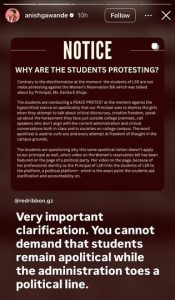
Prominent public figures like Anish Gawande and Akhilesh Yadav have stepped up in support of the protesting students of Lady Shri Ram College; the former wrote on his Instagram story, “Very important clarification. You cannot demand that the students remain apolitical while the administration toes a political line.”

Screenshot of Anish Gawande’s Instagram Story

A student in conversation with DU Beat said,

We’re fighting to protect the ethos of our institution. What we’re seeing right now is a spread of convenient misinformation led by the principal, which is shaping a narrative against her own community, against her own students. That is unacceptable.”

This protest against the actions of Dr. Ahuja is however not the first incident of outrage by the student body of Lady Shri Ram College, but follows the sexist and Islamophobic comments passed by ex-diplomat Deepak Vohra in the presence of the Principal during an event organised within the college. 

However, while the outrage continues, it is to be noted that while the online community of students supporting the protest remains at large numbers of 1000+ across multiple channels, on-campus limited students have actively engaged in the sit-ins. At the same time, student responses have been mixed; while a section of the students are concerned about institutional consistency and the larger implications of the Principal’s involvement on a particular party’s platform, others wholeheartedly welcome her stance. They emphasise an individual’s right to participate in public affairs, especially those involving women’s representation; a LinkedIn user from LSR writes,

“At the end of the day, she is not only our Principal but also an individual entitled to her own thoughts and opinions, just as each of us.”

On this, Principal Ahuja reported to Times Now, “Roughly 175 students participated in the protest out of around 4000 enrolled on campus. They do not represent the majority.” The separation of the personal from the political has at large remained the cause of support towards the Principal’s video, which claims to remain stationed only upon the Bill, and not upon the political party. 

These recent developments across Delhi University and in particular within LSR, with respect to the conversations between the students and the administration during times of dissent, which remain inconclusive, point to a larger question of autonomy, authority, and hierarchy within college spaces, particularly on colleges that allege to be ‘apolitical’ but in practice remain otherwise. If to be or not to be [political] is the question, then the shaping of this incident, especially for a campus like LSR which has a long-standing history of intellectual inquiry, student engagement, and expression of free speech, shall determine the long-term implications of how college spaces are reconstructed, for both the students and the administrators. 


Read Also: LSR Students React to the Principal’s Statement on BJP’s Official Instagram Page

Image Credit: Anonymous Source


DU Beat

Post multiple concerns raised by students and faculty, Delhi University released an updated tentative datesheet with examinations beginning from the 16th of May till mid-June. 

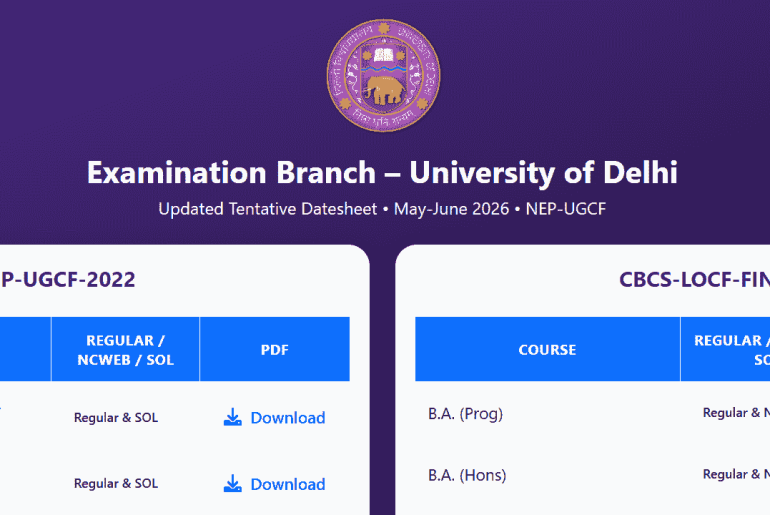
On 16th April 2026, Delhi University released their updated tentative datesheet for the May-June 2026 Examinations with the date for examinations for the even semester starting from the 16th of May as specified initially in the DU Calendar for 2025-26. 

This change in the timetable comes after repeated concerns raised by students with respect to the previously updated tentative date sheet shared by the University where examinations were set to begin from the 1st week of June for a majority of Honours courses across semesters. The non-adherence to the initially released DU Calendar for 2025-26, wherein holidays to begin from the 1st of June had been pushed to end of June in lieu of the released examination schedule, became a crucial point of contention amongst students. However, with the newly released tentative datesheet, a majority of students from the Honours course shall be able to avail their semester break from the second week of June itself. 

According to the updated tentative datesheet, B.A. (Honours) and B.Sc (Honours) courses for Core Papers are to begin from 16th May for Semester VIII, 19th May for Semester VI, 28th May for Semester II, and 30th May for Semester IV. Ability Enhancement Courses are set to begin from the 11th of June till the 12th of June across Semester II and IV with Skill Enhancement Courses being conducted on 16th May for Semester VI, 26th May for Semester IV and 29th May for Semester II. General Elective papers across all disciplines shall be examined between 26th May to 10th June. 

The updated timetable stands tentative and the University of Delhi has requested all discrepancies in the schedule to be sent across to their official email ID by the 21st of April, 5PM. 

Read Also: Exams on Repeat, Errors on Loop: DU’s Perpetual Exam Fumbles

Image Credits: University of Delhi Website

Publicity drive, guest appearance, and celebratory gathering marks International Jat Mahotsav at Delhi University, while raising questions on caste assertion in campus spaces

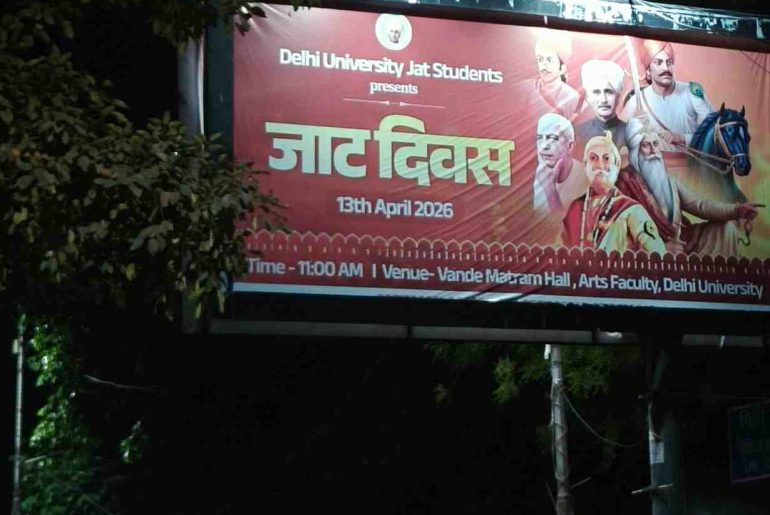
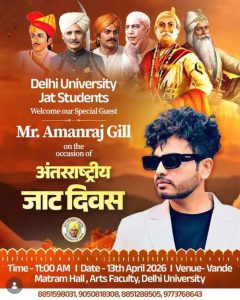
The observance of International Jat Day at the University of Delhi took the form of a Jat Mahotsav organised by the Delhi University Jat Students on 13 April 2026 at Vande Mataram Hall. The gathering began in the late morning with students assembling at the venue to mark the day as a celebration of community identity and historical memory. Posters described the programme as “Antarrashtriya Jat Diwas,” positioning the event as both commemorative and cultural.

Publicity for the Mahotsav was visible across the North Campus. Digital posters circulated on social media announced the schedule, while a large roadside hoarding near the Arts Faculty displayed images of historical figures alongside the event details. The promotional material highlighted the presence of social media personality Amanraj Gill as the special guest,  along with Olympic Medalist Mr. Ravi Dahiya which appeared to be a key draw for student turnout. 

Poster of Jat Diwas celebrations

No formal announcement indicated institutional involvement of the Delhi University Students’ Union, though individual student leaders and attendees were present in a personal capacity. The absence of an official endorsement contrasted with the scale of publicity, suggesting the event functioned primarily as a community-led initiative rather than a union-backed programme.

The celebration included music played at the venue, informal interaction with attendees, and the distribution of sweets among students to mark the occasion. As part of the cultural contributions, students brought 30 kgs of Desi Ghee, 40 kgs of gud or jaggery and 150 kgs of Churma. Participants gathered in small groups, took photographs, and shared greetings, giving the event the atmosphere of a festive campus observance.

At the same time, the Mahotsav raised questions about caste-based celebrations within the university spaces. While supporters described it as cultural pride and representation, others debated whether explicit caste assertion aligns with the inclusive ethos of a public university. The observance thus combined festivity with a broader conversation on identity, visibility, and the place of caste in campus life.


Featured Image Source – DU Beat 

Read Also: Students Secure Artist Approval After Overnight Protest at Hansraj College


Madhav Choudhary 

[email protected]

LSR Principal, Kanika K. Ahuja faces extreme backlash from the students after her statement on Nari Shakti Vandan Adhiniyam gets featured on BJP’s Official Instagram Handle. 

On the 13th of April, the Bharatiya Janata Party posted on their official Instagram Page a series of reactions praising the Nari Shakti Vandan Adhiniyam, that is, the Women’s Reservation Bill. Amongst those featured was the Principal of Lady Shri Ram College for Women, Dr. Kanika K. Ahuja. 

In the video she addresses the Women’s Reservation Bill calling it “a constitutional course correction.” She goes on to say that the bill “reflects the shift from women’s development to women’s led development” and remains hopeful for the prospects it shall bring to the “women leaders” graduating from LSR. What appears as an ordinary video however, received raging reactions from the student community of LSR, including current students and alumni who expressed grave concerns over the college’s state of affairs. 

The comment section of her video—what appears at first glance to have been recorded not at an official event, but exclusively for posting on BJP’s Page—has been exploding with comments from students across colleges, especially LSR bashing the Principal for her statement. One comment reads,

Women empowerment—yes sure. When we were not given a chance to raise our voices. When we were not allowed to make societies. When we were not allowed to invite some ‘specific speakers’ because we are APOLITICAL?” 

Another comment reads, “Political neutrality in the rulebook of the Union and political endorsements in the feed. Interesting.” 

The most common point of criticism that is presented by the students through their sarcastic remarks in the comments section remains against the ‘apolitical stance’ of Lady Shri Ram College, one that has repeatedly been reasserted, especially by the current Principal as reported by multiple students. Recently, an exhibition held by a society of LSR during the annual fest, Tarang 2026, was shut down after being taken out of context, due to its criticism of power hierarchy and certain political figures. Reportedly the Principal responded to the closure saying, “You need to understand that we as a government college can not side with or make any political statements.”  

Similar incidents have sparked over the past year when certain performing societies were made to change their performance scripts to avoid “controversy” and maintain an apolitical stance, along with the Diwali festival of LSR’s NSS, titled ‘Noor’ for as long as students can remember, being changed to ‘Varshik Samaroh Diwas’. 

The Deepak Vohra controversy last year, LSR’s non-affiliation with DUSU, and the college’s refusal to let Nivedita Menon, an ex-faculty member and an alumni of LSR, enter campus due to invitation by the non-affiliated LSR SFI  was further pointed out by students who remain outraged by the Principal’s recording a video for BJP’s page. One comment writes,

Same college that did not allow Nivedita Menon’s session to happen btw on the pretext that it was organised by a non-affiliated organisation. Is LSR affiliated with the beejaypee now?”

A graduate from LSR, assumingly familiar Dr. Kanika K. Ahuja as a professor, before she became the Principal writes, “From preaching in psych classes about non-partisanship, emancipation, and what not to this.” An anonymously-led Instagram Page of LSR called for a protest in lieu of the same on the 15th of April. 

However, while a majority of students continue to express their concerns and outrage over the impact of this video across Instagram, X, and Whatsapp, some students share their solidarity with their Principal. One comment writes, “Funny how every second comment here is trying to define ‘apolitical’. Reality? No one cares. The institution stands strong anyway. And we welcome the bill and ma’am’s stand.”

A similar sentiment was expressed by a fellow student on her Instagram story,

She’s speaking in women’s favour still getting hate cuz political parties matters more than women empowerment. Even I’m not a particular pol party supporter anymore but we should actually praise her for raising her voice on women’s empowerment rather than hating on her.”

What remains the larger question behind this outrage versus sympathy is the truth of being an apolitical college, especially an apolitical ‘women’s’ college in the 21st Century, within the space of Delhi University, and at large India. What consequences does this tag of ‘apolitical’ bear, not just upon the students, but the faculty and the administration, and what is the way forward to prevent as an alumni writes, “an institution undoing its own historical legacy”? 


Read also: Unrest at the LSR Campus Following Retired Diplomat Vohra’s Speech


Image Credits: Vanya for DU Beat

Anonymous


ANI Editor Mrs. Smita Prakash alleged disrespectful treatment at Miranda House by the MUN Club stating that the audience had not shown up to her session. However, contradictory reports state that several students from different colleges had queued up outside the venue for the session.

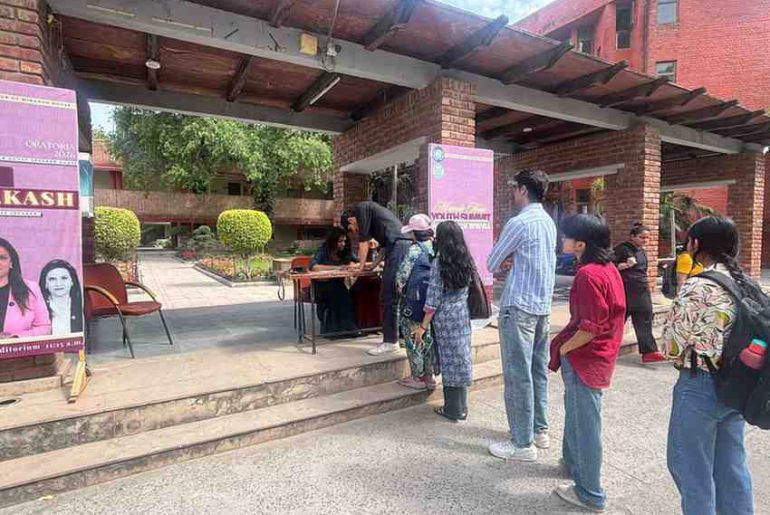
On 11th April, Asian News International (ANI) editor, Mrs. Smita Prakash, wrote on X that she was invited to Miranda House as the Chief Guest by the MUN Club, Suvakta for a speaker session at the Mini Auditorium. She had been invited as a part of the MUN Club’s fest Oratoria 2026 for a speaker session on Day 2, to address the audience on “Feminism and Global Politics”.  However, despite arriving before the scheduled time, she posted in her video that none of the students nor members of the staff were present to greet her, except barely 4 to 5 students while the event was expected to have a turnout of 150 to 300 attendees.

While the event was scheduled to start at 11:00 AM proceeded by the welcome of the Chief Guest at 11:15 AM, Mrs. Prakash after arriving at 10:58 AM, left the venue around 11:04AM. She took to X at exactly 11:17 AM, expressing her frustration. She expressed distrust about the convener of the event being “supposedly stuck in traffic on a Saturday,” and said that she wanted the principal, students, and staff of Miranda House to learn that “tardiness is equal to disrespect.”

However, according to the President of Suvakta, the participants had queued up outside the venue, as they were instructed, so that their confirmation emails could be checked. She stated that it was 11:00 AM when the emails were being checked and that Mrs. Prakash had requested on arrival for the session to commence earlier than the scheduled time, but due to the infeasibility of the request, the organisers had no choice but to deny. 

Speaking to DU Beat, the President dismissed allegations of a boycott on the grounds of conflicting political ideology, revealing that a large number of students, including medical students, students from distant colleges, and IITs, had turned up for the event. She added that the convenors and core council of Suvakta had tried to persuade her to stay, apologising for the inconvenience caused to her, but Mrs Prakash did not wish to listen to their requests. She said,

We were very disappointed, and we even apologised, but unfortunately, the session could not begin. People were very disappointed, so of course, we had to issue a wider apology as well. The formal apology was issued officially by our  club at around 4 in the evening,” 

A medical student who had left their surgery posting to attend the event, writing to the PR Head of Suvakta, said, “The guest entered and exited all in the course of 10 minutes…she posted a video saying there was no audience. We were right outside waiting.”

Another student attending the event wrote,

“I was super excited about the speaker session because I myself aspire to be a journalist. It was a space filled with [young women and men], and many of us admire and learn from such a public figure. It was so disheartening to see her act like this,”

A student from IIT Delhi, said that they had left their classes in hopes of an insightful interaction. He added,

“We were exploring the stalls before the seminar, around 11 and were just coming to the venue when we saw that ma’am had already left, which was quite disheartening because the session was scheduled to start at 11:15.”

A misunderstanding of the itinerary was what had supposedly caused this miscommunication between the event organisers and the Chief Guest. Miranda House has also issued a formal apology to Mrs. Prakash for the supposed delay both on her email, as published by the Chief Guest, and on LinkedIn. She has publicly accepted the apology on X and wrote, “Thank you Miranda House for this mail. Apology accepted. As we say in Punjabi, mitti pao. Wishing students and faculty the very best for the future.”

However, the event is not likely to be rescheduled. Regardless, Miranda House states that it hopes that Mrs. Prakash will likely return to campus in the near future.


Read Also: Hansraj College Fest Witnesses Chaos; Alleged Stabbing and Fights Ensued

Image Credits: President of Suvakta


Souparnika. S. Rajkumar

[email protected]