
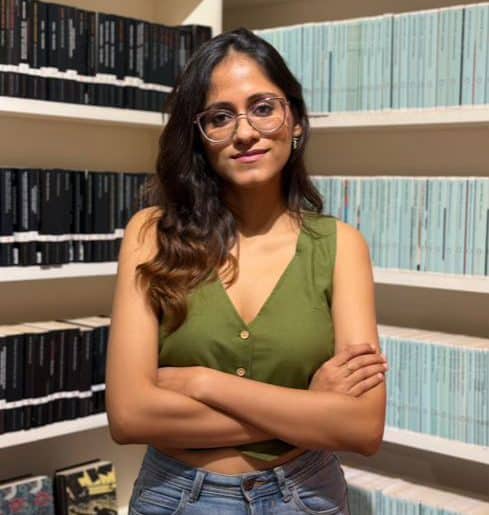
An alumnus of LSR, Ria Chopra is a freelance writer and creative consultant, and (un)officially the neighbourhood internet anthropologist. Chopra’s pop culture trivia reels and the Gen Z analysis essays have earned widespread acclaim. With her debut non-fiction book, Never Logged Out, in the pre-order phase, DU Beat reached out for a conversation about Gen Z and the Internet Culture.
Shikhar: If you had to pick one pop culture moment that stands out as your personal favourite, what would it be? Which one, in your view, has had the strongest influence on this generation?
Ria Chopra: I have too many favourites to be able to pick one, but a recent one would be Zeenat Aman’s Instagram debut and the posts and writing she would publish on the platform. It was lovely in all aspects: to see an older person engage with social media, to have such a legacy star reveal their innermost thoughts and feelings in moments when they were at the peak of their fame. I think the most influential one would be any of the large-scale changes in the world of internet and social media: the advent of Jio, the launch of Instagram Reels, or even the gradual change in social media from being a space of connection to a space of commerce. I think these have had deep-seated impacts on how Gen Z engages with the world around them.
Shikhar: The internet has increasingly become a “third space” for our generation, especially in the post-COVID world. How do you see this shaping the experiences and interactions of DU students?
Ria Chopra: Should we call it that? I think one of the prerequisites of being a third space is that it should be accessible to everyone, and while it may be easy for us to overlook this, the internet is still out of reach for many women, lower-income groups, etc. It is also an inhospitable place for many people to be their fullest selves. That being said, I do agree that it has become a huge space of interaction and interpersonal engagement—for many people, digital socialising is where it’s at. Amongst DU students, I see a lot of intergroup conversation online; on the r/delhi subreddit, for instance, or Twitter threads and Instagram pages, which have DU students sharing experiences and trying to help each other. Hyperlocal communities of this sort can be extremely useful and supportive, especially for young adults, and I love that this has translated to the digital world too.
Shikhar: Pop culture shapes much of our daily lives, from our outfits to the phrases we use. Do you think internet culture and fandom discourse have begun to replace traditional political and literary forms of expression?
Ria Chopra: I don’t think so. Pop culture, along with literary and political discourse, has always been one of the vocabularies of expression that exist. In fact, I would say that pop culture, internet culture, and literary culture references can all fall under the overarching umbrella of political expression. Something I like to say is that the “personal is cultural”, and as we all know, the personal is political too. There’s a false discourse being created online about internet/pop culture vs literary/artistic discourse, which I think has been overblown. One replacing the other or being good/bad compared to the other isn’t true. I think dissecting pop culture and internet culture can be a very politically expressive act, while it is also entirely possible to uncritically engage with literature (like the ‘Performative Man’ trend) and hence strip it of its depth entirely. As long as we are thinking, we are good.
Shikhar: In recent years, cinephile and pop culture circles have developed a sense of elitism, where people look down on others for not recognising references. This often ties back to unequal access to cultural capital and knowledge. Do you think pop culture is losing its essence as a middle ground between high and low culture?
Ria Chopra: Our cultural knowledge has always been a function of our privilege—of the language we speak, the money we have, the access we enjoy, and the things we are allowed to engage with. This is why I would rebel against describing anything as ‘high-brow’ or ‘low-brow’—who decides what the ‘high’ and the ‘low’ is? Elitism or snootiness in art domains simply represents a set of people unwilling to accept their own privilege and to try to understand art in other ways. Whenever I see ‘cinephiles’, critics or anyone else looking down on others for not getting references, I just zone out and move on—I can’t bring myself to respect that kind of discourse.
Shikhar: The revival of Y2K aesthetics and 90s cinema among today’s students comes with varied interpretations. Some call it commercialised nostalgia. What, in your view, drives Gen Z’s fascination with the 90s and 2000s?
Ria Chropra: Multiple factors, the largest one being a huge sense of crisis permeating our existence today, birthing in us a desire to retreat into a warmer, safer cocoon of what feels like a better time—our childhood. Many of us older Gen Zs also remember that time tangibly: the early days of the internet, the early sense of rebellion in OTT, the drive of playfulness on websites and social media, and yearn for that feeling of discovery and curiosity that used to exist in our pop culture and internet culture experiences. It felt more fun, you know? I talk about this in my upcoming book too, but I think there’s also a generational coming-to-terms right now with the effects the internet has had on us. In other words, one day we logged in, and then we never logged out, is the title of my book too. I do think that nostalgia is rose-tinted, though it was a horrible time politically—feminist conversations weren’t as mainstream as they are now, and society wasn’t as progressive as it is now. So we should be careful what we wish for.
Shikhar: One question I love asking everyone: who’s your favourite pop culture icon? And what’s one piece of pop culture you’d recommend everyone experience?
Ria Chopra: I hate this question. How am I supposed to pick one? If you force me, at gunpoint, to say it, then my favourite pop culture icon is Shah Rukh Khan, obviously. Pop culture I’d recommend everyone experience is the entirety of AR Rahman’s Bollywood work (I’m a Hindi speaker, so I connect more with his work which is in Hindi, though his work in other industries is also great), and also the full 16-video YouTube series of the Berklee College of Music’s rendition of his music.
Read Also: Social Media Vilification of the Nerd Archetype
Image Credits: Sanjana Chopra
Shikhar Pathak