Tag

Harassment

Browsing

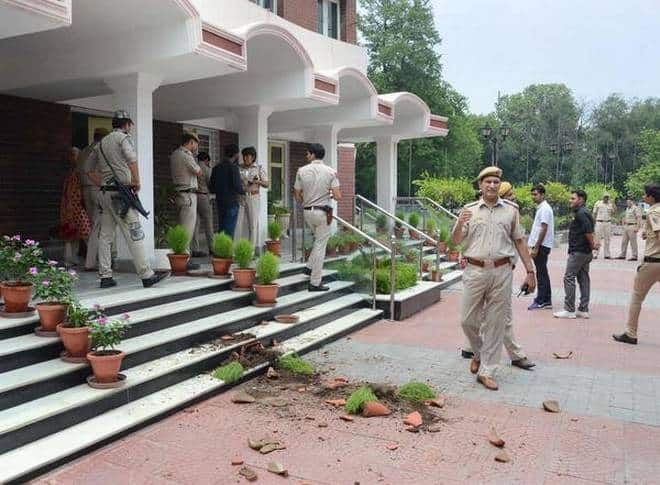
Protests broke out in Daulat Ram College (DRC) as students gathered in large numbers outside the Principal office to protest against the alleged harassment of a minor student by a faculty member.

On 31st January 2018, a complaint was lodged in the Maurice Nagar Police Station against an Ad-Hoc professor of the Political Science Department of Daulat Ram College (DRC), University Of Delhi for allegedly molesting and harassing a minor student.

The student, in her complaint, elucidated that the professor in question would often stare at her and wink during classes. She mentioned that he made lewd remarks and even asked her to join him for a cup of coffee alone during off-days and enquired about her relationship status. “He told me I am looking hot and sexy and then touched me inappropriately and tried to come closer to me,” the student cited in her complaint. Upon refusal from her side on his advances, he threatened to fail her in the internal examinations. The student, who was in her first year of college, was reported to be greatly aggrieved and troubled by this exchange. According to reports, the student was repeatedly told by college authorities to not pursue a legal course of action.

Soon screenshots of the text message exchange between the student and the professor were circulated online in the college groups where they went viral. The students collectively decided to protest this matter to demand immediate action from the college authorities. The student body comprising of over 700 individuals from all departments of the college assembled in front of the administration block of the college at 11:30 AM and shouted slogans in unison like “We want justice”. Several signs and posters were hoisted conveying “We stand together”, “Arrest him, fire him”, “DRC stands against harassment”.

The professor accused was present in the college during this time and quickly retired to the staffroom after a group of girls went to prevent him from taking classes. The protests then began outside the staff room and the students collectively raised slogans and chants.

The Students Union of the college was in communication with the principal of the college and ensured the students that action will be taken against the accused. The basic demand of students was for the speedy arrest and rustication of the accused. The police officials arrived and the professor was escorted to the principal’s office, after which students became a little less agitated.

The principal towards the end addressed the gathering of the students and had an open conversation with them regarding this matter where she ensured and promised the students that the professor in question will not return to the college campus again. She re-iterated that harassment will not be tolerated in the institution and that she will do her best to ensure the well-being of her students.

Nidhi Upadhyay, Vice President, Daulat Ram College congratulated the students on the successful demonstration that was carried out collectively and instructed the gathering to disperse and resume with their classes.

However, after the dispersal of the students, members of Student’s Federation of India (SFI) barged into the college baring their party flags and posters without any permission from the authorities, injuring two female guards in the process. They demanded the establishment of a “GSCASH committee” (Gender Sensitisation Committee against Sexual Harassment). They stipulated to meet with the principal of the college without any prior appointment, however, they were asked to vacate the college premises by teachers and students because of the lack of permission, and by the virtue of DRC being a Non-DUSU (Delhi University Students Union) college.

Feature Image Credits: The Hindu

Bhavya Banerjee

bhavyaba@dubeat.com

Kinjal Pandey

kinjalp@dubeat.com


Bollywood films and songs are often laced with sexism, which does injustice to both women and men by turning the former into a victim and the latter into an aggressor.

“Filmi dhun pe dekh ke tujhko

Seeti roz bajaun”

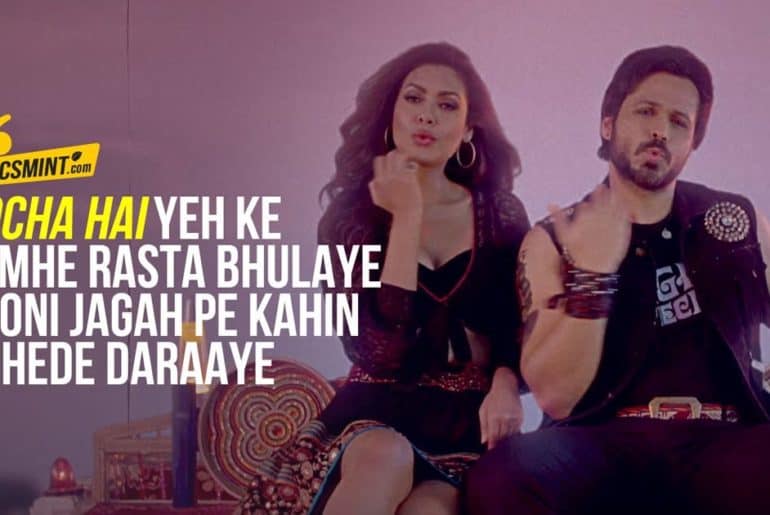
“Socha hai key tumhe rasta bhulaye

Sunee jagah pe kahin chhede daraye”

The aforementioned lyrics have been taken from the songs “ and “Socha Hai”. These songs have steadily been climbing the charts and continue to be extremely popular. The concept of remixing old Bollywood songs and repackaging them to a younger audience has now become the Bollywood norm. Though these songs may evoke nostalgia, it is not the only emotion these remixes incite. With their lyrics and visuals, these songs normalise everyday sexism, stalking, and harassment.

The difficulty with highlighting sexism is that people don’t ever find it legitimate or problematic “enough”. When people, especially women, call out the casual sexism in films, they are labelled as “overtly sensitive buzz kills” or, “feminazis”. When women complain against being inappropriately touched in the metro, people around them respond with “ mein chala karo na (madam,then travel in the ladies’ coach).

The wage gap has been labelled a myth, and marital rape is legal in our country because as Ms. Maneka Gandhi, Union Minister for Women & Child Development, resonates, “It is considered that the concept of marital rape, as understood internationally, cannot be suitably applied in the Indian context due to various factors like level of education/illiteracy, poverty, myriad social customs and values, religious beliefs, mindset of the society to treat the marriage as a sacrament.” Even when brutal crimes against women take place, for instance the Nirbhaya rape case, people have the audacity to blame it on the actions of the victim – her clothing, her company, her social habits, and more.

In short, there is always justification for harassment and rape. We, as a country, do not regard crime against women or even everyday sexism as a problem, we do not acknowledge our problematic mindset. And, believe it or not, our films do play a significant role in that. Our films, on a regular basis, show male characters actively pursuing their love interest by following her around, annoying her, troubling her, and refusing to take no for an answer. In a recent example, in the song “Hans Mat Pagli” from the film “Toilet – Ek Prem Katha”, Akshay Kumar pursues Bhumi Pednekar by stalking her. He sits outside her house, follows her around, climbs trees to secretly photograph her, attacks other men who so much as look at her, and more. This kind of behaviour is not new to Bollywood; this has been going around for so long that it has now been ingrained in our society and we don’t even find it odd anymore. In a country where only 30% of people live in urban areas, in a country where interaction between the sexes is discouraged, this is even more problematic.

When impressionable young men, who may not necessarily be in touch with non-familial people of the opposite gender, watch these films, their idea of romance and love gets distorted. The hero ends up dating the heroine as a result of his shameful antics. Consequentially, young men come to the conclusion that stalking a woman is perfectly normal and acceptable. The idea that this behaviour is unusual or strange never comes to their mind because nobody talks about relationships openly and only films create the idea of what love should be.


Films don’t just affect how young men choose to conduct themselves, but also affect how young women think of themselves. When films portray women as reluctant and naïve, as someone always shying from both active romantic and sexual relationships, it sets the norm of how women should act in real life. It takes away the autonomy of women and establishes that “good” women should never ever want “it”, “it” being both love and sexual contact. When we make women asexual beings, who can only be pursued but can never pursue, we make sexuality in women unacceptable and thus legitimise moral policing.

The “good” women in these films are tragically ignorant and reluctant. Despite liberalisation, greater education for women, and better employment opportunities, the narrative of the reluctant woman has remained the same. From 1972, when Jaya Bhaduri sang “Nahin Nahin, Abhi Nahin” to Randhir Kapoor, to 2017, when Kriti Sanon sang “Na Na Na Na” to Sushant Singh Rajput, the idea of a woman being passive and shy hasn’t changed. If you paid attention to the number of times women said “nahin” or “na” (no) in a Bollywood song, you would be appalled.

Even though sexuality is expressed in Bollywood through ”item songs”, the sexualisation is acceptable only as long as it caters to the male gaze. Overtly sexual Bollywood songs are only deemed acceptable when they cater to men. These songs mostly include a bunch of men (ideally consuming alcohol) leering at a skimpily clad woman. So while the “strictly chaste love” portrayal has considerably reduced, any kind of sexuality in films is limited to women being treated like objects.

“Main toh tandoori murgi hun yar, gatak le mujhe alchohol se” which translates to “I am barbecued chicken, swallow me with alcohol” were the lyrics in the song “Fevicol” from the film Dabangg 2. These crass and crude lyrics are not one of a kind. In fact, the censor board continues to pass films with outright bizarre and perverse innuendos and dialogues, such as Grand Masti, as long as they objectify women. But when women try to seek autonomy and express their sexuality without catering to the male gaze, for instance in “Lipstick Under My Burkha”, the film is denied release because it is “lady-oriented”.

Some people say art imitates life, but I am of the belief that life imitates art as well. It is a symbiotic relationship, where one is dependent and influenced by the other. When people say Honey Singh’s sexist lyrics or films that objectify women do not affect and influence people, they are willingly choosing to live in an alternative reality.

Bollywood continues to be crucial in affecting our lives, and actors continue to be revered like gods. One cannot deny the influence that Bollywood has on us. These songs normalise harassment, they make women look like puppets who have little autonomy and control over their lives, they sexualise women, and only cater to the male gaze. It is high time that they are called out for the same.

The next time someone releases a song called “Tu cheez badi hai mast mast”, which clearly objectifies a woman, I hope their song does not become a chartbuster. I hope people become aware enough to recognise this kind of behaviour as deplorable and actively seek better forms of entertainment.

Feature Image Credits: Lyricsmint


Kinjal Pandey

kinjalp@dubeat.com


In another case of assault by ABVP members, Kawalpreet Kaur, the president of Delhi University All India Students Association (AISA) has alleged harassment by ABVP members as she visited Satyawati College. She alleges that the ABVP members harassed her, tried to physically restrain her and verbally abused her.

She has lodged a FIR against members of Akhil Bharatiya Vidyarthi Parishad (ABVP), the student wing of RSS. The FIR has been registered under Section 154 of CrPC (Code of Criminal Procedure) along with Sections 354, 354(A), 509, 341 within the IPC 1860 Act against the ABVP activists.  The police complaint has been filed against Vikram Singh Tomar, ABVP convenor of Satyawati College, Dharamprakash, Adw-ait Sharma, Mantu Sharma and few unknown activists.

[quote]I had gone to Satyawati College in order to meet a professor there for my own academic work as well as to meet some of my friends and AISA activists. As soon I entered the college ABVP members gathered around me and started harassing me[/quote]

-Kawalpreet Kaur, AISA President, Delhi University

She alleged that the ABVP activists tried to bully her by saying  ‘tum kya kar rahi ho’, ‘show us your ID card’, ‘we shall not tolerate any anti-national activities here’, ‘Satyawati ko Ramjas nahi ban ne denge’. She resisted by saying that it was her right to visit any college. After this, the ABVP members started shooting her videos on their phones. As she resisted their action, she was abused by Dharam Prakash, whom she alleges as an outsider. “They questioned my nationality, called me a slut”, says Kawalpreet.  Meanwhile, one of the students who asked ABVP members to steer clear of her way was also roughed up by them.

Later hearing the commotion, the Principal of the college reached the scene and dispersed the crowd. “He supported me and helped me file a complaint against them”, says Kawalpreet.  She expects the police to take strict action against those who advocate for goonda-gardi in the campus.

Image Credits: News Nation

Oorja Tapan

oorjat@dubeat.com