Author

DU Beat

Browsing

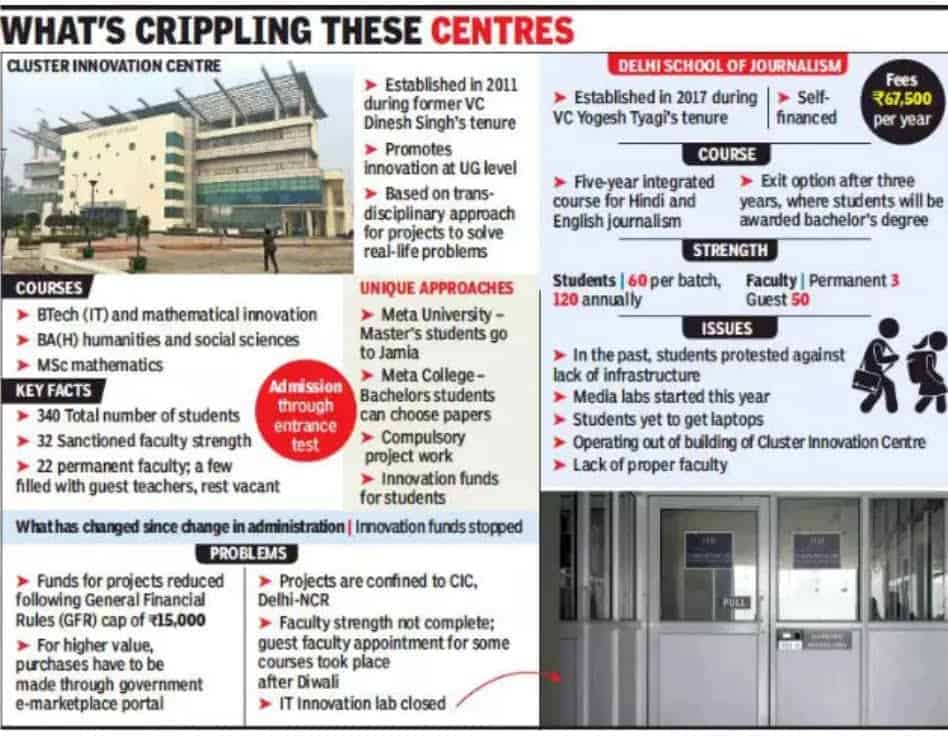
Cluster Innovation Centre (CIC) faced a severe fund crunch as the year 2019 came to an end due to limited resources which also affected the recruitment of new staff. 

Cluster Innovation Centre (CIC), established in 2011, gave students an opportunity to envision a trans-disciplinary approach. CIC offers three courses:  B.Tech and Mathematical innovation, M.Sc in Mathematical Education and B.A. in Humanities and Social Science. These courses are uniquely designed for students to work on several projects with an aim to offer constructive solutions to problems faced by people in real life.

Professor Yogesh Tyagi was appointed as the new Vice Chancellor of the University of Delhi (DU) in 2016 and according to the students and the Faculty, the functioning of the centre changed completely. With a cap of INR 15000, students were asked to go through a lengthy Government e- marketplace (GEM) procedure. The new regulations imposed within CIC are hampering the projects of students. Many students complained about having to negotiate for items on GEM, and if the items were not available, the students were not left with many alternatives to turn to.

IMG-20200115-WA0017

Image Credits: The Times of India

Students mentioned various other problems that they had to face when the new regulations were introduced in CIC after Dinesh Singh’s tenure ended as the Vice Chancellor. Although, there are no serious constraints on funds for humanities projects, the other two courses may require some modifications. CIC projects are solely based in Delhi-NCR which may overlook real issues faced by people outside the targeted area.

Former CIC Director, M. Chaturvedi had previously commented on CIC’s dire need for growth and modification in the curriculum. He had added that the projects formulated by students could help the centre in earning a considerable amount of revenue. With a fund crunch, students and staff in solidarity believe that modifications within the centre must be introduced. However, there has been no official word from the officials of the University regarding this issue.

Feature Image Credits- DU Beat Archives

Suhani Malhotra

[email protected]

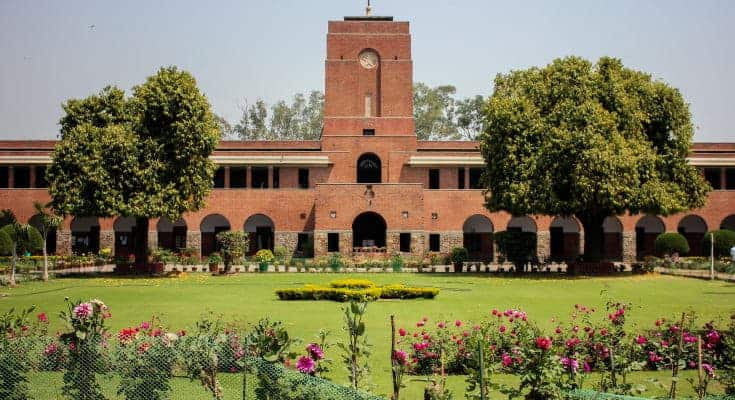
Delhi University’s (DU’s) St. Stephen’s is set to provide short-term courses on Public Policy and International Relations, and other disciplines.

On 12th January, Saturday, St. Stephen’s  College of the Delhi University launched a special centre, namely St. Stephen’s Centre for Advanced Learning (SCAL), for conducting certificate and advanced level courses across a variety of new disciplines. This includes a short-term certificate course on Public Policy and International Relations (PPIR).

An official statement said provided that the SCAL’s PPIR course is to be held over a period of six weekends at the College. It is designed so as to allow young graduates to gain a better understanding of the field, vis-a-vis, “how it is framed, theorized, formulated and implemented”.

The first batch of students for the same is highly diverse and comprises of entry-to-mid-senior level professionals from the fields of banking, development, consultancy, NGOs, politics, and healthcare. The course deals with a variety of topics including policy formation, development, and implementation, policy economics, international relations, international security and diplomacy, and more.

The official statement also suggested that SCAL will involve its intellectual alumni with vast experience and expertise in the said field, across Government Ministries, Departments, and Corporate boardrooms. This includes current and former ambassadors, bureaucrats, and leaders from various fields.

Shashi Tharoor, Congress Minister of Parliament (MP), Mani Shanker Aiyer, diplomat and MP,  and Amitabh Kant, CEO, NITI Aayog, are some of the listed resource persons for this course. An inaugural programme was hosted in the College for the same on Saturday during which an inaugural lecture was delivered by Tharoor.

Other discipline-specific courses have also been planned and announcements regarding this will be made soon on the College website, provided the official statement.

Feature Image Credits: Surbhit Rastogi for DU Beat

Aditi Gutgutia

[email protected]

The National Green Tribunal has ordered a halt and a status quo on the construction of the housing complex being built adjacent to the University Campus.

As on 13th January, the National Green Tribunal (NGT) has ordered a status quo on the construction of the housing complex being built adjacent to the Delhi University’s (DU’s) North Campus. A Bench headed by Adarsh Kumar Goel, the NGT Chairperson Justice, has said that an evaluation of relevant data is required by a Joint Committee comprising representatives of the Central Pollution Control Board (CPCB), Ministry of Environment and Forests, and Indian Institute of Technology Delhi, in regards to the “Precautionary Principle” of Environmental Law, which requires that, if there is a strong suspicion that a certain activity may have environmentally harmful consequences, it is better to control that activity now rather than to wait for incontrovertible scientific evidence.

“The Committee may also undertake carrying capacity study of the area with reference to the project in question-based on the relevant data. The study may be completed preferably within two months,” the Bench said.

This statement by the tribunal comes after a hearing of the plea by DU challenging the environmental clearance granted to the construction of the housing project by Young Builders (P) Ltd. in North Delhi, and CPCB will be acting as the nodal agency for coordination and compliance.

The plea argued the order of the State Environment Impact Assessment Authority (SEIAA) granting Environmental Clearance (EC) for the housing complex located at 1 and 3 Cavalry Lane and 4 Chhatra Marg at Civil Lines in Delhi. It was filed and challenged through advocates Sanjay Upadhyay and Salik Shafique and claimed that the EC could not be granted by the SEIAAbecause it is within 10 km from Critically Polluted Area- Najafgarh, Naraina, Wazirpur and Anand Parbat are critically polluted areas. The EC can, therefore, be granted by the Ministry of Environment and Forests but not by the SEIAA. The project is also in the Silence Zone, being within 100 m from Delhi University and Patel Chest Institute, and also in the water scarcity zone with the Sulphate content of groundwater being above the specified limit.

“As per the project proponent’s own report, the project is susceptible to subsidence and liquefaction during a major earthquake. A geotechnicalinvestigation needs to be carried out which has not been done. Traffic plans/congestion filed by the project proponent with the application is based on the statistics of July 2011,” the plea said.

Several protests- backed by student-led parties and activist groups, as well as the Delhi University Teachers Association (DUTA)- have been protesting against the construction of the high-rise in the University’s North Campus.

Feature Image Credits: DU Beat Archives

Shreya Juyal

[email protected]

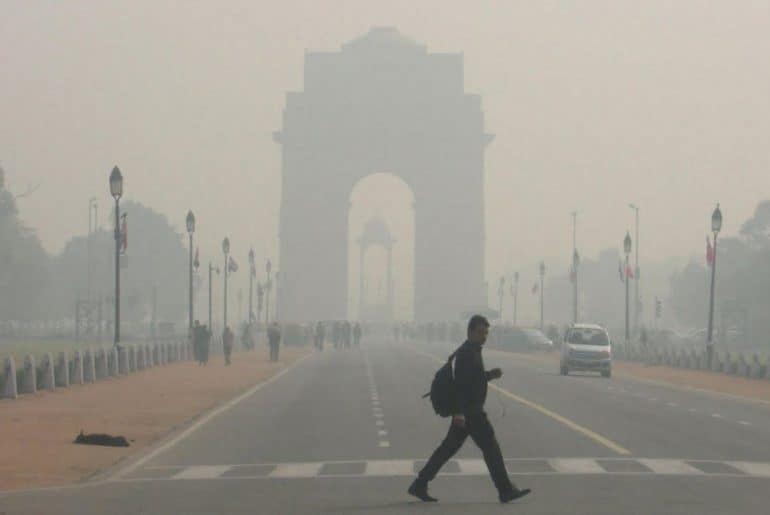
The University of Delhi (DU) has decided to cancel all the first period classes of the colleges under the University, due to heavy fog and biting cold in the Capital.

On 4th January 2020, DU released a notice, stating its temporary policy to cancel all morning classes till 15th January. DU has adopted this policy due to the heavy presence of fog in the capital.

The notice reads, “This is to inform all the students of the University of Delhi (DU) that all classes taking place in the first period according to college timetable are to be cancelled till the 15th of January due to the presence of heavy fog in the city. The classes will continue as intended from the second period onwards.”

For some colleges like Hindu College, the first period starts at 8:50 a.m, for some like Mata Sundri College, it is 9 a.m, while for some colleges like Miranda House, it is at 8:30 a.m.

Jogesh K Tyagi, Vice Chancellor, DU, added that the University administration has taken this decision as a step towards its new policy of being more student-friendly. They plan on carrying out more policies like this in the future.

Rajesh R. Verma, a Professor of Hindi, said, “The students in the morning are drowsy during the first period and the fog will only heighten this. Moreover, students a lot of times tend to skip the first classes due to the fog. This might lead to them missing out on their course material. I think this is a move taken in favour of the students and I appreciate it. I hope the students won’t miss the other classes now.”

Sakshi Sharma, a student of Hansraj College, said, “I welcome this change made by DU. It takes me about two hours to come to college from home. In the fog, it’s especially difficult to travel. It’ll be a great relief for both students and teachers.”

However, Saumya Rao, a third-year student, disagreed with the move, saying, “I don’t think there’s any point in cancelling the classes. Bad weather days may come and go, but I don’t think our routine life should change because of that. This will only lead to us missing out on our syllabus and then cramming during the end. I wish the University focused more on important things like infrastructure.”

While this is going to be implemented only till 15th January, worsening of weather conditions may lead to further changes and cancellation of classes.

Disclaimer: Bazinga is our weekly column of almost believable fake news. It is only to be appreciated and not accepted!

Feature Image Credits: DU Beat Archives

Satviki Sanjay

[email protected]

India has had an illustrious history of protests. Be it the pre-independence times or the post. But nearly every time, these protests are accused of being mere activities of political agendas and activities.

Whenever we see something going wrong in the social or political sphere in the nation, we take to the streets. Be it the recent Citizenship (Amendment) Act (CAA) and National Register of Citizens (NRC) agitations or The Bihar Movementof 1974, the students along with political leaders wanted the nation to change. But both these agitations till some extent had a political flavour within them. The Leftist parties for the latter and Jana Sangh(Later Bhartiya Janata Party) for the post, and it is these political ideologies that have made many of these protests a victim of political rivalries, thereby weakening their credibility. Though politics in protests has helped protests to become effective but this effectiveness always comes with a price.

Nick Srnicek and Alex Williams, writers of the book Inventing the Future: Post capitalism and a World without Work, question the power of marches, protests, and other acts of what they call folk politics.

They said, “These methods are more habit than solution. Protest is too fleeting. It ignores the structural nature of problems in a modern world. The folk-political injunction is to reduce complexity down to a human scale.”

This impulse promotes authenticity-mongering, reasoning through individual stories (also a journalistic tic), and a general inability to think systemically about change.

Take the example of the DTC bus burning near Jamia Millia Islamia. Every time the protestors want to raise a valid critical point over the CAA and NRC legislation, they are shut out by the pro-legislation groups on this violent act. Though the protestors claim that they weren’t a part of the act which was later proved to be true but their credibility was compromised using fake news and propaganda.

Violence has always been part of the political process. Politics does not merely encompass the actions of Legislative assemblies, political parties, electoral contests and other formal trappings of a modern Government. Protest activities of one form or another, efforts to dramatize grievances in a fashion that will attract attention, and ultimately the destruction or threatened destruction of life and property appear as expressions of political grievances even in stable consensual societies like India.

In one sense, to speak of violence in the political process to speak of the political process itself; the two are inseparable. The ultima ratio of political action is force. Political activity below threshold of force is normally carried on with the knowledge that an issue maybe escalated into overt violence if a party feels sufficiently aggrieved. So be it Hindutva for the Bhartiya Janata Party, the dynastic politics for the Congress or the worker and trade union politics for the Left parties.

Medha Patkar, an environmental activist, who was a leading figure in Narmada Bachao Andolan, was able to stall the Narmada Dam project. She was successful as her lobbying made the World Bank withdraw its funding from the project. Still the project was completed with the help of public funding and the dam stands tall on the Narmada River. This tells us that protesting is a right of citizens of a democratic nation but protesting responsibly is also a duty.

We protestors have to be rational in our demands or otherwise protests get intermixed with politics. Like the students’ union protested against the change of names of Aligarh Muslim University and Banaras Hindu University into Aligarh University and Banaras University in the 1970s. Just think about the level of communal harmony this simple name change could have done.

If we look at the protests today as an exercise in public awareness, they appear to have had mixed success at best. Their messages are mangled by an unsympathetic media smitten by images of property destruction—assuming that the media even acknowledges a form of contention that has become increasingly repetitive and boring. Therefore we should always protest whenever we want to see change but always be responsible and rock hard on our goals.

As in recent times many student politicians have started protesting, not for student problems but for popularity, which is not only catastrophic now but also in the future.

One of my close friends told me that hearing about JNU students protesting has become so common that now people don’t even care. Though I have my own interpretations but still I can’t help but agree with him on a great extent.


Feature Image Credits:The New Yorker


Aniket Singh Chauhan

[email protected]

 

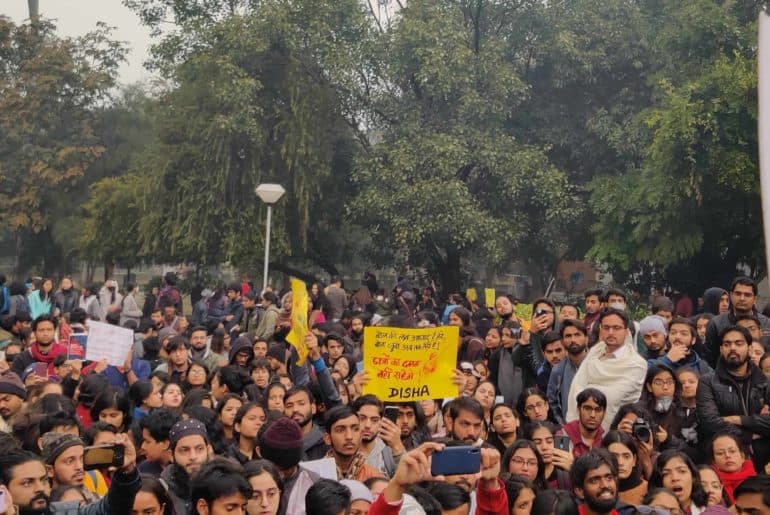
On Wednesday, 8th January 2020, students of University of Delhi (DU) gathered in hundreds and took to roads to express their agitation towards the Government in a peaceful protest

Commencing from the Faculty of Arts, North Campus, the March comprised of not only students but teachers and various political organisations as well. This commotion was followed by the immoral series of events that recently took place in Jawaharlal Nehru University (JNU) after similar incidents happened in Jamia Millia Islamia (JMI) and Aligarh Muslim University (AMU). Students of DU protested in solidarity with those who were victims of police brutality and hooliganism inside college campuses.

 Maitreyi, member of Pinjra tod said, “DU students came together in large numbers today to send a message to this fascist government that the students and citizens of this country won’t be scared into silence. The terror they have unleashed within universities like Jamia, AMU, and JNU clearly shows that the government fears students and wants to suppress any kind of dissent. The thousands of students that turned up today to protest against this fascist government shows that they’ve failed. Colleges like St. Stephen’s which is deemed to be highly isolated from campus politics and larger politics as well saw that 400 hundred students protested and marched within the campus and then marched towards arts faculty. Most colleges have a turnout of hundreds of students here today. The government has failed to instil fear in students through Delhi police. We will march and we will fight this government every step of the way. we won’t forget Kashmir or the trans bill and demand that this fascist state immediately rolls back the CAA and cancels the NRC/NPR. We will continue to be on the streets until this is done.”

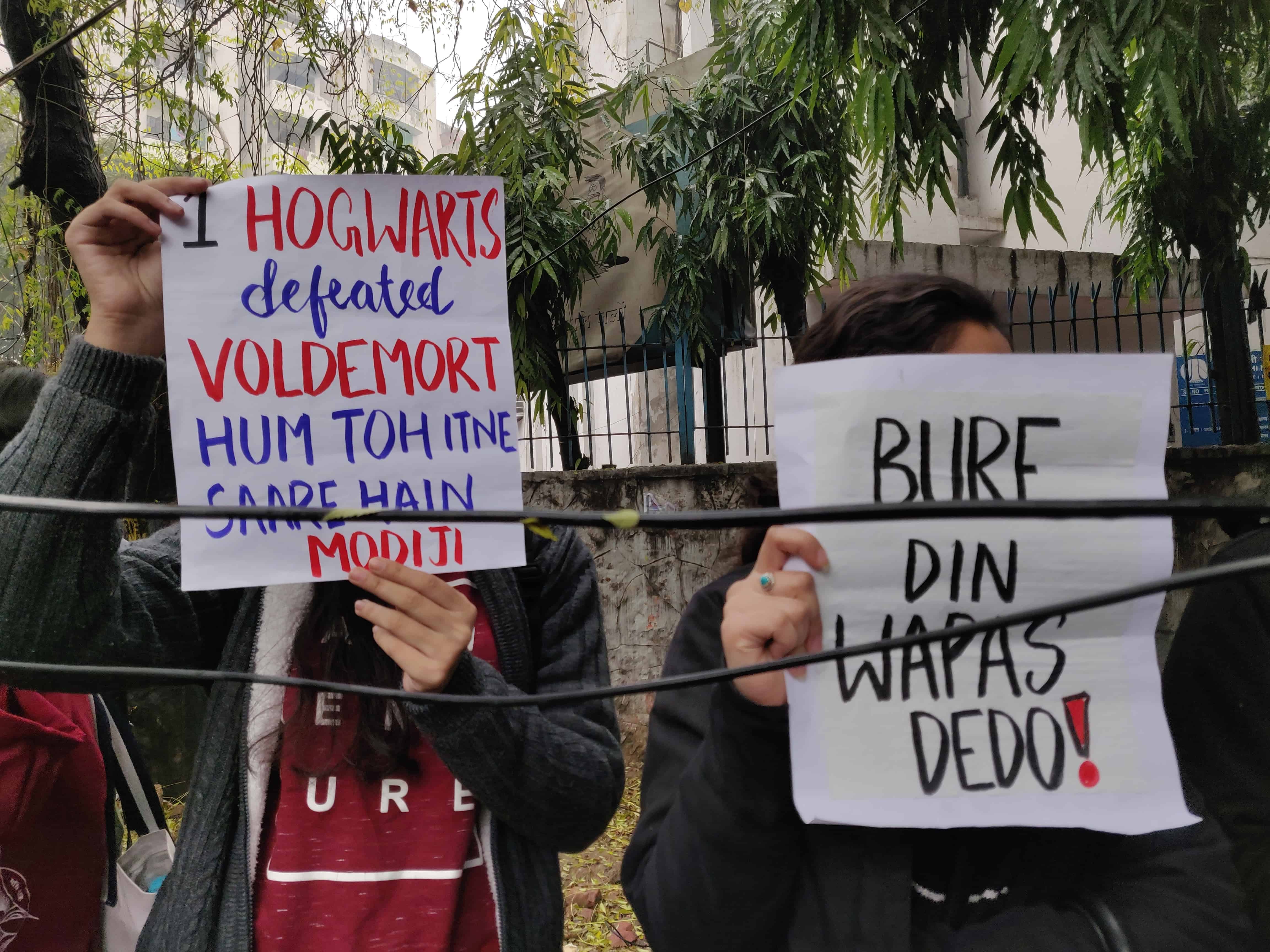
Rain in January’s cold weather didn’t deter the students from expressing their dissent against the Government. The crowd chanted slogans against Akhil Bharatiya Vidya Parishad (ABVP). Students also showed up with Dhapli (Tambourine), making the protest musical. The outcry of students heard slogans like Inquilab Zindabad and CAA wapis lo (Revoke CAA). The rally covered the entire North Campus with constant energy throughout.

Simran Chawdhary, Member of United Against Hate (Umar Khalid’s organisation) said, “This is against the violence that penetrates on our campuses that are supposed to be our safe spaces for us to debate and deliberate. You can’t enter campuses with lathis and axes and getaway. This fight won’t end until each one of us feels safe. Our campuses are our home and no one will get away with violence. This is against ABVP goons who get funded by the right wing organisations. It’s high time Modi and Amit Shah stop behaving like arrogant goons.”

 At the end of the rally, various speakers took turns to express their resentment against the Government. Gautam Bhatia, renowned advocate spoke about how the recently proposed actions of Bharatiya Janata Party (BJP) tarnishes the efforts of those great leaders who made India, the Nation it is today. Gulfisha from Seelampur also addressed the crowd and shared with them how she and dozens of other women stand strong even after the atrocities faced by them in Seelampur.

The protest didn’t stay restricted to one cause but rather, different groups of people uprose on different issues and came together to support each other.

Featured Image Credits: Avni Dhawan for DU Beat

Avni Dhawan

[email protected]

Students participated in a peaceful protest held at Jesus and Mary College on 8th January 2020,  where they also faced problems by the Student Body due to restriction of dissent by the Administration.

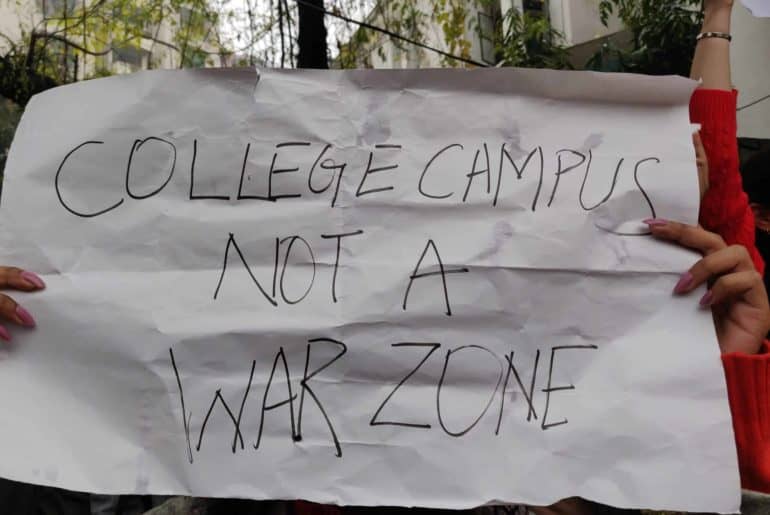
Jesus and Mary College (JMC) saw students gather on the 8th of January 2020, outside the campus in Chanakyapuri, New Delhi at 10:30 a.m. to show solidarity against the brazen misuse of political power and violation of basic Fundamental Rights by the Government. The state-sponsored violence meted out to the students of various educational institutions across the country was strongly condemned, in a silent protest held in front of the campus.

1578488824620_3_IMG_20200108_111548

Students condemning State-sponsored Violence

Despite the absence of the Students’ Council from the place of protests, a message was circulated by them before the protest, condemning violence and voicing their support for freedom of speech in a peaceful way. The students, however, were sceptical at the apolitical stance of the student council, which had earlier refused to comment and release a statement of solidarity condemning the violence citing different views of students. Some students also cited the pressure from the administration when it came to the college societies and departments to release solidarity statements.
Later, the Students’ Council urged the students to come inside the college campus and protest after seeking permission from the Principal.
Some students chose to continue the protest outside the college campus.

The silent protest was held in a peaceful manner, a welcome change that encouraged and fostered dissent in the erstwhile apolitical campus of JMC. Students held banners criticizing the government and the forces of law and order. A healthy dialogue about democracy was fostered, in a protest that saw attendance by students from other colleges too. No disruptions by the police occurred. A group of students joined the protests at The Faculty of Arts, North Campus immediately following this at 12:00 p.m. Students affirmed their support for dissent against authoritarian forces, condemned the growing excesses of fascism within the country and stood up for student-worker unity.

Feature Image Credits: Paridhi Puri for DU Beat

Paridhi Puri 

[email protected]


Got a literal cold feet situation? Boots. Broke your toenail while dancing your heart out at the New Year’s party? Boots. Feeling as active as a sloth? Boots. Feeling “Vogue”? Boots.

Boots are the ultimate saviour. With “Dilli ki sardi” hitting us hard, the halos over boots only become more visible.

With winter in full bloom, it is time to go back to your cart where you saved those pair of boots to combat Delhi’s very own feet freezing January.

For the days when you feel like life is not that bad, take out your old friend out- jeans! Pair it up with a pair of calf-length boots, put on a high neck sweater and a long coat and you are good to go. Here is an advantage- the traitor denims that left you midway for those dirty ankle ends might not be an issue anymore.

For just another lazy college day, get your hoodies to work, put on your denims and get yourself a humble pair of flat-fleece lined boots.

Auburn

Feature Image Source: Anushree Joshi for DU Beat

We have got you covered even for days when sudden parties and dates knock on your door. Get your acquaintance- loose sweater from the bottom-most shelf of your wardrobe, get a wide belt and put on knee-high boots. If you feel like the inner diva needs to vent out, do not hesitate from adding a bold element of thigh-high boots.

For the street style look which needs no introduction, get your cargo pants, oversized knitted sweater, an infinite scarf, a beanie and lace-up boots. Viola! Your Instagram feed gets a treat.

 Pull off power dressing with the “bell-bottoms & boots” master plan. Take out those bell-bottoms and tuck in a knitted sweater. Put on a blazer and finish the look with classic leather boots. A statement piece adds a kick to the outfit.

When it comes to boots, one cannot help but think about fests. Don’t look at, but look like the Vogue model you had your eyes glued on to. Fetch a well fitted high neck sweater, denim skirt a chunky pair of earrings and ankle boots for the perfect chic look.

Style tip #101: Get your peep toe heels out of the closet’s darkest cranny and find stockings of the same colour. Prick a hole at the bottom of the stockings and wear the stockings over the heels, letting the hole fit under the heel and slide the stockings up to achieve the sock-fit boots look without burning a hole in your pocket.

 Feature Image Credits: Instagram: @streetstylestoreofficial

Priyanshi Banerjee

[email protected]


In an unforeseen turn of events, Bhupendra Tomar, leader of ‘Hindu Raksha Dal’, a right-wing organisation claimed responsibility for the attacks on the teachers and students of Jawaharlal Nehru University (JNU) in Delhi on the 5th January 2019.

 Bhupendra Tomar, leader of Hindu Raksha Dal, a right-leaning organisation claimed responsibility for the attacks on the teachers and students of Jawaharlal Nehru University (JNU) in Delhi on the 5th January 2019 through admission in a video.

The video surfaced on the internet after being posted by a Twitter user where Tomar, popularly known as Pinki Bhaiya blamed the university for being a hotbed of “Anti-National” and “Anti-Hindu” activities.

Bhupendra Tomar, said in the video, “We take full responsibility for the attack in JNU and would like to say that they were our workers. The way these people have been behaving over the years, especially the people in JNU, it is against our religion. We can never tolerate such anti-national activities,”.

According to the ANI report on the issue, Government sources have informed that the claims made by Pinky Chaudhary (Popular name for Bhupendra Tomar) are under investigation. The sources also informed that the Delhi Police is using CCTV footage and facial recognition to identify the masked men and women.

He also added, “These people live in our country, eat here, study here and indulge in anti-national activities. Hindu Raksha Dal will never tolerate this and again attack whoever tries such ideals.”

He with much pride also confirmed the party’s ideology to engage in further violence in the name of nationalism.

Affirming to that, Pinky Chaudhary said, “If in future others indulge in similar anti-national activities, we will again carry out a similar action in those universities. We take responsibility to carry out these actions.”

The gruesome display of violence that the students and teachers of JNU endured where more than thirty people were injured along with tremendous property damage by the people, who were seen carrying around sticks and rods has succumbed to this video.

JNU Students’ Union (JNUSU) president Aishe Ghosh was also injured in the incident and was rushed to AIIMS along with the other injured people. All of them were discharged on Monday.

This incident raises major questions about the safety of the students on campus. However, both JNU Students’ Union (JNUSU) and Akhil Bharatiya Vidyarthi Parishad (ABVP) have blamed each other for the violence.

Feature Image Credits: ANI

Khush Vardhan Dembla

[email protected]

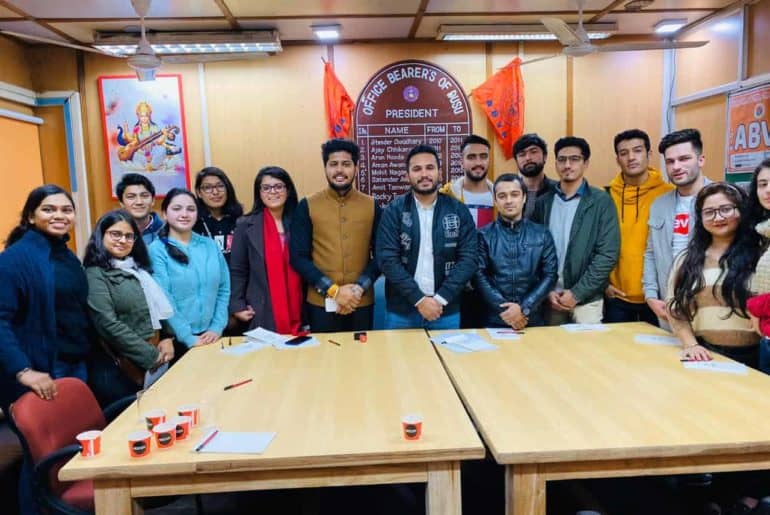
On 3rd January 2020, Akhil Bhartiya Vidhyarthi Parishad (ABVP) led Delhi University’s Student Union (DUSU) met with foreign students of University of Delhi (DU) for establishing DU’s first foreign cell to cater to the needs of  foreign students studying in DU.

Akhil Bhartiya Vidhyarthi Parishad (ABVP) led Delhi University’s Student Union (DUSU) held a meeting at DUSU office in University of Delhi (DU), North Campus on 3rd January 2020 to listen to the needs and difficulties of foreign students studying in DU.

In this discussion DUSU Vice President, Pradeep Tanwar along with DUSU Joint Secretary, Shivangi Khairwal were also present to extend full support to the students.

The motive of the meet was also to discuss the establishment of DU’s first-ever Foreign Cell. Approximately 25 students from 5 different nations put forward problems faced by them during their academic stay in Delhi. Some of the common problems discussed were fee structure, accommodation and linguistic barriers.

The foreign students in anonymity also stated, “We often feel isolated as we don’t belong to the same culture. However, events like this bring pressing issues like Regional Registry office procedure in the discussion.”

In response to their issues, a committee of 15 students from various countries will be launched to pertain to the needs of foreign students particularly and solve the current issues they are facing. A Panel to curb the most prominent communication barrier would also be established.

Selection of the working committee would be done through done Google search and advertisements and then a personal interview would be conducted to judge their merit. 

Akshit Dahiya, President, DUSU has invited all interested foreign students to fill the google form to constitute a committee and has offered a volunteering position with DUSU to rest, who are not selected.

Akshit Dahiya, in a conversation with DU Beat, said, “Much more can be expected from DUSU under the leadership of ABVP to uplift the students of DU. A new committee has also been established to promote sports in the Varsity. More than 12,00,000 lakhs have been allocated to give scholarships to students of Economically Weaker Sections (EWS), Persons with Disability (PWD) and of Extra-Circular Activities (ECA) and Sports quota.”

“This is an initiative taken to strengthen the relations between foreign students and ensure their warm stay in India as they pursue their study” Akshit Dahiya added.

Feature Image Credits:Akshit Dahiya


Chhavi Bahmba

[email protected]