
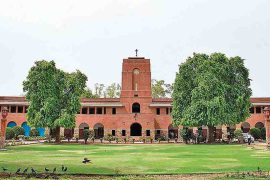
St Stephens College has started the procedure for inducting a new principal for the college.
The National Commission for Minority Education Institutions (NCMEI) upheld DUTA’s contention that Thampu’s appointment was “patently illegal.� And asked Delhi University (DU) to start the process for the appointment of a principal at the college, Thampu had been appointed Officer on Special Duty in 2006 for a term of three years after former principal Anil Wilson took over as the vice-chancellor of Himachal Pradesh University.
The Church of North India (CNI), which governs the college, met members of the college’s supreme council and decided to induct a new principal by March 15. The Church claims that the controversy on Thampu’s appointment has adversely affected the college’s reputation.
“The college’s unblemished reputation has certainly taken a beating due to this controversy. The appointment of a principal is now inevitable,� said Reverend Enosdas Pradhan, general secretary, CNI.
Thampu can apply for the principal’s post, but will have to go through the screening procedure. “He (Thampu) is a priest of our church and is responsible for bringing the college back into the folds of the CNI. We would be happy if he applies for the post,� Pradhan said.
The college has laid down new eligibility conditions for principal. The new criteria, met by incumbent Reverend Valson Thampu, do not require the principal to meet standards fixed by the University Grants Commission (UGC).
According to the new conditions, the principal need not be a PhD. But he/she has to be between 50 and 60 years old. The supreme council of the college said the new principal would have to meet only its criteria, not those set by the UGC or Delhi University.
Less than a year ago, however, it had said it was mandatory for the new principal to meet standards set by both the bodies. The UGC and Delhi University require all college principals to be PhDs. Though Thampu recently got a PhD in theology from Allahabad Agricultural University, the National Council for Minority Education Institutions has asked DU to scrutinise the legitimacy of the degree.

10 comments
Viman Gupta says:
Feb 25, 2008
UGC Regulations 2000 dated 04.04.2000 besides prescribing minimum qualifications for various categories of teachers also mandates constitution of definite composition of selection committee for selection of college principals (para 3.5.0) and lecturers (para 3.1.0).
The duly amended Delhi University Ordinance rightly incorporated above said regulations, makes it compulsory for all its constituent colleges including minority colleges too strictly follow same during such selections.
Delhi, Kerala, Allahabad and Madras High Courts have endorsed constitution of stipulated selection committees as mandatory with no exception to minority or even unaided institutions citing Entry 66 as supreme in the national interest in general and particularly in the interest of maintenance of standards of higher education. Remember landmark TMA Pai case which ruled that standards of education are not at all the part of college managements.
St.Stephen College being affiliated to Delhi University too shall abide by University’s ordinance stipulations on qualifications and even selection committee. The selection turmoil of OSD will no doubt remain as a stigma on one the best reputed college on Indian land. Now College management has decided to go for fresh selection of principal since NCMEI has already struckdown earlier appointment of Valson Thampu as illegal and violative of University rules.
To avoid further litigations and disgrace it will be wiser if Supreme Council of college convenes stipulated selection committee and selects principal, even if it is same Mr.Thampu. The College management being appointing authority reserves the right of appointing any one suiting its philosophy from the candidate shortlisted by selection committee having VCs atleast 3 member panel too besides other members of 2 from Governing Body, principal and professor.
The composition of selection committee is as follows:
3.1.0. Selection Committees for Lecturer in a Private College.
1.Chairperson of the Governing Body of the College or his/her nominee to be the Chairperson of the Selection Committee.
2.The principal of the concerned College.
3.One Senior teacher/Head of the Department (of the concerned subject) preferably having not less than 10 years of services as a teacher.
4.Two nominees of the Vice Chancellor of the affiliating University of whom one should be a subject expert.
5.Two subject-experts not connected with the college to be nominated by the Chairperson of the governing body out of a panel of names approved by the Vice Chancellor.
3.5.0 For the Post of Principal
1.Chairperson of the Governing Board as Chairperson.
2.One member of the Governing Board to be nominated by the Chairperson.
3.Two Vice Chancellor’s nominees, out of whom one should be an expert.
4.Three experts consisting of the Principal of a College, a Professor and an accomplished educationist not below the rank of a professor (to be nominated by the Governing Board) out of a panel of experts approved by the Vice Chancellor.
At least four members, including two experts, should constitute the quorum.
The process of selection should involve the following: –
(a)Assessment of aptitude for teaching and research
(b)Ability to communicate clearly and effectively
(c)Ability to analyse and discuss.
(d)Optional: Ability to communicate may be assessed by requiring the candidate to participate in a group discussion or by exposure to a class room situation/ lecture, wherever it is possible.
Viman Gupta says:
Feb 25, 2008
HC upholds UGC regulations for constitution of Selection Com
Chennai, Feb 06
Madras High Court has upheld the University Grants Commission (UGC) regulations, mandating aided colleges to constitute multi-member Selection Committees to appoint lecturers and principals.
Justice V Ramasubramanian upheld the UGC regulations and dismissed the appeals filed by Association of Management of Private Colleges and the principal of a Tuticorin-based private college.
The issue was related to UGC regulations of 2000 on minimum qualifications required for the appointment and career advancement of teachers in Universities and institutions affiliated to it.
The regulations prescribed the qualifications for direct recruitment to the posts of principal, professor, reader and lecturer and for career advancement of lecturers as well as constitution of committees for selection to these posts.
Counsel for the appellants conceded that there could not be any challenge to the rule prescribing minimum educational qualifications for appointment to various posts. The challenge hence was restricted only to the portion on the need to form committees to appoint lecturers and principals.
The appellants confined their challenge only to paragraph Nos.3.1.0 and 3.5.0 of the U.G.C. Regulations, which provide for the constitution of the Selection Committees as follows:-
3.1.0. Selection Committees for Lecturer in a Private College.
1.Chairperson of the Governing Body of the College or his/her nominee to be the Chairperson of the Selection Committee.
2.The principal of the concerned College.
3.One Senior teacher/Head of the Department (of the concerned subject) preferably having not less than 10 years of services as a teacher.
4.Two nominees of the Vice Chancellor of the affiliating University of whom one should be a subject expert.
5.Two subject-experts not connected with the college to be nominated by the Chairperson of the governing body out of a panel of names approved by the Vice Chancellor.
3.5.0 For the Post of Principal
1.Chairperson of the Governing Board as Chairperson.
2.One member of the Governing Board to be nominated by the Chairperson.
3.Two Vice Chancellor’s nominees, out of whom one should be an expert.
4.Three experts consisting of the Principal of a College, a Professor and an accomplished educationist not below the rank of a professor (to be nominated by the Governing Board) out of a panel of experts approved by the Vice Chancellor.
At least four members, including two experts, should constitute the quorum.
The process of selection should involve the following:-
(a)Assessment of aptitude for teaching and research
(b)Ability to communicate clearly and effectively
(c)Ability to analyse and discuss.
(d)Optional: Ability to communicate may be assessed by requiring the candidate to participate in a group discussion or by exposure to a class room situation/ lecture, wherever it is possible.
The qualifications prescribed by the impugned Regulations, indicate only the bench mark or bottom line, viz., the eligibility criteria for selection. All candidates, who fulfil the eligibility criteria, cannot stake a claim for automatic appointment to any post. Candidates, who satisfy the eligibility criteria, can only lay a claim for consideration for appointment and the purpose of constitution of a Selection Committee, is to enable the appointing authority to select the best out of all those eligible for appointment.
It is seen from paragraph Nos.3.1.0 and 3.5.0 of the impugned Regulations that the intention of the UGC, is to pack the Selection Committee, with as many academicians and subject experts as possible, so that the best of talents is selected for appointment. A comparative chart between the composition of the Selection Committee under the impugned Regulations and the composition of the College Committee under the Tamil Nadu Act, would amply demonstrate this point.
Therefore, the Selection Committee prescribed by the impugned UGC Regulations, commands more credibility and it would certainly ensure co-ordination, determination and maintenance of high academic standards in higher educational institutions. Consequently, the impugned regulations squarely fall within Entry 66 of List I and hence, it is within the legislative competence of the University Grants Commission.
Any Regulation framed in the National interest must necessarily apply to all educational institutions and that the right under Article 30(1) cannot be such as to over ride the National interest. If the right under Article 30(1) itself is not absolute, it is needless to state that the right guaranteed under Article 19(1)(g) is also of the same nature since it is always subject to any reasonable restriction imposed by law framed under Article 19(6). Therefore, we hold that the mandate issued under the impugned Regulations, to constitute Selection Committees for the appointment of Lecturers and Principals, is not violative of Article 19(1)(g) of the Constitution.
The selection of Dr.J.Mohanraj as the Principal of Kamaraj College, Tuticorin, (appellant in W.A.No.585 of 2006) by a Committee other than the Selection Committee prescribed by the U.G.C. Regulations, 2000, has been rightly set at naught by a well-considered judgment of the learned Judge.
Citing Supreme Court orders, the judge said the direction to consitute Selection Committees aimed at enhancing the quality and calibre of teachers selected for appointment and would fall within the UGC’s preamble of coordination and maintenance of standards in higher educational institutions
Viman Gupta says:
Feb 25, 2008
DS
DELHISCOOP
Minority Educational Institution, DU & UGC at loggerheads over qualitative selection of Lecturers
By Unregistered Visitors, Section Education
Posted on Wed Sep 19, 2007 at 07:48:39 AM EST
In the wake of the judgement from the Delhi High Court, which set aside the appointment of lecturers of Jesus and Mary College (an aided minority institution), Delhi Teachers’ Association has urged all colleges to effect selection by a duly constituted committee in accordance with the UGC regulations. Instead, aggrieved college has filed an appeal in Supreme Court.
The petitioner by an advertisement invited applications for the sanctioned posts, constituted its own Selection Committee and recruited teachers. However, the affiliating Delhi University questioned the constitution of the Selection Committee as it transgressed provisions of its Ordinance amended as per UGC guidelines.
The Selection Committee composition shall comprise (i) the Chairperson of the Governing Body, (ii) the Principal of the concerned college, (iii) two nominees of the Vice-Chancellor, of whom one should be a subject expert, (iv) two subject experts not connected with the college to be nominated by the Chairperson of the governing out of a panel approved by the Vice Chancellor, (v) one senior teacher/Head of the Department of the concerned subject.
The petitioner knocked the doors of High Court, as its first petition seeking relief was dismissed by National Commission for Minority Educational Institutions. The petitioner contended that being an aided minority institution, it cannot be compelled to constitute a stipulated Selection Committee which violates its fundamental right to administer under Article 30(1) of the Constitution of India.
In reply the University submitted that the condition imposed couldn’t be construed as an interference with the rights of college to administer its affairs. Being affiliated with the University it is required to comply with said requirement just like other colleges since there is no discrimination in the application of impugned Clause whose object is to ensure greater transparency and objectivity in the selection process. The University’s learned counsel cited long line of judgments that have examined the reasonableness of the regulatory measures that a State might seek to impose on the functioning of minority educational institutions.
Dismissing the writ petition for want of merits, Justice D.Mukul Mudgal and Dr. Justice S.Muralidhar said that the petitioner has failed to discharge its onus of showing that impugned selection committee provision infringes the rights of minorities under Article 30, because, the choice of nominating two neutral subject experts from the approved panel of University remains with the college, hence it cannot be said that there is no freedom of choice. Two members nominated by the Vice-Chancellor out of a total of seven cannot be said to give such member any unfair advantage. As regards two nominees of the Vice Chancellor, one is the subject expert who can only ensure a better quality of selection. This can by no means be said to be detrimental to the interests of the minority institution. The petitioner has not been able to demonstrate how two persons nominated by the Vice Chancellor from amongst nine persons constituting the Selection Committee can actually override the decisions of the Selection Committee which otherwise is comprised of persons nominated by the petitioner itself, and the nominees of the management command a healthy and overwhelming majority.
University sources described it as a “landmark judgement” and said it would eradicate arbitrariness in the selection of lecturers. When meritorious quality oriented candidates are selected, it would ensure standards of excellence promoting quality teaching.
by Saha Bahu, Source:DelhiDailykhabar-Education
Nandini says:
Mar 7, 2008
MODE OF SELECTION OF COLLEGE PRINCIPALS & TEACHERS IN UTTARPRADESH
At Allahabad High Court, 7 writ petitions by Committees of Colleges (including minority) questioning the constitutionality of the UP Higher Education Services Commission Act, 1980 were dismissed by the Division Bench of J Yatindra Singh and J Vijay Kumar Verma, on being found devoid of merit.
UP Higher Education Services Commission, Allahabad published the advertisements no. 38 and 39 on 24.04.2005 for selection of the Principals and Lecturers. The petitioners challenged the selection process on the ground that the Commission Act is ultravires the Constitution.
The petitioners contended that the Commission Act, by selecting the teachers and principals, imposed unreasonable restrictions on the conferred rights of colleges. The petitioner’s counsel further submitted that the University Grant Commission (UGC) had already laid down minimum standard for appointment of teachers and uniformity in the standard of teaching has already been achieved, it is unreasonable on the part of State to make appointments in the colleges. The UP State Universities Act 1973 provided sufficient safeguard for appointments of teachers. This procedure coupled with the minimum qualification set up by the UGC ensured uniformity and by not permitting the management to appoint the teachers is unreasonable restriction.
After hearing both the parties, the learned judges upheld impugned restrictions as reasonable on the basis of TMA Pai case, para 71 to 73 (all then 11 judges of Apex Court were unanimous on it) which answered the question no.3 of that case “In case of private institutions (unaided and aided including minorities), can there be government regulations and, if so, to what extent?.
The West Bengal Higher Education Commission Act is similar to the Commission Act and the appointments there are also made on the recommendations of the West Bengal Higher Education Commission. Brahmo Samaj Educational Society was claiming itself to be a minority in West Bengal and challenged the vires of the WB Commission Act. This matter was dealt in Brahmo Samaj Educational Society and others versus State of West Bengal and others: (2004) 6 SCC 224 (the BrahmoSamaj case). In this case, the Supreme Court neither decided the issue of minority/ denominational status of Brahmo Samaj, nor declared the WB Commission Act as ultravires. The court disposed it off with the direction to the State to reconsider the matter in the light of paragraphs no. 71 to 73 of the TMA Pai case. The counsel for the petitioners, relying upon the BrahmoSamaj case and paragraph 71 to 73 of the TMA Pai case unsuccessfully submitted that the Commission Act is ultravires the Constitution.
As a measure to curb favouritism, illegality and whimsicality in public appointments, the Commission Act was enacted on the recommendations made in 1975 by the Vice-Chancellors, and is applicable to all the affiliated colleges including minorities. The selection committees of the individual colleges were expensive; often selection meetings were postponed because a common date did not normally suit the members of the selection committee. The University Grant Commission too, however, expressed the view that, in the first instance, the proposed Commission may be confined to the selection of teachers in affiliated and associated colleges only.
Section 24 of the original Act (prior to 2004 amendment) provided some exemption to the minority institution but even here the minority institution were only required to take approval before making appointments. The post amendment position is that now the Commission can only make appointments in respect of the posts for which the State Government has undertaken liability to pay the salary, if the candidate fulfils the minimum qualification prescribed by the statutes of the different universities. It would have been better if the State had left the appointments to the Committee of management but in case it does not do so then it can not be said that the State has imposed unreasonable restriction by entrusting right to make the appointment to the Commission. The Court declared it as reasonable restriction within the meaning of Article 19(6) as well as article 26(a) of the Constitution. The altered UP Higher Education Commission Act, 1980 was upheld as intra-vires the constitution.
J.Stephenraj says:
Mar 15, 2008
I had been keenly observing for past 2 and half years, the hot issue concerning appointments of teachers and principals in minority colleges. Only privileges they have in this regard is that they need not follow roaster system. Other than that all statutory regulations will be applicable to all MEIs as applicable to Non MEIs. Still more privilege allowed is none other than that, no Act, rule, regulation or bye-laws can command that MEIs shall appoint only Mr.A or Mr.B or say one who is senior most or one who has more degrees behind his name. Such norms shall leave some scope for choice to them, so that they can appoint best among them for the upliftment of their community students.
UGC selection committee as stipulated in its regulation of 04-04-2000 only specifies a composition comprising few academicians, experts apart from College Principal, HODs etc and ofcourse Chairman of Governning body. The so called outsiders have been given no power of appointment at all. Their purpose is only to shortlist along with the insiders (College secretary, Principal) in Committee the adequate number of best candidates among all those interviewed. Appointing authority is vested in College Secretary so insiders can appoint the best they feel suitable from the short-listed ones.
But the fact is that all MEIs all these days were appointing Principals and lecturers on substantive post without calling these experts. The moot question arises in the mind of any rationale person is that how can non-academicians and non experts can appoint academicians. Chairman of Governing Body in most of the cases is not even an under-graduate. Principal in the present era of advancement is only an outdated expert that too in one discipline only. Moreover Supreme Court have made it clear in TMA pai case that standards of Higher education donot fall under ambit of College Managements at all. Definite composition of selection committee and qualifications are no doubt are standards of Higher Education.
It is commendable that Courts are rightly checking the maladministration rooted in so called MEIs. Under the garb of Minority status, it is students of MEIs who are ultimately allowed to suffer. How can Courts deprive students of MEIs of quality teaching? The purpose of establishing huge colleges is not to benefit Managements or wrongly appointed Staff but to benefit students and their parents who aspire good studies and consequently good future for kith and kins.
After Delhi, Allahabad, Madras and Kerals HCs, now once again Delhi HC have coomanded Stephens to aboide by statutory selection norms.
News repoted in daily:
Abide by UGC norms, court tells St Stephen’s College
Express news service, Posted online: Friday, March 14, 2008 at 2340 hrs IST
New Delhi, March 13
The Delhi High Court has directed St Stephen’s College to abide by the process set out by the University Grants Commission (UGC) for the appointment of a principal. Justice Gita Mittal made it clear on March 12 that “anything done in the matter relating to the appointment of a principal shall abide by the final outcome� of the present litigation.
Sachin Dutta, counsel for petitioner Sheetal Singh, alleged the college deviated from UGC and university guidelines in selecting Valson Thampu as principal.
“In the matter of said appointment (of principal) the respondent shall also ensure compliance with qualification requirements prescribed by the UGC and the law,� ordered Justice Mittal, posting the case for further hearing on April 29 later this year.
Dutta went on to contend that Thampu did not have a PhD degree in a “subject taught in the college�.
“The college rather than promoting the implementation of UGC guidelines is trying to dilute the eligibility criteria by keeping Thampu as principal,� said the counsel, adding that Thampu did not qualify as a principal because his doctorate in Theology was not taught as a subject in the college.
Last month, Nyanjot Lahiri, dean of colleges, Delhi University, had also sent a letter to St Stephen’s College, highlighting the violation of UGC and Delhi University ordinances in the advertisement issued by the college for selecting a principal.
While the UGC requires a candidate to have 55 per cent or equivalent grades in a Master’s degree, advertisements dated February 12 only asked for a Master’s degree.
“The qualification and the experience mentioned in the advertisement is not matching with the minimum qualifications prescribed by UGC regulations and adopted by the university under Ordinance XXIV,� she has written.
According to Vinod Chowdhury, the media advisor of St Stephen’s College, the college has to wait for the courts to decide a course of action. “The case is currently being handled by the court and so we are not in a position to speculate about Valson Thampu’s future as principal,� he said.
Raj Munger says:
Mar 17, 2008
Thampu (acting Principal, St Stephen College) resigned on March 15 2008, since Delhi High Court ordered College to strictly abide to the University Grants Commission (UGC) guidelines on appointing principals. Thampu’s appointment had violated UGC guidelines on at least 4 counts.
The first was that the para 3.5.0 of UGC Regulations dated 04.04.2000 stipulated definite composition of selection committee for appointing Principal was not constituted. Delhi University has already rightly amended its ordinance in the lines of UGC selection committee norms with no exemption to minority institutions as also in UGC norms. On March 12, Delhi HC too has directed college to follow selection process as in UGC norms and not any independent process on its own.
The designation of OSD is an unsanctioned one.
He lacked vital basic degree of Ph.D when he was appointed as OSD. And now he has one but that too is not recognised by UGC.
And lastly, he held three posts, OSD at Stephen and member of College Governing Body and member of National Commission of Minority Educational Institutions.
News reported is that the Stephen’s Management is for fresh appointment as per UGC guidelines. But further violation of selection committee norms will trigger yet another controversy. Even NCMEI in its order citing lack of Ph.D as per University ordinance, also highlighted that VCs panel of atleast 3 members was not formed when Wilson was appointed.
Nandini says:
Apr 2, 2008
Date:29/03/2008 URL: http://www.thehindu.com/2008/03/29/stories/2008032961980300.htm
——————————————————————————–
New Delhi
Wrangling over St. Stephen’s Principal continues
Staff Reporter
NEW DELHI: The tug of war between Delhi University and St. Stephen’s College over the qualifications required for the post of Principal continues.
The “final advertisement” issued by St. Stephen’s College this past week has prompted a communication from the University administration to the college governing body chairman, Bishop S.K. Singh.
The letter written by the Dean of Colleges, Nayanjot Lahiri, on Thursday instructed the governing body to ensure that the composition of the selection committee for the new Principal is done as per the norms of the University Grants Commission regulations that are also incorporated into the ordinances of the University.
With regard to the final advertisement, the missive also highlighted that it was unfortunate on the part of the college administration that it had removed the criterion on applicability of “qualifications/conditions laid out by the UGC/University” as mentioned in the second advertisement.
Also, the other condition of “preferable age” of the potential candidates to be between 50-60 years as specified in the last advertisement was “not in consonance with the UGC regulations as well as University ordinances”.
The Hindu
Judyjf says:
Apr 6, 2008
omg.. good work, dude
bharath nrayanan says:
May 18, 2008
The prestigious St.Stephen College is affiliated to one of the best-ranked in world and India’s top-ranked, Delhi University. For the present, both are at loggerheads, over the issue of mode of selection and appointment of Principal. After woeful experiences at National Commission for Minority Educational Institutions (NCMEIs) and Delhi High Court (HC), now it has knocked the doors of Supreme Court. But Supreme Court has asked college to exhaust its prayer completely at Delhi High Court before coming to it.
OSD SANS A DOCTORATE DEGREE?
In May 2007, the College grossly erred by appointing Rev.Vilson Thampu as acting Principal on the post of Officer on Special Duty (OSD), who did not have a doctorate degree, a mandatory requirement as per University ordinance and University Grants Commission (UGC) norms.
NCMEI’s ORDER – Go by University Ordinance!
The controversial appointment reached NCMEIs, which declared same as patently illegal for want of Ph.D., and also highlighted in its order the fact that college has erred by not recommending a panel of at least three names to Vice-Chancellor (VC) for approval of a candidate as an OSD, as required by Clause 7(3), Chapter XVIII of University’s Ordinance and asked the college to look for a regular Principal.
DELHI HC SAYS – Follow UGC norms
Rev.Thampu and the College Governing Body challenged the order of NCMEIs at Delhi HC. On 25th February 2008, Honourable Justice Gita Mittal refused to stay order of NCMEIs and hold Thampu’s appointment as patently illegal and on another petition, directed UGC to clarify on Thampu’s Ph.D status.
UGC found Thampu’s Ph.D., as unrecognized and invalid, citing Section 22 of UGC Act, 1956. On March 12, Court declared Thampu’s Ph.D., as illegal and directed the College to abide by the process set out by the UGC for the appointment of a principal and made it clear that “anything done in the matter relating to the appointment of a principal shall abide by the final outcome� of the present litigation.
On March 15, Rev.Thampu resigned from the post of OSD. The Governing Body of college then revoked all the decisions taken by Thampu as OSD of college.
SURPRISE U-TURN BY UGC
But the issue of illegality in Ph.D., suffered another turn. Times of India on 29.04.08 reported that the Thampu’s conversial Ph.D in theology is valid as found by an expert team of UGC under the justification that Allahabad Agricultural Institute is a “minority institution� and may conduct its theology courses in whatever mode it wants to as it has the right to do so�. But the fact is that no where in UGC Act 1956 and various rules thereunder any such exemption is available to minority institutions from any provision relating to standards of Higher Education. The exercise of second scrutiny of Theology Ph.D., by an UGC expert committee rewarded legitimacy to Ph.D., of Rev.Thampu.
IRREGULARITIES IN ADVERTISEMENT
Meanwhile, Governing Body of college by mid-February issued an advertisement to induct new Principal. The advertisement was tailored to suit selection of Rev.Thampu as Principal. The mention of 50-60 age criteria and the requirement that candidate shall be a member of Church of North India was violative of UGC and University advertisement norms. On the intervention of University and on direction by Court, college issued a fresh advertisement with minor corrections, but still it remained against UGC norms. The last date for applying to the Principal post twice extended upto May 10.
CONFUSED SUPREME COUNCIL AND GOVERNING BODY
The Supreme Council of College was scheduled to meet on May 12 to appoint Principal but meeting stood postponed. The reason cited was that many members were out of the State. But to everyone’s surprise, college reached Supreme Court on May 15 challenging the clause 7(2) of Chapter XVIII of Delhi University Ordinance 2002, since Delhi University by an ultimatum letter dated 29th April 2008 to college insisted that it shall go by proper selection committee procedure as stipulated in University’s Ordinance while appointing Principal or else face legal action. Having burned its fingers already at Delhi HC, college chose to go to apex court this time.
Supreme Council of College erred by going to Supreme Court as it has undermined Delhi HC’s direction of March 12, 2008 that “anything done in the matter relating to the appointment of a principal shall abide by the final outcome of the present litigation�, the one pending at Delhi High Court.
SUPREME COURT ORDERS – Retreat to Delhi High Court
On 15th May 2008, Supreme Court has asked St Stephen’s College to approach the Delhi High Court to test the constitutional validity of Delhi University’s right to appoint principals for the minority institution. A bench of Justices B.N.Aggrawal and G.S. Singhvi declined to hear the institution’s writ petition but allowed it to withdraw the same for approaching the Delhi High Court. In its petition, the college had challenged Clause 7 (2) of the Delhi University’s 2002 ordinance, which empowered the University to appoint principal for the college as being violative of the Constitution and destroying its minority character. The petition cited a number of judgements of the apex court wherein it had ruled that minority institutions enjoyed the absolute power to appoint teachers and principals for their respective institutions as provided under Article 30 of the Constitution.
CONFLICT – UGC based selection Vs Independent Selection by College
The University is insisting on due observance of its Ordinance, where as college argues that being a minority institution, it has the constitutional right to adopt its own method of selection and appointment of Principal sans including the nominees of University’s Vice –Chancellor on selection panel.
Incorporation of UGC Regulations on Selections into University’s Ordinance
The University of Delhi has rightly incorporated UGC Regulation 2000 dated 04.04.2000 in its Ordinance of 2002, as how every University and its affiliated institutions in India are under legal obligation to do. The same provision is exactly found in clause 7(2) of University Ordinance Chapter XVIII, that also has a mention that selection committee provision modified to bring it in Ordinance with UGC Regulations vide letter no. F.3-1/2000(PS) dt. 4.4.2000as directed by the Hon’ble Visitor vide MHRD letter no. F.4-22/2002-(Desk) (U) dt.7.1.2004
The para 3.5.0 of UGC Regulations 2000 dated 04.04.2000 specifies the composition of selection committee for selecting and appointing Principal in a Government aided college be it minority or non-minority. No dilution is allowed in its observance to minority institutions by UGC or Ministry of Human Resource Development (MHRD).
Similarly para 3.1.0 of UGC regulation 2000 specifies composition of selection committee for selecting and appointing lecturers. And that is what exactly adopted in clause 7(4A) of Chapter XVIII of Delhi University’s Ordinance, which has already been upheld by Division bench of Delhi HC in WP 5652/2006 and CM 4686/2006 filed by Jesus and Mary College, New Delhi. The UGC was 2nd Respondent in the case. The mandatory applicability of same clause to minority colleges was also endorsed by National Commission for Minority Educational Institutions. Now the Jesus and Mary College has gone for appeal of it by Appeal Civil 747/2007 at Supreme Court Bench of Justices B.N.Aggarwal and G.S.Singhvi and matter is pending since admitted on February 26,2007.
So, University ordinance gets authority from UGC regulation and UGC has authority from Entry 66 of List I, Schedule VII of Indian Constitution. As a result, every college shall simply abide by UGC norms and relevant University rules while selecting and appointing its Principal and lecturers.
Text of Clause 7(1) and (2), Chapter XVIII of Delhi University Ordinance
Clause 7(1) – The appointment of the Principal and other members of teaching staff shall be made after advertisement. The Principal should in addition to his duties
as Principal, be also be required to undertake teaching work in college, or the University.
Clause 7(2) – The appointment of the Principal shall be made by Governing Body (GB) of the College on the recommendation of a selection committee consisting of
the -
1.Chairman of the GB as Chairman of Committee,
2.One member of the GB to be nominated by the Chairman,
3.Two nominees of VC, out of whom one should be an expert.
4.Three experts consisting of the Principal of a College, a Professor and an accomplished educationist not below the rank of a professor (to be nominated by the GB) out of a panel of experts approved by the VC.
At least four members, including two experts, should constitute the quorum.
Prior to the final selection and appointment
(a) GB shall submit to the University a list of persons who have applied for the post of Principal, as also names of person, who may not have applied but whose names the Governing Body may desire to consider for the post, in a form as prescribed by the University and shall indicate the persons from whom, in their opinion, the final selection may be made;
(b) the list thus submitted by the Governing Body shall be considered by a selection committee constituted for the purpose and consisting of the following:(i) VC, (ii) Pro-VC, (iii) a nominee of the visitor; (iv) Chairman of GB of College; and (v) 2 members of Executive Council, nominated by it and
(c) on the recommendations of the selection committee the University shall transmit to GB a list of persons mentioned in order of preference whom the University would be prepared to recognise as Principal or, if none of the applicants are considered suitable, shall refrain from sendind a list, in which case the post shall be re-advertised:
Provided that where in the opinion of the VC, emergency action is called for or where in his opinion, it would be unnecessary to adopt the procedure prescribed in (b) and (c) above, the VC may indicate merely which of the candidates include in the list submitted by the GB under sub-clause 2(a) of Clause 7 of Ordinance XVIII, will not be acceptable to the University, briefly indicating ground for the decision. In such a case, the GB will be free to appoint any person from any of the candidates against whom no such disapproval has been indicated.
The process of selection should involve the following: –
(a)Assessment of aptitude for teaching and research
(b)Ability to communicate clearly and effectively
(c)Ability to analyse and discuss.
(d)Optional: Ability to communicate may be assessed by requiring the candidate to
participate in a group discussion or by exposure to a class room situation/ lecture, wherever it is possible.
DR. M. S. FRANK says:
Jan 14, 2011
Dear Bharath,
It was interesting to read what you have posted on Thampu’s appointment! As I am also challenging his appointment on the same grounds, I would be highly obliged if you can give me authentic copies of the following:
1. NCMEI’s order declaring Thampu’s Ph. D. in Theology as invalid
2. Justice Gita Mittal’s directive to UGC to clarify the status of Thampu’s Ph. D
3. UGC’s submission in response to Justice Gita Mittal’s directive in the same court
4. Court’s declaration dated 12th March 2008 saying that Thampu’s Ph. D is illegal
Expecting a favourable action from your end,
With regards,
DR. M. S. FRANK