Quacquarelli Symonds Rankings or better known as simply QS Rankings released Asian Universities Ranking List on May 13, 2014. While the sciences fared better by getting impressive spots (IIT Delhi-38th , IIT Bombay- 41st), the traditional universities such as University of Delhi, Benares Hindu University, University of Calcutta scored satisfactorily.
While rankings in general seldom matter in the overall assessment of an institution, the quality of education offered by an institute is surely a matter of concern. Once, a renowned magazine published a list of colleges in India that are at at the top for a particular course and later it was found that the college on #1 did not even offer that course! While this is not to cause ill repute to the nature of rankings and deter anyone from looking at rankings for making their personal decisions, but shift the focus from the numerical value of a rank to the qualitative assessment of an institution on the basis of certain parameters that WE deem important for OUR personal growth, not dictated by the parameters preferential to the authorities distributing ranks.
Moving on, the University of Delhi has been controversy’s favorite child for quite a while. Whether it be the FYUP or the autocratic non-democratic functioning of the Padma Shri VC, it has numerous issues that need to be dealt with. Here is my list of the changes that I would like to see in DU being implemented, which I believe can raise the quality of education, and maybe subsequently the unimportant rankings too-
1) Inclusion of a Statement of Purpose in the admissions process
Much has been said about how the Board Examination marks are not indicative of a person’s potential, except that of his potential to rote learn and present it on paper. In addition to this, what is important is that even if a student is not passionate about his subjects, he can still score decently in the Boards because of the way in which our evaluation system is structured; we don’t assess the student’s grasp over the concept, but how the concept has been put on paper.
Almost all international universities have the concept of writing a statement of purpose wherein the student is required to explain why he wants to do a particular course. This is not only reflective of the student’s passion for the subject but also helps the examiner gauge how much has the student engaged with the subject, how much has he mulled over the concepts and theories and most importantly, is he actively thinking about the subject? The amount of engagement a person has had with his subject prior to admission is also important as it is a significant marker of the future projects you’ll undertake once admitted to the University and even beyond that.
This becomes crucial in the context of improving the University’s admission of students, the research wing of the University and the larger intellectual ethos.
2) Valuing quality education over mere employability
One of the key arguments put forth by the VC in favor of FYUP was that it will increase the employability of students. While there is nothing wrong with concerns over the employment generation for the larger demographic dividend of the country, the problem arises when you begin to mould the intellect of the students in order to satisfy the larger market ideologies that are seldom governed by thirst for knowledge but rather by a production oriented approach that seeks to garner more money and eye balls through the medium of their undertaken projects. Think tanks are few in India, and for them a drive towards knowledge supersedes any other drive that the university is trying to impose upon us.
It is slowly creating a structure for students that designs them to submit to market oriented strategies rather than giving free way to the cultivation if the imagination of students. Moves such as FYUP are constant reminders of the regressive mentality of “padh likh ke afsar bano” that plagues the Indian mind. Rather, the end of education should be a refinement of one’s own intellect and personality that gives us the potential to negotiate with the world, carve our won way and create our own employments sans the “help” of FYUP.
3) The structure of the course and subsequent evaluation
Our course structure is designed in a way that even if a student has not studied the entire semester, and opens the book 2 days prior to exams, he can still score well, the reason being that the marking scheme is a set of extremely loose ended parameters that seldom negatively reinforce bad arguments and end up distributing marks. The previous Semester, I started studying 2 weeks before the exams and scored the fifth highest in college, not too bad, eh?
I’m not taking any moral stance on how many hours a student needs to put in for study, but what I’m stressing on is that a paper doesn’t evaluate how much has the student engaged with the subject. It involves a routine set of questions with a routine set of answers that can help you score decently well.
Processes such as writing term papers helps the examiner assess how much has the student gone beyond the text and made attempts to come up with his own theories and rhetoric, something absolutely essential in the process of education. There are also provisions for designing your own course in many masters level courses where you can decide what all you want to study, and except for a few compulsory credits you can custom make your course as it helps in writing your thesis in future.
4) Inclusion of radical political philosophies with the dominant ones
This might appear a little out of place but allow me to put it into context. In the 1970’s during the 2nd wave feminist movement in India, the University was an important breeding ground for several front runners of the movement. Also, the University has been the place where radical political philosophies of Communism have taken shape and been accommodated into the larger political scenario.
But now there is an indirect polarization of political philosophies, and binaries are too quick to be created in terms of political affiliations. Also, the amount of freedom students enjoyed earlier to protest against issues has diminished, because of the advent of the autocratic administration of the university.
It is important to locate the socio-political importance of an environment that actively accommodates dissenters. A lot of students who were active in student politics in Delhi University went on to become some of the most important public commentators, social rights activists, intellectuals, and so on. Accommodation of dissent should not looked upon as a threat to establishment but as a way to create citizens who’re more aware of their identity and existence and who dare to carve their own niche in the world that is constantly seeking to kill individuality.
As a secondary thing, it is also a matter of great repute for a University in retrospect to produce people like these, who contribute to making the world a better place and bring the margins to the mainstream.
In conclusion, Delhi University till now has produced almost all of the present academia and intelligentsia of India by virtue of its professors and curriculum designed to make a student bloom to his fullest potential. What is important is to incorporate more divergent ideas and lay emphasis on the quality of education than being driven by dominant mainstream approaches.


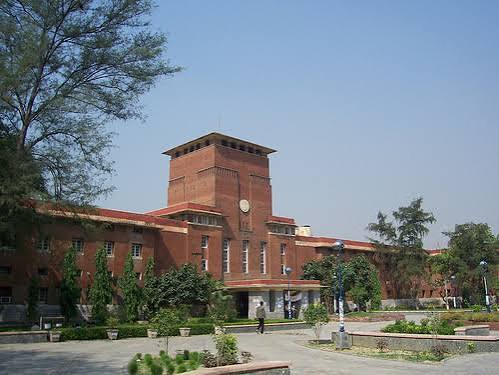
 The English department of DU has recently been ranked among the top 100 places to study english, by the QS World University Rankings. Ranked in the 51-100 group in QS’s annual survey, DU happens to be in the same league as Durham University, Dartmouth University, Pennsylvania State University, University of Sussex and the like, having beaten the likes of Nottingham and Purdue.