Tag

Awards

Browsing

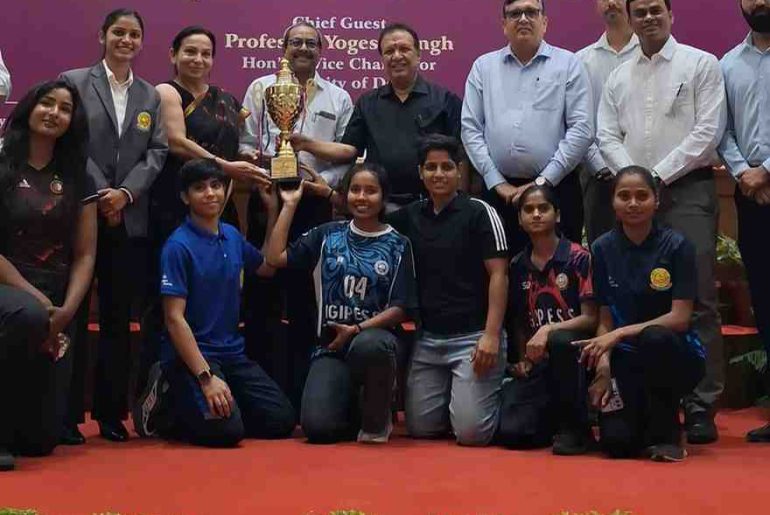
On 8th May, the Annual Sports Awards Function was organised, where several student athletes were honoured by the Vice Chancellor of Delhi University and Director of the Delhi University Sports Council for their remarkable athleticism and dedication.

The Annual Sports Awards Function 2026, conducted by the Delhi University Sports Council (DUSC), was held on 8th May 2026, from 11:30 am onwards at the Convention Hall, Vice Regal Lodge, University of Delhi. Prof. Yogesh Singh, the Vice Chancellor of the University of Delhi, was honoured as the Chief Guest. The event was organised to recognise the achievements of students across various colleges of the University of Delhi in the realm of sports and bestow upon them accolades for their remarkable contributions in the arena. 

The event saw the presence of several dignitaries who graced the dais alongside Prof. Yogesh Singh, including Dr Anil Kumar Kalkal, Director DUSC, who facilitated the Vice Chancellor; Dr Vikas Gupta, Joint Registrar; Prof. Rajni Abbi, Director South Campus, and Prof. Payal Mago, Director, Campus of Open Learning.

The Delhi School of Journalism (DSJ) was designated as the media partner for the event, with the Officer on Special Duty (OSD) of DSJ being assigned the role of convener of the Media and Website alongside a role in the Central Coordination Committee. “We have put together a team of students for the task, and will be performing our duty as intended,” they said.

The event began with the presentation of the DUSC’s Annual Report, followed by a welcome address from the Director of the Delhi University Sports Council, after which the Vice Chancellor addressed the audience. In his speech, the VC urged that sports be seen as “core curricular” rather than “co-curricular,” citing the importance of movement and physical activity in people’s lives. He also asked the principals of various colleges present at the event to not only encourage students to partake in physical activities but also to make use of the sports infrastructure provided, citing the Rugby ground, gymnasium, and indoor sports facilities at the Multipurpose Hall of the University Sports Complex. Additionally, he also commemorated the students who had shown talent, determination, and dedication in their respective fields, in his speech.

Following the Vice Chancellor’s Address, the award distribution ceremony commenced. Notably, a large portion of the students honoured were women. Individual students as well as college teams were honoured, with Deshbandhu College’s Women’s Archery team and Kirori Mal College’s Women’s Basketball team, amongst others, winning the Intercollege Tournament. For the second year in a row, the Indira Gandhi Institute of Physical Education & Sports Sciences was awarded the Champions’ Trophy.

After the conclusion of the event, students were seen celebrating, trophies in hand and coaches by their side, clicking pictures in the afternoon sunshine.


Image Credits: Souparnika.S.R

Read Also: Delhi University student petitions High Court for separate vegetarian mess facilities


Souparnika.S.R
[email protected]

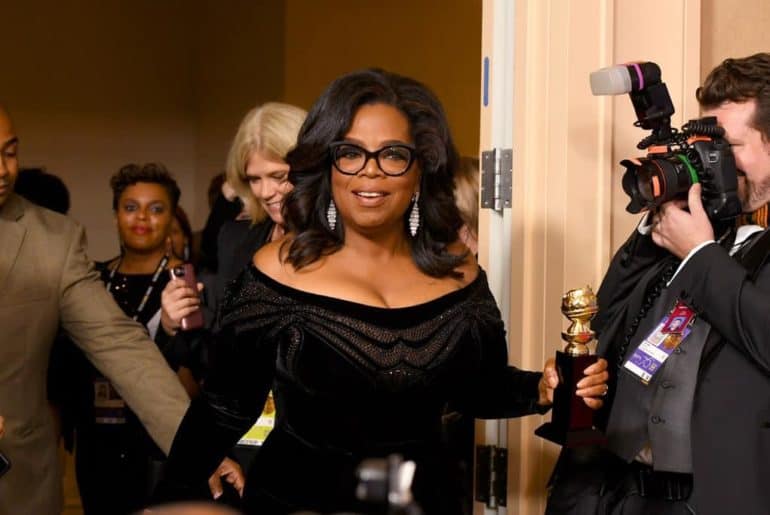
A speech “to express gratitude to all the women who have endured years of abuse and assault, because they — like my mother — had children to feed and bills to pay and dreams to pursue”; and to much more. In the times of #MeToo movement and the big and powerful of the Hollywood opening up with sexual harassment allegations against Harvey Weinstein, Oprah’s Winfrey’s address made an emphatic statement for a global audience, raising and answering questions on the same. The 75th Golden Globe Awards at The Beverly Hilton in Beverly Hills, California would be remembered for many things. As the biggest names of the Hollywood turned up draped in black in solidarity with the victims of the sexual harassment, a winners list drawn from a global cultural and geographical background also stood remarkable. But, save for the statement made by the award reception of Oprah Winfrey, the gala would have been miles short of greatness. After being introduced to the stage by Reese Witherspoon for the Cecil B. DeMille Award for lifetime achievement, Oprah Winfrey knew exactly what needed to be said. She knew the perfect address the crowd sitting in the Grand Hall needed and the follow-up the applauds sought. She delivered a speech which was to be the preamble to the event curated to the MeToo and Time’s Up campaign, intertwining the political, social, and gender nuances but not exceeding the decorum and scope of an award show stage. She made a political commentary which was derived from her personal life and her acting career, and with the ring of “dreams”, “incredible men and women” and “new dawn”, she made it know to “all the girls watching” among others that hope has a new day. It began with her story, “a little girl sitting on the linoleum floor of my mother’s house in Milwaukee, watching Anne Bancroft present the Oscar for best actor at the 36th Academy Awards”, as she went on to tell the story of the stories, the struggle of dreams being the daughter of a lady, “bone-tired from cleaning other people’s houses”. Her energy gradually culminated like a soprano, cinematically developing from Sidney Poitier to Dennis Swanson, and from the soul wrenching effect of Recy Taylor to the hope in Rosa Parks. Her address was a story of hope that could not have come from any other place in the universe. Here was a tale which would have been too dramatic for a presidential speech and far too powerless without the jingle of the applauds by the most distinguished professionals in the global cinema. Stories had magic, she knew, and she used stories to create a narrative no number of articles in newspapers and tweets could have ever created. “So I want all the girls watching here and now to know that a new day is on the horizon! And when that new day finally dawns, it will be because of a lot of magnificent women, many of whom are right here in this room tonight, and some pretty phenomenal men, fighting hard to make sure that they become the leaders who take us to the time when nobody ever has to say, ‘Me too’ again. Thank you.”, thus concluded the most beautiful speech, in all the beauty’s sense, and Oprah Winfrey descended to the thunder of applauds, smiles, and tears. New York Times, the very next day, came up with an article about her presidential potential and NBC in a since deleted tweet referred to her as “OUR future president”. But all said and done, we could all leave the White House speculations for some time and just bask in the glory of a wonderful speech made with a wonderful motive.   Feature Image Credits: Getty images Nikhil Kumar [email protected]]]>

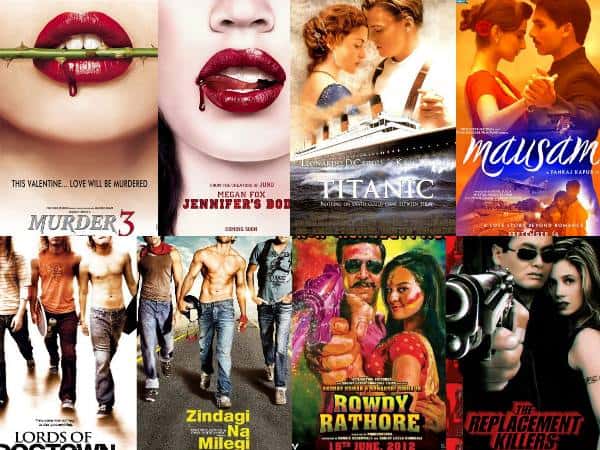
It’s commonly said that Bollywood makes movie stars and Hollywood makes star movies.

Bollywood and Hollywood rule hearts of billions of movie-buffs worldwide. Despite various similarities, both the movie industries draw their inspiration from varied sources, which provide basic ideas for commencing with a celluloid venture. Indians are always shy when it comes to comparison between Hollywood and Bollywood. Now, it’s fair to say that Bollywood is behind Hollywood when it comes to experimenting with a variety of genres. India has been making films for a hundred years; getting started just ten years later than America. Storytelling is a craft as much as anything else.  So is screenwriting.

As the film industry grows, so does the list of film festivals and awards ceremonies across the globe. What better way to spend two to three hours of your day than to watch a masterfully-written movie? From the good old movies to today’s featured flicks, film industry has something for everyone. From the Academy Awards in Los Angeles, Cannes Film Festival in France to International Indian Film Academy Awards, there is an awards ceremony for various types of films. There are awards distributed by critics, the festival and industry professionals as well as the general public. But here comes another comparison between the Hollywood award shows and the Indian award shows. First, Hollywood is inclusive of films and artists from all around the world which tends to be encouraging for the artists for being recognized in a global platform. But, as the trend goes with awards of Indian Cinema, most of them include Bollywood actors only.

Of lately, Indian viewers have turned to appreciating Hollywood and to tuning to International Award shows to keep track of the best films released globally. Hollywood studios put out between 200-250 movies a year and own 85% of the world market share, while Indian movie industry puts out about 1000 movies and has 4% market share. This is not to say Hollywood always makes better movies than Indian industries.  It just means Hollywood is able to tell more universal stories. Not one Indian movie has been a mainstream movie that audiences all over the world have flocked to see.  Every year, Hollywood puts out a handful that the whole world, basically, pays to watch.  If a comparison is to be made standing on neutral ground, Indian film makers rarely venture out to tell universal stories that everybody in the world can understand. Thus, Indian viewers in the present time have turned to Hollywood as a large part of Indian Cinema is about conventional song and dance sequences whereas Hollywood rarely follows the trend of relying on music heavily, except for a few movies and it drives its motivation from a diverse set of emotional, fictional and non-fictional subjects with a universal appeal. Bollywood in general is a genre as recognised by the world but, Hollywood is a style. Also, B-Town actors like Priyanka Chopra and Deepika Padukone are creating news because they got into Hollywood. It is an achievement to enter Hollywood. Is it true vice-versa? Not really.

Image credits: india.com

Radhika Boruah

[email protected]

On 14th March 2014, University of Delhi conducted its 91st Annual Convocation for Conferment of Degrees. Candidates who emerged successful in examinations of 2013 were awarded in the Convention Hall of the Viceregal Lodge, University of Delhi. Among these degrees there were 499 doctoral degrees, 35 DM/MCh degrees and 162 medals to be conferred upon the successful students.

Lt. Governer of Delhi and Rector of Delhi University, Najeeb Jung was the Chief Guest at the event who also happens to be an alumnus of Delhi University. The Vice Chancellor of Delhi University, Dinesh Singh welcomed the Chief Guest to be a part of ceremonial procession along with the Pro Vice Chancellors, Director of South Campus, Dean of Colleges, Treasurer, Registrar, Deans of all Faculties, Principals, Executive Council and Head of Departments of Delhi University.

“I do not know if these prizes mean what they should really mean to the young minds, therefore I am largely speaking to them. You must think how this recognition can be put to good use and what the real duty that descends upon you is. These medals are conferred upon you to encourage and keep working for a bright future of India”, said Vice Chancellor Dinesh Singh to the 700 people who were present at the gathering.

The Lt. Governer Najeeb Jung said,” There is no greater pleasure than having the opportunity to speak to these young minds who have this enormous quantum of energy seemingly waiting to burst forth and contribute to various facets of life. This is the time for you to understand the value of internal and external peace, forthrightness and openness to accept viewpoint of others and an intrinsic belief in having an inclusive society which will only lead to peace in our country” at the annual convocation.

He quoted the verse from Rubayyat of Omar Khayyam translated into English in 1859 by Edward FitzGerald,

“Dreaming when Dawn’s Left Hand was in the Sky
I heard a voice within the Tavern cry,
“Awake, my Little ones, and fill the Cup
Before Life’s Liquor in its Cup be dry.”

He emphasised on the need to remain empowered and proud, to say, “I am the master of my fate and captain of my ship” while choosing from the unlimited number of choices that life offers to the young souls at present.

“I am happy to receive the award and all my family and friends are very happy at the award conferred upon me by the University”, said Neha Lal, a BA(Honours) Journalism student from Lady Shri Ram College (LSR) who won the University Medal for securing the highest marks in her course at Delhi University.